Sustainable Packaging Materials Certification in 2026
In 2026, sustainable packaging materials certification is no longer a compliance checkbox—it is a procurement safeguard against plastic taxes, failed tenders, greenwashing claims, and supply chain disruption.
For buyers sourcing films, labels, cushioning, ribbons, or decorative foils, verified certifications help distinguish truly recyclable, biodegradable, or low-impact materials from marketing language.
This guide outlines what procurement teams should watch as global regulations tighten, brand owners demand traceable proof, and packaging suppliers compete on environmental credibility and performance reliability.
What Buyers Are Really Searching For
Procurement teams searching this topic usually want a practical answer: which certifications reduce sourcing risk, and which claims still need deeper verification?
The core intent is not academic sustainability theory. Buyers need defensible evidence before approving suppliers, negotiating contracts, or switching materials across regulated markets.
The biggest concerns are compliance acceptance, material performance, audit readiness, cost impact, and whether the certification matches the packaging application.
A compostable mailer certificate does not prove a barrier film is recyclable. A recycled-content claim does not confirm food-contact suitability or traceable chain of custody.
Therefore, the best procurement approach is certification mapping: link each material, market, claim, and end-of-life route to specific evidence requirements.
Why Certification Matters More in 2026
Packaging regulation is becoming more specific, especially in Europe, North America, and major export-driven Asian supply chains serving global brand owners.
The EU Packaging and Packaging Waste Regulation is pushing packaging toward recyclability, recycled content, minimization, and stronger documentation across the value chain.
Extended producer responsibility schemes are also becoming more data-driven. Poorly documented packaging can increase fees, delay listings, or trigger customer disputes.
For procurement, certification turns sustainability from a supplier promise into an auditable procurement asset, especially during tenders and retailer compliance reviews.
It also protects buyers from greenwashing exposure, where vague phrases like eco-friendly, biodegradable, or recyclable may not survive regulatory scrutiny.
The Procurement Rule: Certify the Claim, Not the Material Name
A common mistake is assuming a material automatically qualifies as sustainable because it is paper-based, bio-based, mono-material, or lightweight.
In reality, certification should support the exact claim being made, whether recyclability, compostability, recycled content, forest sourcing, or carbon footprint.
For example, kraft honeycomb cushioning may need forest-chain certification, while PLA cushioning may require industrial compostability evidence and clear disposal labeling.
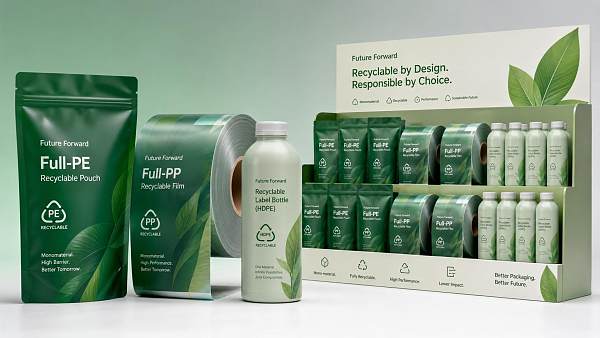
A mono-PE pouch may need recyclability testing, but printed inks, adhesives, coatings, and barrier layers can still disrupt recycling streams.
Procurement should request product-specific certificates, not only factory-level certificates, because one certified facility may produce both compliant and non-compliant structures.
Key Certification Categories Buyers Should Know
The most useful certifications in packaging procurement fall into several groups, each answering a different commercial and compliance question.
Forest-based packaging often depends on FSC, PEFC, or equivalent chain-of-custody systems to verify responsible sourcing for paper, board, and molded fiber.
Recycled-content claims may use certifications such as GRS, RCS, ISCC PLUS, or other chain-of-custody systems, depending on polymer and market expectations.
Recyclability claims may involve RecyClass, APR design guidance, cyclos-HTP, or local assessment schemes that evaluate compatibility with recycling infrastructure.
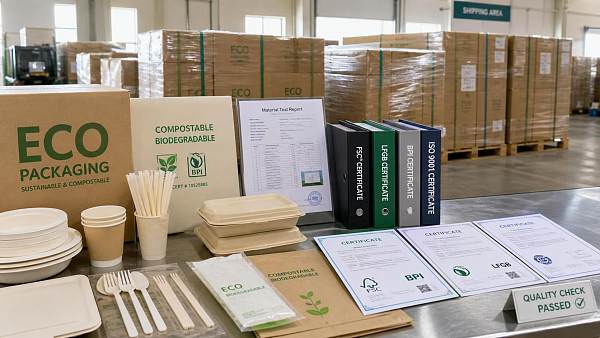
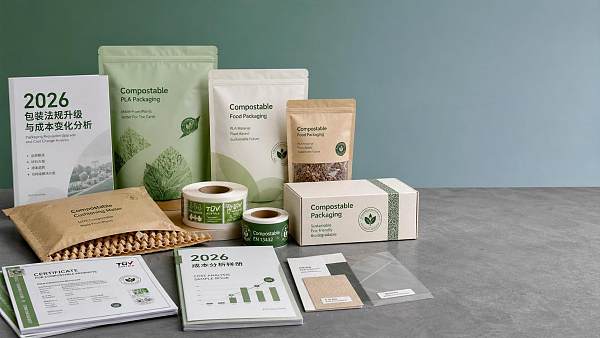
Compostability claims typically require standards-based certification through organizations such as TÜV Austria, BPI, or DIN CERTCO, depending on target region.
Carbon-related claims may use ISO 14067 product carbon footprint studies, verified life-cycle assessments, or environmental product declarations for larger procurement programs.
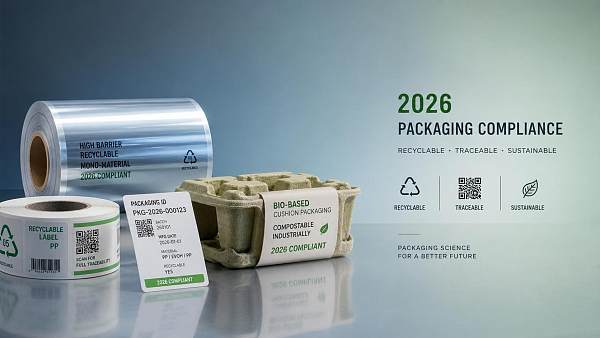
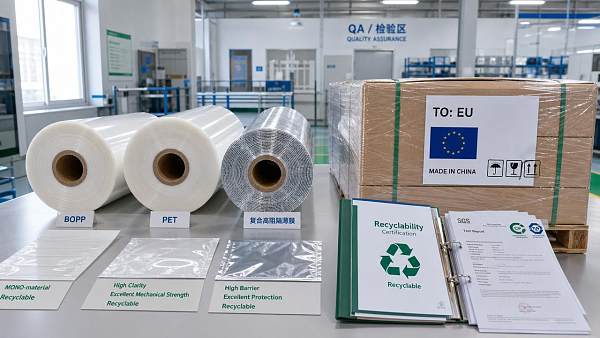
Films: BOPP, PET, PE, and High-Barrier Structures
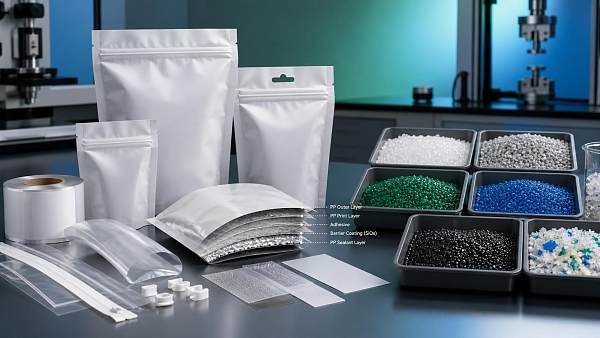
For flexible films, procurement should focus on recyclability design, recycled-content traceability, downgauging evidence, and whether barrier layers compromise recovery.
BOPP and PET films can deliver excellent strength, printability, and barrier performance, but sustainability acceptance depends on structure and local collection systems.
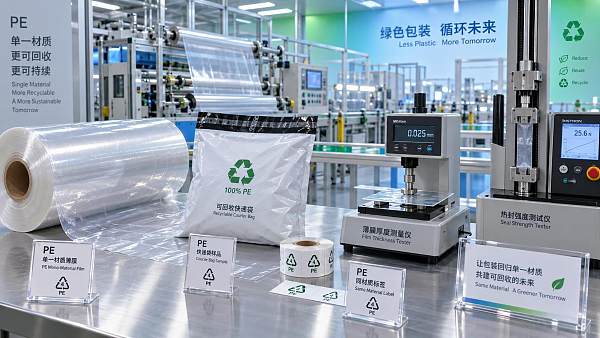
Mono-material flexible packaging is increasingly favored because it simplifies sorting and reprocessing, especially for PE or PP-based packaging families.
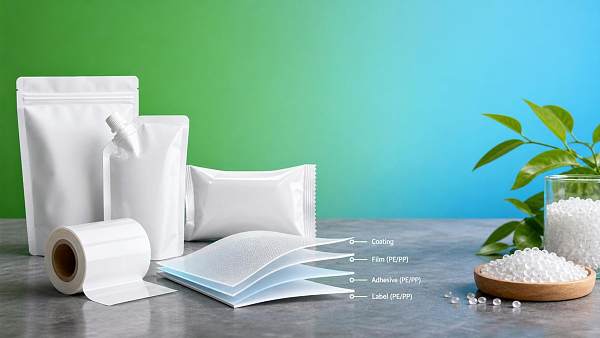
However, metallization, EVOH barriers, adhesives, inks, and coatings must be evaluated because small layers can affect recycling quality or detection.
Buyers should request film composition declarations, recyclability test reports, food-contact documentation where relevant, and evidence of claimed post-consumer recycled content.
Labels and Adhesives: The Hidden Risk in Recyclability
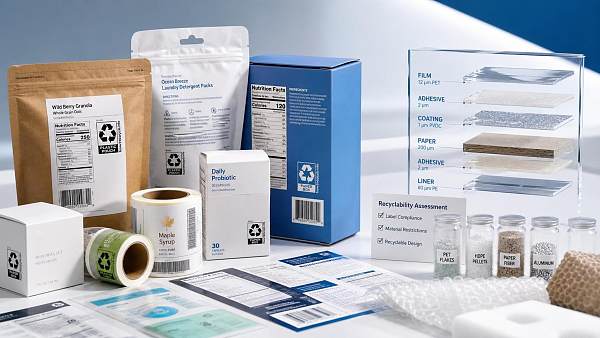
Labels can quietly make otherwise recyclable packaging harder to process, especially when adhesives contaminate wash water or labels fail to separate.
Procurement should assess facestock, adhesive chemistry, release liner, inks, and removability in the context of the container recycling stream.
For PET bottles, washable label adhesives and compatible facestocks are essential. For glass, metal, or reusable containers, different requirements may apply.
Anti-counterfeit labels add complexity because tamper-evident layers, holographic films, and security coatings may conflict with recyclability goals.
Buyers should ask suppliers to prove that security performance does not undermine the declared sustainability claim for the final package.
Cushioning: Compostable, Recyclable, or Reusable?
Eco-friendly cushioning is often marketed aggressively, but procurement should first define the intended end-of-life route before accepting any claim.
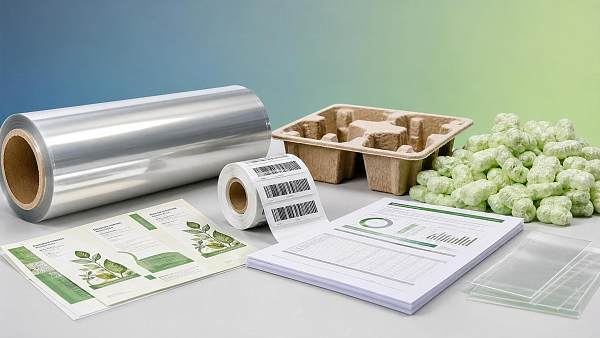
Paper honeycomb, molded pulp, biodegradable air columns, and reusable protective systems each solve different logistics, branding, and disposal problems.
Compostable packaging is valuable only where proper composting infrastructure exists and labels prevent consumers from placing it in recycling bins.
Recyclable paper cushioning may be simpler for many markets, but coatings, wet-strength additives, and laminated surfaces can reduce acceptance.
For high-value electronics or precision instruments, drop protection still matters. Sustainability certification must be paired with shock, vibration, and compression testing.
Thermal Transfer Ribbons, Inks, and Coatings
Thermal transfer ribbons rarely receive the same sustainability attention as films or boxes, yet they influence traceability, waste, and compliance.
Procurement teams should review ribbon formulations, solvent usage, hazardous substance declarations, durability performance, and compatibility with recyclable label systems.
A barcode that fails during cold-chain transport can create more waste than a slightly higher-impact ribbon that preserves identification.
For inks and coatings, buyers should request migration data, restricted-substance compliance, low-VOC evidence, and compatibility with recycling or composting claims.
The most sustainable marking system is one that maintains readability while avoiding unnecessary material layers, excessive reprints, and label rejection.
Decorative Foils and Shelf Impact Claims
Hot and cold stamping foils can create premium visual impact, but buyers should evaluate whether they affect recyclability or sorting behavior.
Thin metallized decoration may be acceptable in some paperboard systems, yet heavy coverage or plastic laminates can create different outcomes.
Procurement should ask whether the decorative effect has been tested on the final substrate, not only approved as a standalone material.
Luxury packaging teams often balance shelf impact with sustainability scorecards. Certification helps avoid subjective debates between brand, compliance, and sourcing teams.
The practical goal is not eliminating decoration, but choosing structures that preserve visual differentiation without creating avoidable recovery problems.
How to Verify a Certificate Before Approving a Supplier
Buyers should never accept a certificate screenshot without checking scope, product coverage, validity date, certifying body, and chain-of-custody connection.
The certificate should name the relevant company, site, process, material type, and standard, with clear linkage to the purchased item.
Ask for the certificate number and verify it through the certifier database when possible, especially for recycled content or compostability claims.
Review whether the certificate covers mass balance, segregated material, or physical recycled content, because these models carry different procurement implications.
Also confirm regional relevance. A certification accepted in one market may not satisfy labeling rules or tender requirements elsewhere.
Questions Procurement Should Ask in RFQs
RFQs should request sustainability documents with the same discipline used for technical data sheets, safety data sheets, and quality certifications.
Ask suppliers which sustainability claim they are supporting, which standard applies, and whether the certificate covers the exact SKU offered.
Request material composition ranges, recycled-content percentage, testing laboratory details, and any limitations related to printing, coating, lamination, or adhesives.
For biodegradable or compostable packaging, ask whether certification is industrial, home, soil, or marine, since these are not interchangeable.
For recyclable packaging, ask which recycling stream was assessed, which design guideline was used, and what design changes could improve acceptance.
Cost, ROI, and Total Procurement Value
Sustainable packaging materials certification can raise unit prices, but procurement should evaluate total cost rather than purchase price alone.
Certified materials can reduce tender failure, customer rejection, plastic tax exposure, and emergency redesign costs when regulations change suddenly.
Lightweight certified films may lower freight emissions and pallet costs, while stronger materials can reduce damage rates and reverse logistics.
For global buyers, standardized certification requirements also reduce supplier comparison friction and make multi-region sourcing decisions easier to defend.
The best ROI often appears when certification, material reduction, performance reliability, and regulatory readiness are evaluated as one procurement package.
Common Red Flags in Supplier Sustainability Claims
Be cautious when suppliers use broad language without naming standards, certification bodies, testing methods, or applicable end-of-life conditions.
Claims such as 100% eco, degradable, recyclable everywhere, or plastic-free should trigger documentation requests before commercial approval.
Another red flag is a factory certificate presented as proof for every product, especially when products use different coatings, resins, or laminates.
Buyers should also question expired certificates, altered PDFs, unclear scope pages, or documents issued by bodies lacking recognized accreditation.
If a supplier cannot explain disposal instructions clearly, the claim may be too weak for consumer-facing packaging or retailer programs.
Building a 2026 Certification Checklist
A practical checklist should begin with material category, market destination, customer requirement, legal requirement, and the sustainability claim being made.
Next, buyers should identify required certificates, supporting test reports, chain-of-custody documents, technical specifications, and labeling approval evidence.
The checklist should also capture operational factors, including minimum order quantities, lead times, formulation change controls, and alternative certified sources.
For strategic materials, require suppliers to notify buyers before changing resin, adhesive, coating, ink, liner, or recycled-content sourcing.
This prevents a certified packaging design from becoming non-compliant through an unnoticed substitution during cost reduction or supply shortage.
What Certification Cannot Replace
Certification is powerful, but it does not replace performance testing, supplier audits, regulatory review, or packaging line validation.
A certified recyclable film can still fail on a high-speed machine if coefficient of friction, sealing window, or stiffness is unsuitable.
A certified compostable mailer can still create customer complaints if it tears during fulfillment or lacks clear disposal instructions.
Procurement should integrate certification into broader qualification, including trials, aging tests, transport validation, print durability, and complaint data review.
The goal is not buying the greenest claim, but buying a verified material that performs reliably in the real supply chain.
Conclusion: Make Certification a Procurement Control Point
In 2026, sustainable packaging materials certification is best understood as a procurement control point, not a marketing decoration.
For films, labels, cushioning, ribbons, and foils, buyers should match each sustainability claim with the right certificate and supporting evidence.
The strongest sourcing decisions combine regulatory readiness, material performance, supplier transparency, and credible end-of-life documentation.
Procurement teams that build this discipline will avoid weak claims, protect tenders, reduce redesign risk, and strengthen supplier accountability.
Ultimately, certified sustainable packaging should help commodities remain protected, traceable, visually competitive, and genuinely aligned with environmental expectations.