Search News
Industry Portal
Hot Articles
- How destructible tamper evident tags prevent label removal and reuseDestructible tamper evident tags prevent label removal and reuse with visible evidence. Explore materials, adhesives, surface testing, and installation tips.
- Where to find packaging specification resources for compliance checksPackaging specification resources: discover trusted regulations, test standards, and supplier documents to streamline compliance checks, reduce risk, and approve packaging confidently.
- How adhesive labels hold up in cold chain shipping conditionsAdhesive Labels cold chain performance depends on more than freezer rating. Learn how adhesion, print durability, condensation, and substrate choice affect reliable shipping.
Popular Tags
FDA Draft Tightens UV Flexo Ink Migration Limit
Time
Click Count
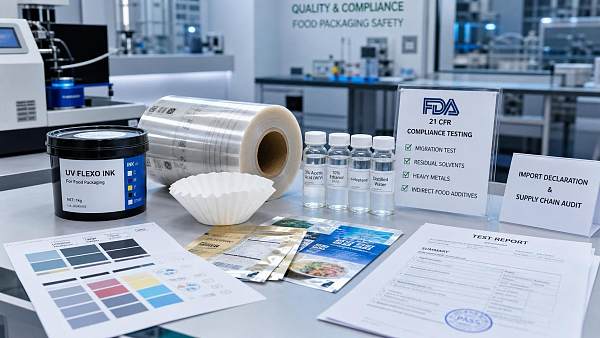
On July 12, 2026, the U.S. FDA released a draft amendment to Food Contact Substance Notification (FCN) No. 1927 that would tighten the migration limit for the photoinitiator TPO-L in UV flexo inks and add a specific verification method for new filings from January 2027. This development is particularly relevant to companies involved in cosmetic and health supplement flexible packaging for the North American market, because it directly affects market access conditions for UV inks used in those packaging applications.
What the draft amendment says
According to the information provided, the FDA draft would reduce the migration limit for TPO-L in UV flexo inks from 0.05 mg/kg to 0.01 mg/kg.
The same draft also states that, starting in January 2027, all newly filed products must be validated using the LC-MS/MS method.
The public comment period for the draft runs until September 11, 2026.
The stated direct impact is on North American market access for UV inks used in flexible packaging for cosmetics and health supplements.
Where the immediate pressure may appear
Packaging ink suppliers may face a narrower compliance window
From an industry perspective, ink suppliers are likely to be the first group to feel the impact because the draft speaks directly to a tighter migration threshold and a specified verification method. The business effect would most likely appear in formulation review, compliance documentation, and preparation for new product filings tied to North American customers.
What deserves closer attention is whether existing and pipeline products intended for cosmetic and health supplement flexible packaging can continue to align with the proposed threshold and the required LC-MS/MS-based validation path for new filings.
Flexible packaging converters may see added review at the customer interface
Analysis shows that converters using UV flexo inks in relevant packaging formats may face added scrutiny from brand owners and buyers. The pressure is less about a general packaging change and more about whether the selected ink system can still support customer access to the North American market under the proposed rules.
The operational impact may show up in supplier qualification, technical file collection, artwork-to-production approval timing, and customer communication around compliance status.
Brand owners in cosmetics and health supplements may need tighter upstream coordination
Observably, companies placing cosmetic and health supplement products into the North American market may need to pay closer attention to packaging specification control. Even though the draft focuses on the food contact substance notification framework and UV ink migration, the practical issue for these end users is whether packaging choices could delay or complicate market access.
The business focus is likely to fall on packaging approval cycles, vendor communication, and confirmation of what materials are being used in current and future flexible packaging programs.
Testing and compliance service providers may become more central to new filings
From an industry perspective, the explicit reference to LC-MS/MS for all new filings from January 2027 suggests a more formal role for analytical verification in the filing process. For service providers, this means the critical business link is not only testing capacity but also alignment between test output, filing requirements, and customer submission schedules.
Companies relying on outside compliance support should therefore pay attention to method readiness, documentation consistency, and turnaround planning for projects aimed at North America.
What companies should watch now
Track the draft through the end of the comment period
What deserves closer attention is that this is still a draft amendment, with a public comment period open until September 11, 2026. Companies should distinguish between the current proposal and a final rule outcome, especially when making decisions on reformulation, requalification, or customer commitments.
Separate current shipments from new filing requirements
Analysis shows that the most practical reading of the information provided is to distinguish immediate commercial exposure from the January 2027 requirement for newly filed products. This matters because the draft specifically mentions new filings and a required LC-MS/MS validation method, which may affect project timing, submission planning, and product launch sequencing.
Review which product lines are tied to North American entry
For businesses serving cosmetics and health supplement packaging, the priority is to identify which UV flexo ink applications are linked to North American access. This is where procurement teams, compliance staff, and sales teams may need a common view of which customer programs could be sensitive to the proposed threshold change.
Prepare supplier and customer documentation paths early
Observably, even before any final outcome is known, companies may benefit from clarifying what supporting documents, validation records, and supplier confirmations would be needed if the draft proceeds in its current direction. The practical issue is less about broad policy interpretation and more about whether documentation and testing can keep pace with customer deadlines and filing calendars.
Why this reads as a regulatory signal, not a finished outcome
Analysis shows that this development should not yet be treated as a completed regulatory result, because the amendment is still in draft form and remains within its public comment window. At the same time, it is more appropriate to understand this as a concrete regulatory signal rather than a routine notice, because it combines a lower migration threshold with a specified analytical verification method and a clear future timing point.
From an industry perspective, that combination matters. A lower limit alone would already affect compliance planning, but the addition of LC-MS/MS verification for new filings suggests that businesses should watch both the substance standard and the evidentiary standard. That is why this item deserves continued attention from packaging, regulatory, and commercial teams rather than being treated as a short-lived headline.
How this news is best understood at this stage
At this stage, the FDA draft is best understood as a developing compliance issue with direct relevance to UV inks used in cosmetic and health supplement flexible packaging for North America. The confirmed facts are limited but clear: the proposed TPO-L migration limit would be tighter, the draft sets a January 2027 LC-MS/MS validation requirement for new filings, and the comment period remains open until September 11, 2026.
It is more appropriate to understand this as an active regulatory development that may affect formulation review, testing preparation, and customer communication, while still requiring continued observation before any final compliance conclusion is made.
Basis of this article and follow-up verification
This article is based on the user-provided news title, event date, and event summary. The confirmed factual basis used here is limited to the reported FDA draft amendment, the stated TPO-L migration limit change, the January 2027 LC-MS/MS validation requirement for new filings, the September 11, 2026 public comment deadline, and the stated relevance to North American access for cosmetic and health supplement flexible packaging UV inks.
For this type of regulatory development, relevant source categories would typically include official regulatory notices, company compliance disclosures, industry association updates, authoritative trade media reporting, and standard-setting or technical documentation. A specific official source link was not provided in the input, so the exact source document path still requires ongoing verification.
Further follow-up should focus on whether the draft language changes during the comment period, whether final implementation timing remains the same, and how the final text defines the practical expectations for new product filings and analytical validation.
Recommended News
 Jul 19, 2026How to Verify Food-Safe Packaging Inks for CompliancePackaging inks food safe compliance starts with real-world verification. Learn how to assess migration, documents, barriers, and production controls to reduce risk.
 Jul 14, 2026FDA Tightens Migration Limit for UV Flexo InksFDA Tightens Migration Limit for UV Flexo Inks: learn how the new FDA rule cuts photoinitiator migration limits, requires toxicological dossiers, and impacts U.S. food packaging compliance after Dec 2026.
 Jul 13, 2026FDA Draft Tightens UV Flexo Ink Migration LimitFDA draft tightens UV flexo ink migration limits for TPO-L, signaling new LC-MS/MS validation rules in 2027. See how packaging, compliance, and North American market access may be affected.
 Jul 13, 2026Packaging Inks Guide: Choosing the Right Ink for Adhesion, Speed, and CompliancePackaging inks guide for choosing the right solution for adhesion, press speed, and compliance. Learn how to reduce risk, improve print performance, and make smarter packaging decisions.
 Jul 12, 2026FDA Requires Migration Filing for Food-Contact UV Flexo InksFDA requires migration filing for food-contact UV Flexo Inks before first U.S. import. Learn the compliance risks, CBP review impact, and what exporters must prepare now.
 Jun 30, 2026Packaging Inks Lamination: Common Adhesion Problems and FixesPackaging inks lamination issues can weaken bond strength and product safety. Discover common adhesion failures, root causes, and practical fixes to improve lamination reliability.
 Jun 29, 2026Vietnam Sets PFAS Testing Cost Rule for UV Flexo Ink ImportsVietnam Sets PFAS Testing Cost Rule for UV Flexo Ink Imports: learn how Vietnam’s new PFAS testing mandate affects costs, compliance, shipments, and supplier risk from July 2026.
 Jun 28, 2026Vietnam to Add 3% Green Surcharge on Imported UV Flexo InksVietnam to Add 3% Green Surcharge on Imported UV Flexo Inks from June 26, 2026. See how the new non-creditable cost affects pricing, sourcing, contracts, and Vietnam market strategy.
 Jun 27, 2026Vietnam Adds 3% Green Surcharge on Imported UV Flexo InksVietnam adds a 3% green surcharge on imported UV Flexo Inks from June 26, 2026. Learn who is affected, how VOC rules and certifications impact customs clearance, costs, and compliance.
 Jun 13, 2026AsiaFlexo 2026 Highlights Compliance-Driven Printing MaterialsAsiaFlexo 2026 spotlights compliance-driven printing materials, from low-migration UV Flexo Inks to Holographic Hot Foils, revealing how faster proofing and supplier validation can reshape packaging sourcing.
 Jun 12, 2026Qingdao Gravure Expo Puts Compliance Inks in FocusQingdao Gravure Expo puts compliance inks in focus, highlighting low-VOCs UV flexo inks and holographic foils aligned with EU REACH, US FDA, and GB 3095—2026. See what buyers now expect.
 Jun 10, 2026EU Tightens Phthalate Limit for UV Flexo InksEU Tightens Phthalate Limit for UV Flexo Inks: learn how the new 0.01% EU REACH rule impacts food-contact packaging, SGS testing, SDS updates, and export shipment compliance.
 May 24, 2026Vietnam Bans 12 Biocides, Tightens UV Flexo Ink ControlsVietnam bans 12 biocides & tightens UV flexo ink controls—urgent compliance guidance for exporters, formulators, and suppliers targeting ASEAN markets.
 May 24, 2026EN 1175:2025 Industrial Vehicle Electrical Safety Standard Enters ForceEN 1175:2025 industrial vehicle electrical safety standard takes effect May 2026—key for UV Flexo inks, AGV labels & functional printing compliance. Act now!
 May 23, 2026Saudi Arabia Updates Washer Energy/Water Efficiency StandardSaudi Arabia's new washer energy/water efficiency standard SASO 2663:2026 mandates 60°C steam-resistant labels—key for UV flexo ink makers, OEMs & GCC exporters. Act now to ensure compliance.
 May 23, 2026Vietnam Updates Pesticide Ban & Disclosure List, Affecting UV Flexo Ink SolventsVietnam bans TPO, HMPP & more UV flexo ink solvents—urgent compliance update for pesticide-adjacent printing chemistry exporters to food/pharma packaging markets.