Search News
Industry Portal
Hot Articles
- What drives micro coating materials price in industrial use?Micro coating materials price depends on chemistry, process control, substrate fit, and compliance. Learn what really drives cost in industrial use and how to choose smarter.
- EU PPWR enforcement: BOPP high barrier film exports need to pay attention to labeling complianceEU PPWR enforcement makes BOPP high barrier film exports to Europe focus on labeling compliance. Learn the key rules on recycling marks, recycled content, and recyclability claims before 2026.
- How to Evaluate Cold Chain Adhesive for Pharmaceuticals Under Freeze-Thaw ConditionsCold chain adhesive for pharmaceuticals: learn how to evaluate freeze-thaw performance, label durability, print readability, and real-world package compatibility before approval.
Popular Tags
Packaging Inks Lamination: Common Adhesion Problems and Fixes
Time
Click Count
Packaging Inks Lamination: Common Adhesion Problems and Fixes
In flexible packaging, packaging inks lamination failures can quietly undermine bond strength, appearance, and product safety long before defects become visible on the line.
That risk becomes more serious when structures run faster, gauges get thinner, and shelf-life expectations keep rising.
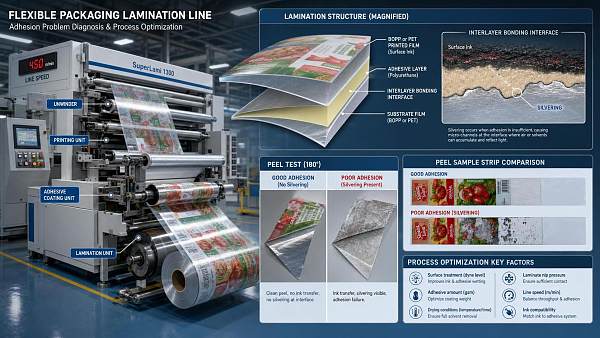
In practice, packaging inks lamination problems usually start at the interface, not at the adhesive drum.
An ink may look dry, glossy, and stable, yet still resist adhesive anchorage.
This guide explains the most common failure modes, what they look like, and the fixes that improve bond strength and process reliability.
Why packaging inks lamination fails
Most adhesion issues come from one simple fact.
The adhesive must wet, anchor, and cure across a printed layer that may contain waxes, resins, pigments, additives, and trapped solvent.
If one part of that chain fails, packaging inks lamination performance drops quickly.
The warning signs are often familiar:
- low initial bond after lamination
- peel failure on the ink layer
- silvering or hazy interface appearance
- bond loss after heat, retort, or pouch forming
- ink pick-off during peel testing
- curl, tunneling, or delamination at edges
The root cause is rarely random.
More often, it is a mismatch among ink chemistry, film treatment, adhesive selection, and process window.
Problem 1: Low surface energy on the printed side
This is one of the most common packaging inks lamination issues on BOPP and some coated PET structures.
If the printed surface energy is too low, the adhesive cannot wet the ink film evenly.
That leads to weak anchorage, poor spread, and spotty bond development.
Typical causes
- aged corona treatment on the film
- ink formulations with slip or wax additives
- over-varnished or over-smooth print surfaces
- migration of low-molecular components to the surface
Practical fixes
- Measure dyne level on the printed face, not only on the base film.
- Target a surface energy that supports reliable adhesive wetting under plant conditions.
- Review ink additive packages, especially wax, silicone, and slip promoters.
- Use lamination-grade inks designed for bond anchorage, not just print appearance.
- Shorten storage time between printing and lamination when treatment decay is suspected.
A quick dyne reading can be helpful, but peel data remains the better decision tool.
Problem 2: Solvent retention inside the ink layer
Many packaging inks lamination failures are actually drying failures that only appear later as bond loss.
Residual solvent can soften the ink, interfere with adhesive cure, and create gas at the interface.
The result may be odor, bubbles, weak peel, or delayed delamination.
Where it usually starts
- high press speed with limited oven dwell
- heavy ink laydown or dense reverse printing
- poor air balance in dryers
- solvents with slower evaporation profiles
How to fix it
Start by checking retained solvent on finished printed rolls.
Then adjust the variables that matter most:
- raise effective drying capacity, not just temperature
- improve air exchange and exhaust balance
- reduce wet film thickness where possible
- allow printed rolls to condition before lamination when needed
- confirm adhesive compatibility with residual solvent exposure
From a risk standpoint, trapped solvent is especially important for food packaging and high-barrier structures.
Problem 3: Poor ink cure or incomplete crosslinking
Packaging inks lamination can also fail when the ink film is chemically weak, even if it appears dry.
Two-component ink systems, radiation-cured systems, and specialty coatings need the right cure window.
If cure is incomplete, the adhesive may pull the ink apart during peel.
Common signs
- ink transfer during tape or rub testing
- soft or blocking printed rolls
- cohesive failure within the ink layer
- high variation between early and late peel values
Corrective actions
- Verify hardener ratio, pot life, and mix uniformity.
- Check UV dose or EB exposure where relevant.
- Respect the recommended maturation time before lamination.
- Review pigment loading that may shield cure energy.
- Run ink adhesion tests before releasing rolls to lamination.
This is where process discipline matters more than visual inspection.
Problem 4: Adhesive and ink incompatibility
Not every adhesive likes every ink system.
A structure may pass a short trial, then fail after curing, slitting, or heat exposure.
That delayed failure is a classic packaging inks lamination warning sign.
Typical incompatibility points
- PU adhesive chemistry not matched to the ink binder
- water-based systems facing moisture-sensitive layers
- high-slip inks reducing intercoat anchorage
- aggressive additives attacking the cured adhesive network
Best fix strategy
Treat the ink, adhesive, and film as one system.
That means supplier data alone is not enough.
Use structured qualification trials that include:
- initial and aged peel testing
- heat resistance and seal-area checks
- chemical resistance when product contact is possible
- appearance review after storage and transport simulation
For technical evaluation, system compatibility is often the deciding factor, not standalone material cost.
Problem 5: Weak process control during lamination
Sometimes packaging inks lamination defects are created on the laminator itself.
Even a well-matched structure can fail if coat weight, tension, temperature, or nip conditions drift.
High-impact process variables
- adhesive coat weight too low for rough or heavy-ink surfaces
- uneven mixing of two-component adhesives
- poor nip pressure or trapped air
- web tension causing distortion or micro-channeling
- insufficient cure time before slitting or pouch conversion
What works in production
- Control adhesive mix ratio with traceable checks.
- Confirm actual coat weight by method, not estimate.
- Set cure hold times by structure and end-use condition.
- Monitor peel trend by roll position and machine shift.
- Link every failure back to print batch and drying record.
That last step matters because many lamination defects are upstream issues wearing a downstream label.
A practical troubleshooting workflow
When packaging inks lamination starts failing, speed helps, but sequence matters more.
- Identify the failure plane with peel testing and microscopy if available.
- Check printed surface energy and ink adhesion first.
- Measure residual solvent and review dryer settings.
- Confirm adhesive ratio, coat weight, and cure history.
- Compare results across roll position, press batch, and aging time.
- Run a controlled remake using one variable change at a time.
This approach shortens diagnosis and prevents expensive overcorrection.
How to reduce future packaging inks lamination risk
The strongest prevention strategy is cross-stage control.
In other words, design the print surface for lamination from the start.
- specify lamination-grade inks during structure development
- align film treatment, ink system, and adhesive chemistry early
- set acceptance limits for surface energy, solvent retention, and peel
- validate aged performance under actual filling and storage conditions
- keep material change control strict across suppliers and plants
As packaging structures become lighter and more functional, packaging inks lamination tolerance usually gets narrower.
That also means small chemistry differences can create major converting risk.
Final takeaway
Most packaging inks lamination problems trace back to five controllable areas: surface energy, solvent retention, cure, compatibility, and process control.
Once the failure plane is identified, the right fix usually becomes clear.
The practical goal is not only stronger bond numbers.
It is stable packaging inks lamination that holds through converting, distribution, shelf display, and end use.
For better outcomes, evaluate the full print-adhesive-film system together, qualify changes with aged testing, and treat every weak bond as a measurable interface problem.
Recommended News
 Jul 19, 2026How to Verify Food-Safe Packaging Inks for CompliancePackaging inks food safe compliance starts with real-world verification. Learn how to assess migration, documents, barriers, and production controls to reduce risk.
 Jul 14, 2026FDA Tightens Migration Limit for UV Flexo InksFDA Tightens Migration Limit for UV Flexo Inks: learn how the new FDA rule cuts photoinitiator migration limits, requires toxicological dossiers, and impacts U.S. food packaging compliance after Dec 2026.
 Jul 13, 2026FDA Draft Tightens UV Flexo Ink Migration LimitFDA draft tightens UV flexo ink migration limits for TPO-L, signaling new LC-MS/MS validation rules in 2027. See how packaging, compliance, and North American market access may be affected.
 Jul 13, 2026Packaging Inks Guide: Choosing the Right Ink for Adhesion, Speed, and CompliancePackaging inks guide for choosing the right solution for adhesion, press speed, and compliance. Learn how to reduce risk, improve print performance, and make smarter packaging decisions.
 Jul 12, 2026FDA Requires Migration Filing for Food-Contact UV Flexo InksFDA requires migration filing for food-contact UV Flexo Inks before first U.S. import. Learn the compliance risks, CBP review impact, and what exporters must prepare now.
 Jun 30, 2026Packaging Inks Lamination: Common Adhesion Problems and FixesPackaging inks lamination issues can weaken bond strength and product safety. Discover common adhesion failures, root causes, and practical fixes to improve lamination reliability.
 Jun 29, 2026Vietnam Sets PFAS Testing Cost Rule for UV Flexo Ink ImportsVietnam Sets PFAS Testing Cost Rule for UV Flexo Ink Imports: learn how Vietnam’s new PFAS testing mandate affects costs, compliance, shipments, and supplier risk from July 2026.
 Jun 28, 2026Vietnam to Add 3% Green Surcharge on Imported UV Flexo InksVietnam to Add 3% Green Surcharge on Imported UV Flexo Inks from June 26, 2026. See how the new non-creditable cost affects pricing, sourcing, contracts, and Vietnam market strategy.
 Jun 27, 2026Vietnam Adds 3% Green Surcharge on Imported UV Flexo InksVietnam adds a 3% green surcharge on imported UV Flexo Inks from June 26, 2026. Learn who is affected, how VOC rules and certifications impact customs clearance, costs, and compliance.
 Jun 13, 2026AsiaFlexo 2026 Highlights Compliance-Driven Printing MaterialsAsiaFlexo 2026 spotlights compliance-driven printing materials, from low-migration UV Flexo Inks to Holographic Hot Foils, revealing how faster proofing and supplier validation can reshape packaging sourcing.
 Jun 12, 2026Qingdao Gravure Expo Puts Compliance Inks in FocusQingdao Gravure Expo puts compliance inks in focus, highlighting low-VOCs UV flexo inks and holographic foils aligned with EU REACH, US FDA, and GB 3095—2026. See what buyers now expect.
 Jun 10, 2026EU Tightens Phthalate Limit for UV Flexo InksEU Tightens Phthalate Limit for UV Flexo Inks: learn how the new 0.01% EU REACH rule impacts food-contact packaging, SGS testing, SDS updates, and export shipment compliance.
 May 24, 2026Vietnam Bans 12 Biocides, Tightens UV Flexo Ink ControlsVietnam bans 12 biocides & tightens UV flexo ink controls—urgent compliance guidance for exporters, formulators, and suppliers targeting ASEAN markets.
 May 24, 2026EN 1175:2025 Industrial Vehicle Electrical Safety Standard Enters ForceEN 1175:2025 industrial vehicle electrical safety standard takes effect May 2026—key for UV Flexo inks, AGV labels & functional printing compliance. Act now!
 May 23, 2026Saudi Arabia Updates Washer Energy/Water Efficiency StandardSaudi Arabia's new washer energy/water efficiency standard SASO 2663:2026 mandates 60°C steam-resistant labels—key for UV flexo ink makers, OEMs & GCC exporters. Act now to ensure compliance.
 May 23, 2026Vietnam Updates Pesticide Ban & Disclosure List, Affecting UV Flexo Ink SolventsVietnam bans TPO, HMPP & more UV flexo ink solvents—urgent compliance update for pesticide-adjacent printing chemistry exporters to food/pharma packaging markets.