Search News
Industry Portal
Hot Articles
- Maine DEP Updates Packaging EPR Timeline, Plans to Revise Stewardship RFPMaine packaging EPR timeline updates and a revised stewardship RFP could affect business planning. Discover what companies should watch next.
- How run size affects the cost of holographic packaging for spiritsSee how holographic packaging for spirits costs change with run size. Compare setup fees, volume savings and inventory risks to choose the right quantity for your brand.
- How to choose printable clear PET film for your inkjet printerNeed clear PET film printable on your inkjet printer? Compare coatings, ink compatibility, clarity, and feeding to avoid costly misprints and choose confidently.
Popular Tags
What Documents Verify Eco-Friendly Packaging Claims?
Time
Click Count
Evidence Matters More Than the Claim
Eco-friendly packaging claims are only as credible as the documents behind them. A statement such as “recyclable,” “compostable,” “made with recycled content,” or “plastic-free” may appear simple on a box or specification sheet, but each claim relies on a different set of evidence. For converters, packaging buyers, brand owners, and exporters, the practical question is not whether a supplier can provide a green-looking certificate. It is whether the document proves the precise claim for the exact packaging format, material structure, market, and end-of-life route involved.
A compostability certificate for an air cushion does not prove that a laminated pouch is recyclable. A recycled-content declaration for a PET bottle does not validate a pressure-sensitive label, adhesive, ink, or metallized decoration applied to it. Likewise, a general environmental management certificate may demonstrate how a factory operates, while saying little about the environmental performance of a specific film or finished pack.
The strongest documentation package connects four points: what the claim says, what material is being claimed, which recognized method supports it, and whether the claim remains valid after converting, printing, labeling, filling, and use.
Start by matching the document to the claim
Packaging teams often lose time because they ask for “sustainability certificates” without defining the claim that must be supported. That request can produce a stack of documents that looks impressive but does not answer a buyer’s compliance, procurement, or marketing question.
A useful first screen is simple: ask the supplier to identify the exact wording it supports. If it supports only “contains recycled resin,” it should not be used to substantiate “fully recyclable packaging.” If the certificate applies only to industrial composting, consumer-facing copy must not imply home compostability.
For compostable packaging, verify the finished article and its disposal route
Compostability is among the most misunderstood packaging claims because it combines material science, conversion chemistry, and local waste infrastructure. A PLA- or PBAT-based cushioning film may have a valid compostability basis, but final packaging can include inks, coatings, valves, adhesive strips, labels, barrier layers, and pigments. Those additions can alter the result or fall outside the certificate’s scope.
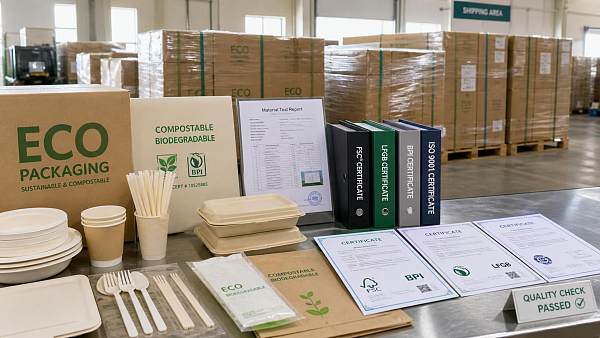
Request the certificate itself, not only a logo authorization or a marketing summary. Read its product description, material limits, thickness limits, intended composting environment, certificate holder, and validity period. The description should closely match the article being purchased. A certificate covering a clear film of a particular thickness does not automatically extend to a printed, laminated, or adhesive-backed version.
Supporting technical documentation should identify every relevant component: substrate, coating, adhesive, ink, release liner, valve, tie layer, and any functional barrier. This is particularly important for compostable mailers, air-column cushioning, coated paper, and multi-part label constructions. Where a package is assembled from separately supplied components, a buyer needs evidence that the complete article, not merely its principal material, supports the final claim.
Disposal language also needs discipline. “Compostable” is incomplete unless the claim indicates the conditions under which composting is expected. Industrial composting and home composting are distinct claims. Local collection programs may not accept compostable packaging even where the material has been independently certified. Certification validates performance under a defined standard and test environment; it does not create a collection route.
For recyclability, material structure is only the beginning
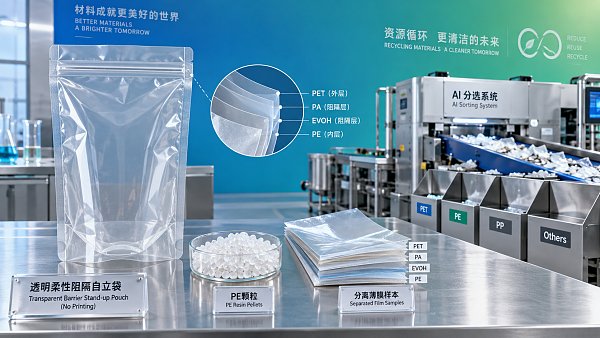
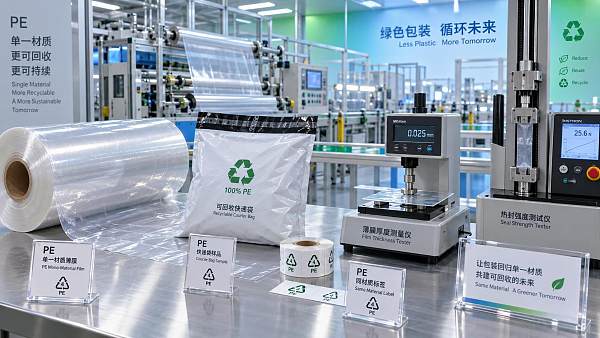
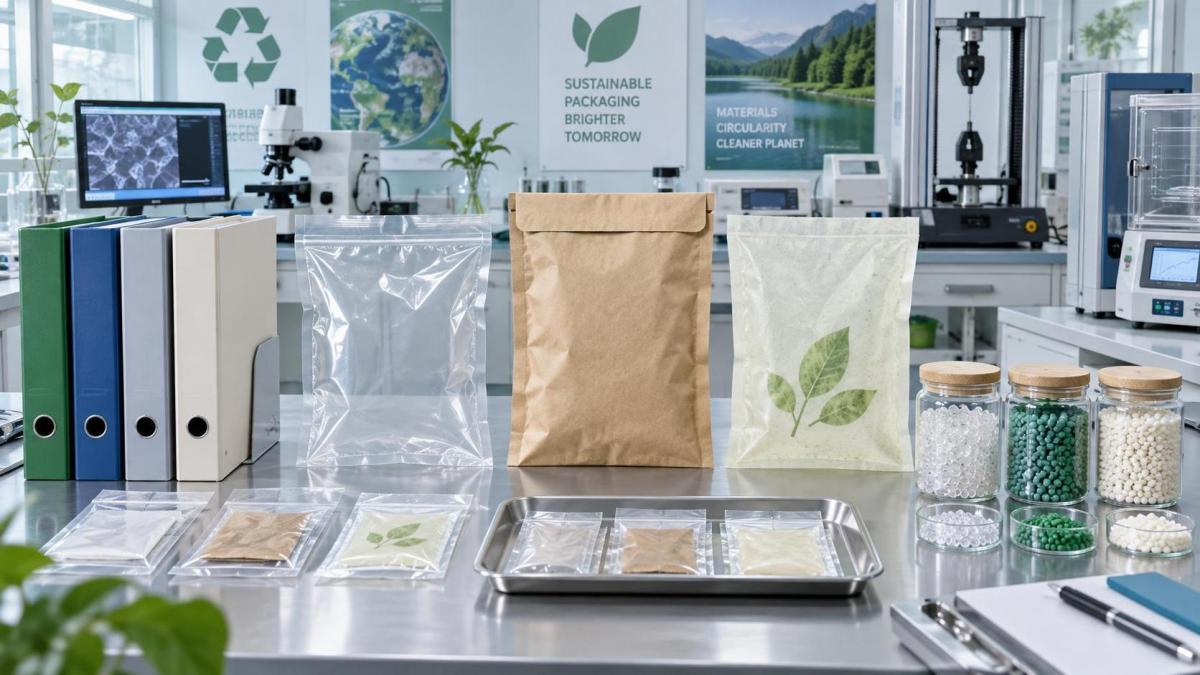
Recyclability documentation should show both what the package is made of and how its design affects sorting and recycling. Mono-material structures can simplify that assessment, but a package cannot be evaluated from the headline material alone. A polyethylene or polypropylene pack may still contain incompatible labels, metallized layers, heavy coatings, silicone release systems, dark colorants, barrier treatments, or adhesive residues that affect recycling performance.
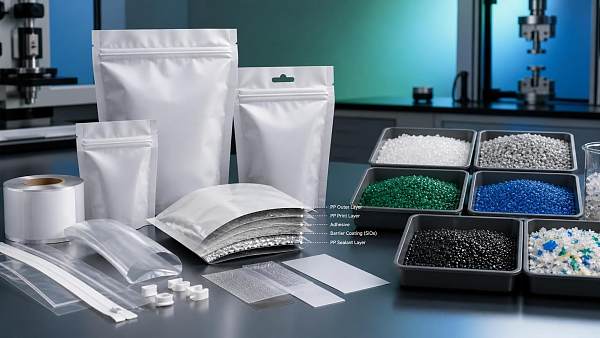
For flexible films, ask for a full construction specification. It should state resin families, layer sequence, thickness or basis weight, coatings, inks, adhesives, and any metallization or barrier treatment. For labels, include the facestock, adhesive, liner, ink system, and the intended container substrate. A wash-off or recycling-compatible label may work on one bottle and fail on another because the container, wash process, density separation, or adhesive behavior differs.
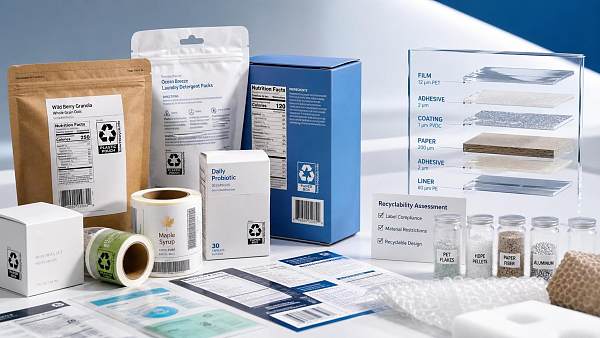
A design-for-recycling assessment is often more useful than a generic material declaration because it considers the complete pack. The assessment should be relevant to the market where the product will be sold. Collection, sorting, and reprocessing capabilities differ by region, so a claim suitable in one system may be poorly supported in another.
Buyers should also separate “designed for recycling” from “widely recycled.” The first describes compatibility with a recycling pathway under stated conditions. The second implies a higher bar involving actual access to collection and recycling systems. Treating those phrases as interchangeable creates avoidable legal and reputational exposure.
Recycled-content claims need traceability, not a one-time letter
For recycled-content packaging, the central evidence is traceability. A supplier declaration should identify whether the recycled content is post-consumer, post-industrial, or a combination; whether it is measured by weight; and whether the stated percentage applies to the complete article, a component, or a single layer.
That declaration should be supported by records that can follow material through the supply chain. Depending on the packaging type and sales channel, this may include purchase records, batch documentation, production records, material balance reports, and chain-of-custody certification. A single annual statement is weak evidence when resin sourcing changes by production run or when a converter uses multiple approved sources.
Food-contact and sensitive-product applications require an additional review. A packaging team may have evidence of recycled content while still needing separate documentation on regulatory suitability, contaminant control, migration, or performance. Recycled content does not remove the need to verify seal strength, barrier properties, print adhesion, abrasion resistance, or product protection.
For lightweight films and stretch materials, claims should be especially precise. Downgauging can reduce material use per wrapped load, but it is not proof that the film contains recycled content, is recyclable in a local system, or has a lower lifecycle impact in every application. Performance evidence remains necessary because a thinner film that causes load failure, product damage, or excessive rewrapping can undermine the intended environmental benefit.
Lifecycle assessments can support broad claims, but only when they are comparable
Lifecycle assessment documentation is appropriate when a business wants to claim a lower carbon footprint, reduced resource use, or a lower environmental burden than an alternative. It is also the document most likely to be overextended in sales materials.
A credible assessment identifies the functional unit being compared. For packaging, that may be protection and delivery of a defined quantity of product for a defined journey, rather than one kilogram of material. It should also state system boundaries, data sources, treatment of recycled content, transport assumptions, end-of-life scenarios, and the categories assessed. A comparison focused only on resin production may reach a different conclusion from one that includes conversion losses, product protection, transport efficiency, and disposal.
Use the study for the limited claim it actually supports. An assessment showing lower greenhouse-gas emissions does not prove compostability or recyclability. Nor does a favorable result for a shipping mailer automatically apply to a retail display pack made from a different structure.
Build a file that procurement, compliance, and marketing can all use
The most reliable approach is to create a claim file for each packaging format or family. This should be a controlled package of documents rather than a folder of disconnected certificates. The file can include:
- A signed claim declaration describing the exact wording approved for use.
- A complete bill of materials and technical specification for the finished package.
- Relevant third-party certificates and their scope documents.
- Test reports or design assessments tied to the material construction.
- Recycled-content and chain-of-custody records where applicable.
- Lifecycle assessment documentation for comparative environmental claims.
- Artwork approval showing that on-pack language matches the evidence.
- Version control, expiry dates, supplier names, and batch or product references.
This structure is particularly valuable for packaging that combines several consumables: a barrier film with a printed label, a thermal transfer ribbon, an adhesive, a tamper-evident feature, or decorative foil. Each component may have a separate technical and environmental profile. The finished pack should be evaluated as a system, especially when a small coating or label can change recycling behavior or when an added security feature affects material separation.
The document test before making a claim
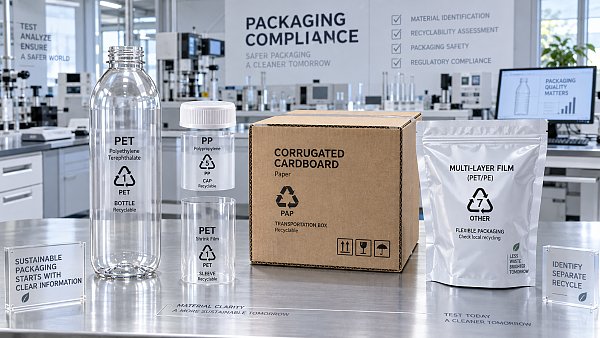
Before approving an eco-friendly packaging statement, ask four questions. Does the document cover the finished article? Does it support the exact language proposed? Does it apply in the market and disposal conditions where the package will be used? Can the evidence be traced to the supplied material and kept current?
If any answer is unclear, narrow the claim until it matches the proof. That may mean describing a package as containing a specified percentage of recycled content rather than calling it sustainable, stating that it is certified for industrial composting rather than simply compostable, or using a design-for-recycling statement rather than claiming universal recyclability. Precise claims are easier to defend, easier for B2B buyers to evaluate, and more useful than broad environmental language that collapses under scrutiny.
Recommended News
 Oct 29, 2026Maine DEP Updates Packaging EPR Timeline, Plans to Revise Stewardship RFPMaine packaging EPR timeline updates and a revised stewardship RFP could affect business planning. Discover what companies should watch next.
 Oct 27, 2026HERMA Gains Cold-Wash Certification for PP and PE Labels, Supporting PPWR AlignmentHERMA earns cold-wash certification for PP and PE labels, proving complete removal at 40°C. Discover how this supports cleaner recycling and PPWR alignment.
 Oct 26, 2026Plastic is Fantastic Association Plans Middle East Debut at GPCA ForumPlastic is Fantastic Association plans its Middle East debut at the GPCA Forum in Dubai in November 2026. Discover its goals for regional partnerships and evidence-based plastic packaging dialogue.
 Oct 25, 2026Freiburg to Limit Packaging Tax to Disposable Cups from 2027Freiburg’s packaging tax will target disposable drink and ice cream cups at €0.50 each from January 1, 2027. Explore what this means for purchasing costs and reusable alternatives.
 Oct 23, 2026UK Confirms Plastic Packaging Tax Rules Introducing Chemical Recycling Mass BalanceUK Plastic Packaging Tax changes introduce chemical recycling mass balance from 1 April 2027. Explore what packaging businesses should review to prepare for compliance.
 Oct 22, 2026Avery Dennison AD CleanFlake Earns First RecyClass Approval for PET Tray RecyclingAvery Dennison AD CleanFlake earns the first RecyClass approval for PET tray recycling. Discover how its label separation technology helps preserve recycled PET quality.
 Oct 12, 2026How to verify whether flexible barrier packaging is recyclableIs flexible barrier packaging recyclable? Learn how to verify materials, barriers, inks, collection routes, and evidence for credible recycling claims.
 Oct 11, 2026How PPWR rules may change customs checks for packaged goodsPPWR customs checks may reshape EU imports. Learn how to prepare packaging evidence, manage border risks, and keep packaged goods moving.
 Oct 10, 2026What a PPWR packaging label should show for compliant EU shipmentsPPWR packaging label guidance for compliant EU shipments: show accurate material details, sorting instructions, recyclability evidence, and component-level disposal information.
 Oct 01, 2026How to verify whether PLA PBAT compostable film meets compostability standardsPLA PBAT compostable film verification guide: check EN 13432, ASTM D6400, certificates, thickness, inks, layers, and industrial composting scope.
 Sep 18, 2026How to verify BPI certification for compostable packaging materialsCompostable packaging materials BPI verification made practical: learn how to confirm certified products, documentation, labels, coatings, and supplier traceability.
 Sep 16, 2026How to verify compostability claims for eco friendly packaging filmsEco friendly packaging films require more than a logo. Learn to verify compostability certificates, finished-film scope, components, and disposal claims.
 Sep 19, 2026What Documents Verify Eco-Friendly Packaging Claims?What documents prove eco-friendly packaging claims? Learn which certificates, traceability records, recyclability assessments, and LCAs support credible, compliant packaging claims.
 Sep 18, 2026EPR Labeling Requirements: What Packaging Teams Must Declare by MarketEPR labeling requirements by market: learn what packaging teams must declare, from sorting marks and material data to producer details, for confident global pack releases.
 Sep 15, 2026PPCS Compliance Explained: Packaging Data, Documentation, and Audit ControlsPPCS compliance explained: build traceable packaging data, controlled documentation, and audit-ready controls to reduce risk and strengthen market confidence.
 Sep 15, 2026PPWD Compliance: How Packaging Producers Can Prepare for EU Waste RulesPPWD compliance guide for packaging producers: prepare for EU waste rules with smarter materials, recyclability, EPR planning, and practical design steps.
 Sep 15, 2026How to verify a mono material recyclable packaging manufacturerVerify a mono material recyclable packaging manufacturer with practical checks on composition, recyclability evidence, certifications, performance, and factory controls.
 Aug 27, 2026Where to find packaging specification resources for compliance checksPackaging specification resources: discover trusted regulations, test standards, and supplier documents to streamline compliance checks, reduce risk, and approve packaging confidently.
 Aug 22, 2026How to verify whether recyclable flexible packaging in Europe meets PPWR expectationsRecyclable flexible packaging Europe: learn how to verify PPWR readiness, assess sorting and barrier performance, and avoid weak claims with a practical evaluation framework.
 Aug 16, 2026China Enforces Eco-Environment Code, Raising Export Packaging Compliance RequirementsChina enforces its Eco-Environment Code, tightening export packaging compliance for food, FMCG, e-commerce, and pharma. Learn the new risks, certification checks, and sourcing actions now.
 Aug 05, 2026Packaging Compliance in North America: Which Labels and Material Rules Matter Most?Packaging compliance North America explained: learn the label, bilingual, material, recyclability, and EPR rules that matter most to reduce risk and speed market access.
 Jul 14, 2026Packaging Compliance Materials Guide for Plastic Ban ReadinessPackaging compliance materials guide for plastic-ban readiness: compare films, labels, cushioning, and print systems to reduce risk, protect performance, and stay ahead of changing regulations.
 Jul 13, 2026Biodegradable Packaging Compostable: Key Claims, Standards, and Common MistakesBiodegradable Packaging compostable explained: learn the key differences, standards, compliance checks, and common claim mistakes before choosing or marketing sustainable packaging.
 Jul 10, 2026How Mono Material Packaging Affects Recyclability and Shelf AppealMono material packaging can improve recyclability without sacrificing shelf appeal. Discover key trade-offs, hidden risks, and practical evaluation tips for smarter packaging decisions.