Search News
Industry Portal
Hot Articles
- Maine DEP Updates Packaging EPR Timeline, Plans to Revise Stewardship RFPMaine packaging EPR timeline updates and a revised stewardship RFP could affect business planning. Discover what companies should watch next.
- How run size affects the cost of holographic packaging for spiritsSee how holographic packaging for spirits costs change with run size. Compare setup fees, volume savings and inventory risks to choose the right quantity for your brand.
- How to choose printable clear PET film for your inkjet printerNeed clear PET film printable on your inkjet printer? Compare coatings, ink compatibility, clarity, and feeding to avoid costly misprints and choose confidently.
Popular Tags
How to verify whether flexible barrier packaging is recyclable
Time
Click Count
A flexible barrier pack is not recyclable merely because it carries a recycling symbol, contains a “recyclable” claim, or is made mainly from plastic. The relevant question is more demanding: can the complete converted structure be collected, sorted, processed, and turned into a usable secondary material in the recycling system where it will enter the waste stream?
For quality and safety control, verification must therefore start with the finished packaging specification rather than the headline substrate. A PE-based pouch with an incompatible metallized layer, a high-loading barrier coating, a non-removable label, or unsuitable inks may perform well in filling and distribution while failing a practical recycling assessment. Conversely, a multilayer construction is not automatically unrecyclable if its minor components are compatible with the intended recycling stream and have been assessed under a relevant design-for-recycling protocol.
Separate “technically recyclable” from a valid recyclability claim
Three statements are often treated as interchangeable, but they describe different conditions:
- Technically recyclable: the material can be reprocessed under controlled conditions.
- Compatible with a recycling stream: the package can pass through a defined collection, sorting, and recycling route without causing unacceptable losses in yield or recyclate quality.
- Recyclable in practice: appropriate collection, sorting, and recycling infrastructure is available at a meaningful scale in the market where the package is sold.
A supplier may demonstrate that a film can be pelletized in a laboratory. That alone does not establish that a retail pouch will be accepted in a municipal stream, recognized by optical sorters, separated from unsuitable fractions, and recycled by a commercial operator. Claims should be limited to the evidence available and to the market covered by that evidence.
This distinction matters especially for flexible barrier packaging. Rigid bottles and containers are more widely captured by household systems in many regions. Films, wraps, stand-up pouches, sachets, and laminated structures may instead be collected through store drop-off routes, specialized industrial channels, or not at all. A material-compatible pack may still lack a realistic end-of-life route in a specific country or municipality.
Start with a full material bill of substances and components
The most reliable first check is a current, version-controlled material declaration for the finished pack. “PE laminate” or “mono-material pouch” is not enough. The declaration should identify every functional layer and its approximate proportion by weight:
- primary web, sealant web, and any structural web;
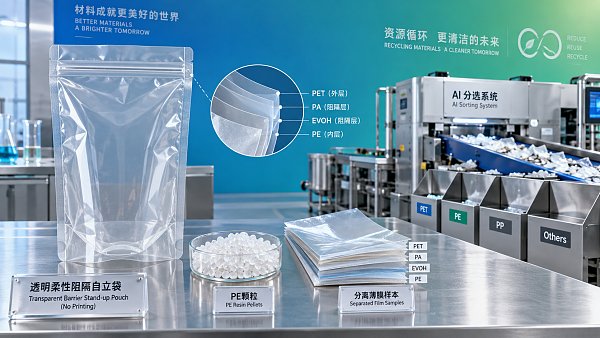
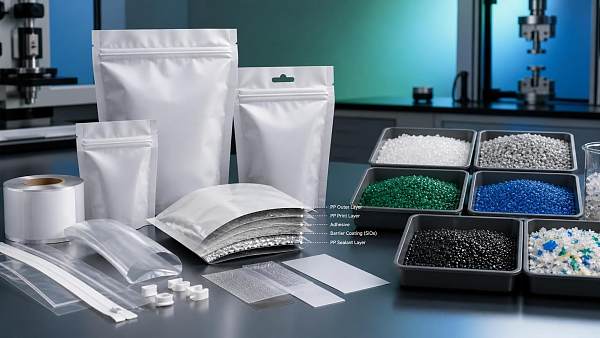
- barrier layers such as EVOH, PVdC, aluminum foil, vacuum-metallized film, silicon oxide, or aluminum oxide coatings;
- tie layers, extrusion laminating resins, dry-bond adhesives, and primers;
- printed inks, overprint varnishes, matte coatings, and lacquer systems;
- zippers, spouts, valves, handles, sliders, and reinforcement patches;
- labels, sleeves, tamper features, and any attached paper or metal component.
The finished article, rather than an individual film roll, is the unit that should be evaluated. A PE web may be widely recyclable on its own; once bonded to PET, aluminum foil, paper, or an incompatible closure, the packaging format has changed materially. Quality release documentation should also identify the manufacturing route, since coextrusion, extrusion lamination, solvent-based lamination, solvent-free lamination, and coating can create different recycling effects even where the headline polymer family appears similar.
Material percentages must be based on the commercial construction, including printing and added features. A formulation that meets a compatibility threshold before adding a zipper, label, or heavy ink coverage may no longer meet it in the final SKU.
Read the barrier structure, not just the polymer name
Barrier requirements are often the reason flexible packaging becomes complex. Oxygen-sensitive foods, aroma-retaining products, moisture-sensitive powders, pharmaceuticals, and electronics may require functions that a simple mono-polyolefin film cannot provide at the required shelf life or distribution conditions. The presence of a barrier component is not itself disqualifying, but its type, loading, location, and compatibility are decisive.
EVOH is commonly used as an oxygen barrier in coextruded polyolefin structures. In a PE or PP recycling route, its acceptability depends on the applicable assessment method and concentration limits. It should not be assumed acceptable merely because it is a thin layer. The surrounding tie layers must also be included in the calculation.
Metallized films and inorganic coatings require different scrutiny. A very thin vacuum-metallized layer may behave differently from aluminum foil, and a transparent SiOx or AlOx coating may behave differently again. Their influence depends on the base film, coating weight, removal or dispersion behavior during reprocessing, and the destination recyclate application. “Metal-free appearance” does not prove the absence of a metallized or mineral barrier layer.
Aluminum foil laminates generally present a more difficult separation issue when bonded permanently to plastic webs. They may be appropriate where product protection requires them, but they should not be represented as equivalent to a mono-polymer flexible structure without evidence for the relevant recovery route.
PVdC-containing films need particular caution. Chlorine-containing components can create processing concerns in conventional mechanical recycling and may affect downstream quality and emissions control. The precise formulation and the intended recycling pathway need specialist review.
Barrier performance also cannot be treated separately from product safety. Reducing a barrier layer to improve recyclability may alter oxygen transmission rate, water-vapor transmission rate, aroma retention, light protection, seal integrity, or shelf-life performance. A material change should pass the same validation discipline as any other packaging change: product compatibility, transport testing, seal-window verification, migration assessment where applicable, and shelf-life confirmation.
Adhesives, inks, and labels are frequent hidden failure points
Flexible packs are usually evaluated visually by their main substrate, while recycling operations experience them as a mixture of polymers, adhesives, pigments, coatings, and residues. This gap explains many weak recyclability claims.
Adhesives can affect melt filtration, odor, gel formation, discoloration, and mechanical properties of recyclate. A packaging specification should state the adhesive chemistry, coat weight, curing conditions, and whether the supplier has evidence of compatibility with the target recycling stream. Under-cured laminating adhesives create an additional safety and quality concern: residual components may affect odor, migration compliance, and converter consistency before end-of-life performance is even considered.
Printing is equally relevant. Ink coverage, pigment choice, varnishes, and primer systems can affect optical sorting, wash behavior, color of the recyclate, and contamination risk. Carbon-black coloration has historically created sorting challenges for some near-infrared systems, although sorter capability varies by installation and technology. A black package should not be judged solely by old assumptions, but it should be verified against the actual sorting conditions and protocol used for the target market.
Paper labels, multilayer labels, metallized decorative elements, and tamper-evident features can also shift a package away from the intended stream. For a PE film recycling route, a PE-compatible label may be preferable to a paper label that remains attached. The correct conclusion depends on the size of the label, adhesive behavior, washing process, and whether the pack is designed for removal. “Peelable” is not enough unless removal is clear to the user and the packaging instructions support that behavior.
Use recognized assessment frameworks, but do not confuse them
No single global certificate proves that flexible barrier packaging is recyclable everywhere. Verification should align with the market and recycling route concerned.
In Europe, design-for-recycling assessments are commonly associated with organizations and protocols such as RecyClass and national systems that define material-specific requirements. The CEFLEX design guidance is also widely used as a reference for flexible packaging design, but guidance is not the same as a certification. For packaging placed on the EU market, the Packaging and Packaging Waste Regulation (PPWR), Regulation (EU) 2025/40, increases the importance of substantiated recyclability and packaging design requirements. Its application timetable and detailed obligations vary by provision, so legal review should be tied to the actual product category and destination market.
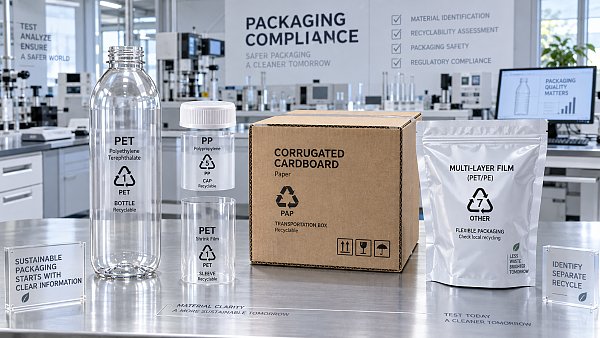
In the United States, the Association of Plastic Recyclers (APR) publishes design guidance and critical guidance for plastic packaging recycling. Its relevance depends on the resin stream and format under review. The resin identification code system established under ASTM D7611 identifies the predominant plastic resin category; it does not certify collection, sortability, or recyclability of the complete package. A number inside the chasing-arrows symbol is therefore not evidence for a recyclable claim.
For general packaging evaluation, EN 13430 addresses requirements for packaging recoverable by material recycling. ISO 18604 provides requirements and procedures for assessing packaging material recycling. These standards are useful reference points for disciplined assessment, but they do not replace market-specific proof of collection and recycling. Environmental claims should also be controlled under the principles of ISO 14021, which requires self-declared claims to be accurate, specific, substantiated, and not misleading.
A credible supplier submission should name the protocol, assessment scope, construction version, and result. A generic statement such as “tested recyclable” is inadequate if it does not show whether testing covered the exact printed, converted pack with its closure and barrier system.
Check the evidence chain before approving a claim
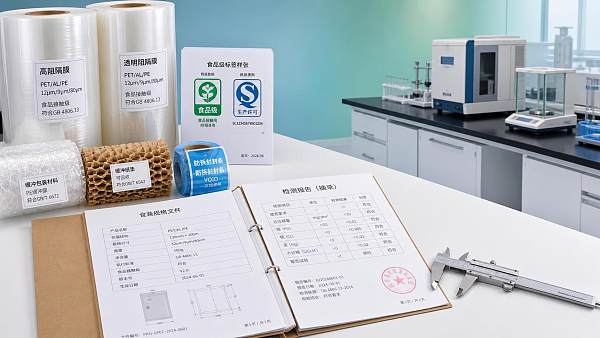
Recyclability verification is strongest when it is treated as a controlled quality file rather than a marketing statement. The file should connect the commercial packaging specification to evidence from the relevant recycling route.
The assessment should be repeated when a material specification changes. A new ink supplier, altered adhesive coat weight, different metallization level, revised zipper, or downgauged web can affect both recyclability and pack performance. Change control should require notification before implementation, updated declarations, and a determination of whether the existing recyclability evidence remains applicable.
Collection and sorting must be verified at market level
A technically sound structure can still generate a misleading claim if its route into the recycling system is unclear. Flexible films may be accepted in curbside collections in one location, collected through retail take-back in another, and excluded entirely elsewhere. Export packaging creates an additional complication: the country of manufacture is not necessarily the country of disposal.
Verification should identify the actual market where the packaging will become waste, the relevant collection channel, whether the format is accepted, and whether the specified material is likely to be sorted into the intended bale. This is particularly important for small-format packs. Sachets and very small pouches can be lost in sorting equipment even when their polymer composition is compatible with a recycling process.
Product residue also matters. A recyclable package contaminated with hazardous residues, strongly odorous contents, or difficult-to-remove materials may not be handled in the same way as a clean, empty consumer pack. Recycling design does not remove the need to assess product classification, cleaning feasibility, and waste-handling instructions.
Claims should reflect the narrowest proven condition
The safest claim is often more precise than the broadest available claim. “Designed for PE film recycling where collection facilities exist” may be more defensible than “recyclable,” provided that the underlying evidence supports the design statement and local labeling rules permit the wording. Claims should not imply universal recyclability where access depends on a particular take-back system or regional infrastructure.
Quality approval should treat front-of-pack icons, e-commerce product descriptions, technical data sheets, and sustainability declarations as controlled outputs. The same claim must remain consistent across markets, languages, and packaging revisions. If local collection differs, artwork and digital content may require market-specific control.
Flexible barrier packaging is recyclable only when material design and real-world recovery align. The necessary evidence is not a single logo but a traceable chain: exact composition, demonstrated compatibility with a named recycling stream, confirmation of local collection and sorting, and a claim limited to what that evidence can support. That approach protects product safety requirements without turning recyclability into an unverified packaging attribute.
Recommended News
 Oct 29, 2026Maine DEP Updates Packaging EPR Timeline, Plans to Revise Stewardship RFPMaine packaging EPR timeline updates and a revised stewardship RFP could affect business planning. Discover what companies should watch next.
 Oct 27, 2026HERMA Gains Cold-Wash Certification for PP and PE Labels, Supporting PPWR AlignmentHERMA earns cold-wash certification for PP and PE labels, proving complete removal at 40°C. Discover how this supports cleaner recycling and PPWR alignment.
 Oct 26, 2026Plastic is Fantastic Association Plans Middle East Debut at GPCA ForumPlastic is Fantastic Association plans its Middle East debut at the GPCA Forum in Dubai in November 2026. Discover its goals for regional partnerships and evidence-based plastic packaging dialogue.
 Oct 25, 2026Freiburg to Limit Packaging Tax to Disposable Cups from 2027Freiburg’s packaging tax will target disposable drink and ice cream cups at €0.50 each from January 1, 2027. Explore what this means for purchasing costs and reusable alternatives.
 Oct 23, 2026UK Confirms Plastic Packaging Tax Rules Introducing Chemical Recycling Mass BalanceUK Plastic Packaging Tax changes introduce chemical recycling mass balance from 1 April 2027. Explore what packaging businesses should review to prepare for compliance.
 Oct 22, 2026Avery Dennison AD CleanFlake Earns First RecyClass Approval for PET Tray RecyclingAvery Dennison AD CleanFlake earns the first RecyClass approval for PET tray recycling. Discover how its label separation technology helps preserve recycled PET quality.
 Oct 12, 2026How to verify whether flexible barrier packaging is recyclableIs flexible barrier packaging recyclable? Learn how to verify materials, barriers, inks, collection routes, and evidence for credible recycling claims.
 Oct 11, 2026How PPWR rules may change customs checks for packaged goodsPPWR customs checks may reshape EU imports. Learn how to prepare packaging evidence, manage border risks, and keep packaged goods moving.
 Oct 10, 2026What a PPWR packaging label should show for compliant EU shipmentsPPWR packaging label guidance for compliant EU shipments: show accurate material details, sorting instructions, recyclability evidence, and component-level disposal information.
 Oct 01, 2026How to verify whether PLA PBAT compostable film meets compostability standardsPLA PBAT compostable film verification guide: check EN 13432, ASTM D6400, certificates, thickness, inks, layers, and industrial composting scope.
 Sep 18, 2026How to verify BPI certification for compostable packaging materialsCompostable packaging materials BPI verification made practical: learn how to confirm certified products, documentation, labels, coatings, and supplier traceability.
 Sep 16, 2026How to verify compostability claims for eco friendly packaging filmsEco friendly packaging films require more than a logo. Learn to verify compostability certificates, finished-film scope, components, and disposal claims.
 Sep 19, 2026What Documents Verify Eco-Friendly Packaging Claims?What documents prove eco-friendly packaging claims? Learn which certificates, traceability records, recyclability assessments, and LCAs support credible, compliant packaging claims.
 Sep 18, 2026EPR Labeling Requirements: What Packaging Teams Must Declare by MarketEPR labeling requirements by market: learn what packaging teams must declare, from sorting marks and material data to producer details, for confident global pack releases.
 Sep 15, 2026PPCS Compliance Explained: Packaging Data, Documentation, and Audit ControlsPPCS compliance explained: build traceable packaging data, controlled documentation, and audit-ready controls to reduce risk and strengthen market confidence.
 Sep 15, 2026PPWD Compliance: How Packaging Producers Can Prepare for EU Waste RulesPPWD compliance guide for packaging producers: prepare for EU waste rules with smarter materials, recyclability, EPR planning, and practical design steps.
 Sep 15, 2026How to verify a mono material recyclable packaging manufacturerVerify a mono material recyclable packaging manufacturer with practical checks on composition, recyclability evidence, certifications, performance, and factory controls.
 Aug 27, 2026Where to find packaging specification resources for compliance checksPackaging specification resources: discover trusted regulations, test standards, and supplier documents to streamline compliance checks, reduce risk, and approve packaging confidently.
 Aug 22, 2026How to verify whether recyclable flexible packaging in Europe meets PPWR expectationsRecyclable flexible packaging Europe: learn how to verify PPWR readiness, assess sorting and barrier performance, and avoid weak claims with a practical evaluation framework.
 Aug 16, 2026China Enforces Eco-Environment Code, Raising Export Packaging Compliance RequirementsChina enforces its Eco-Environment Code, tightening export packaging compliance for food, FMCG, e-commerce, and pharma. Learn the new risks, certification checks, and sourcing actions now.
 Aug 05, 2026Packaging Compliance in North America: Which Labels and Material Rules Matter Most?Packaging compliance North America explained: learn the label, bilingual, material, recyclability, and EPR rules that matter most to reduce risk and speed market access.
 Jul 14, 2026Packaging Compliance Materials Guide for Plastic Ban ReadinessPackaging compliance materials guide for plastic-ban readiness: compare films, labels, cushioning, and print systems to reduce risk, protect performance, and stay ahead of changing regulations.
 Jul 13, 2026Biodegradable Packaging Compostable: Key Claims, Standards, and Common MistakesBiodegradable Packaging compostable explained: learn the key differences, standards, compliance checks, and common claim mistakes before choosing or marketing sustainable packaging.
 Jul 10, 2026How Mono Material Packaging Affects Recyclability and Shelf AppealMono material packaging can improve recyclability without sacrificing shelf appeal. Discover key trade-offs, hidden risks, and practical evaluation tips for smarter packaging decisions.