Search News
Industry Portal
Hot Articles
- How order volume affects OEM packaging material pricesSee how order volume affects OEM packaging materials price, compare total costs and MOQ tiers, and find practical ways to save without overbuying.
- Washington Fines 38 Companies Over Recycled Plastic RequirementsWashington recycled plastic requirements led to $246,548 in fines for 38 companies. See which products are affected and what businesses should review.
- How to check printer compatibility with a variable data printing materials manufacturerLearn how to assess a variable data printing materials manufacturer, verify printer compatibility, and run production trials before approving materials.
Popular Tags
How metallized BOPP films improve moisture barriers in packaging
Time
Click Count
BOPP vacuum metallization films improve moisture protection by adding a thin, continuous metal layer to a biaxially oriented polypropylene substrate. The metal makes it harder for water vapor to pass through the film, but the benefit depends on how well that layer survives coating, lamination, forming, and sealing. A strong barrier result on a flat film sample does not automatically translate into a dry product throughout its intended shelf life.
For packaging evaluation, the useful question is therefore not simply whether a film is metallized. It is whether the complete structure can limit moisture ingress under the humidity, handling, and sealing conditions the product will encounter.
How the metallized layer slows water vapor
Polypropylene already provides a degree of moisture resistance. Biaxial orientation stretches the material in two directions, giving BOPP the stiffness, strength, and dimensional properties needed for many packaging processes. The film remains permeable to water vapor, however, so moisture can gradually move through it when conditions on the two sides are different.
During vacuum metallization, metal—typically aluminum—is evaporated in a vacuum and deposited onto the moving film surface. The resulting coating is extremely thin, but a sufficiently continuous layer creates an additional obstacle to vapor transport. Its effectiveness depends less on the shiny appearance than on the continuity and integrity of the deposited metal.
Water vapor can still pass through microscopic defects in the coating and through areas where the metal is damaged after deposition. Creases, scratches, cracks, and poor adhesion can create easier routes for transmission. The underlying BOPP, any coatings, and the other layers in a laminate also influence the final result.
Metallization can improve oxygen and light protection as well, but those properties should be evaluated separately. A structure selected for moisture-sensitive biscuits may not provide the oxygen barrier required for an oxygen-sensitive product, and a silver appearance alone does not establish the level of light protection.
Read moisture barrier figures in context
Water vapor transmission rate, or WVTR, describes the amount of water vapor passing through a material over a defined area and time under specified test conditions. A lower WVTR indicates less vapor transmission under those conditions. For a meaningful comparison, film specifications should identify the test method, temperature, relative humidity on each side, and whether the result applies to the base film, a laminate, or a finished package.
Temperature and humidity matter because they affect both the driving force for moisture movement and the behavior of packaging materials. Comparing two WVTR figures measured under different conditions can lead to the wrong selection. Results should also be expressed in the same units, and an average result should be considered alongside the supplier’s specification limits and normal production variation.
For technical comparisons, ask for measurements on structures that represent the intended application. A value for a metallized BOPP web before printing and lamination may be useful for screening suppliers, but it does not describe what happens after the web has been converted into a pouch. If the intended package will be folded, flexed, or handled roughly, barrier performance after representative handling is often more informative than the initial value alone.
Commonly used WVTR methods include instrumental and gravimetric approaches. The method and sample preparation can affect the result, particularly when comparing high-barrier materials. Use the same method and conditions when assessing competing structures whenever practical, and agree on how samples are conditioned before testing.
Coating quality matters as much as film choice
The metallized layer must form consistently across the usable width and length of the roll. Uneven deposition, contamination on the film surface, and localized defects can all reduce barrier performance. Optical density is often used as a production control for metal deposition: it indicates how much light passes through the coated film and can help identify variation in coating coverage.
Optical density is useful, but it is not a direct substitute for WVTR. Two films with similar optical density can behave differently if their metal layers differ in continuity, adhesion, or resistance to damage. A purchasing specification based only on appearance or optical density can therefore miss a moisture-barrier problem.
Adhesion is particularly important when the metallized surface will be laminated to another film. If the metal separates from the BOPP or fails at the interface under stress, the laminate can lose integrity. The appropriate adhesion assessment depends on the adhesive, curing conditions, and intended use; a result for one laminate construction should not be assumed to apply to another.
Film treatment and surface chemistry also affect how reliably inks, adhesives, and coatings bond. When evaluating a proposed structure, identify the treated and metallized sides and confirm which surface is intended for printing or lamination. A film that performs well in one converting sequence may require different handling in another.
Why converting can change the barrier
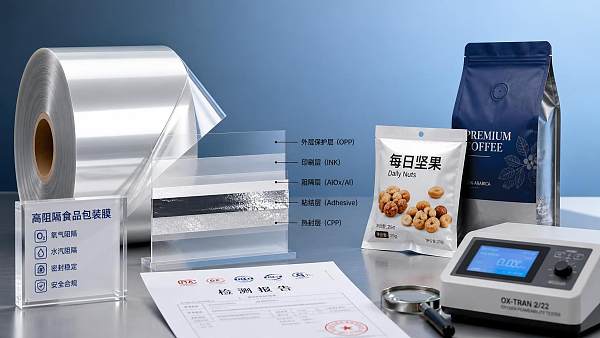
Metallized BOPP is often one layer in a laminate rather than the complete packaging material. Other layers may provide printability, heat sealing, stiffness, or protection for the metal. The layer arrangement affects both performance and manufacturing: burying the metal within a laminate can protect it from abrasion, while the choice of adjacent adhesive and substrate influences bond quality.
Converting can also introduce defects. Excessive tension, tight folds, contact with rough machine parts, or repeated flexing can damage the metal layer. Lamination conditions and adhesive application need to support a consistent bond without creating channels or weak areas. Subsequent slitting, pouch forming, and transport can add stresses that were absent from the original film test.
A useful qualification sequence compares the material at several stages: the supplied web, the converted laminate, and the formed package. If the flat laminate performs well but the finished package does not, the investigation can focus on forming stresses, seals, and handling rather than the metallization process alone. Samples should represent normal production settings, including the expected range of machine speeds and operating conditions.
Seals and leaks can dominate the result
Even a very low-WVTR film cannot compensate for an open seal or a channel caused by product trapped in the sealing area. Wrinkles, uneven pressure, inadequate sealing temperature or dwell time, and contamination can all undermine package integrity. Seal strength is useful, but a seal can resist pulling apart and still contain a path for leakage; integrity testing addresses a different question.
For a heat-sealed pack, assess the sealant layer and sealing window as part of the structure. Check the most difficult locations, such as overlaps and corners, and include realistic product contamination where relevant. A moisture-sensitive powder, for example, can behave differently from a clean test pouch if particles reach the seal during filling.
From film WVTR to product shelf life
Film transmission is only one source of moisture change inside a pack. Initial product moisture, headspace, residual moisture in the packaging, seal leakage, and storage conditions can also affect the result. The direction of moisture movement depends on the water-vapor conditions inside and outside the package: a dry, crisp product may pick up moisture in a humid environment, while another product may lose moisture and become stale or hard.
A preliminary estimate can relate the exposed film area and storage period to the measured transmission rate, provided the calculation uses conditions representative of storage. It is a screening tool, not a complete shelf-life prediction. It does not automatically account for changing humidity, seals, package geometry, handling damage, or the relationship between product moisture content and water activity.
The product’s acceptable moisture range is just as important as the film rating. A small change may noticeably affect the texture of a crisp snack, while a different product may tolerate more variation. Set an end-of-life criterion tied to the actual failure mode—such as loss of crispness, clumping, or another relevant quality attribute—and assess filled packs under representative distribution and storage conditions.
Where metallized BOPP fits—and where alternatives deserve attention
Metallized BOPP can be a practical choice for dry foods and other moisture-sensitive goods when a flexible, opaque structure is acceptable. Its combination of moisture resistance, stiffness, and metallic appearance can support snack and confectionery packaging, provided the complete laminate and seals meet the product’s requirements.
It may be less suitable when buyers need to see the product through the pack. Transparent barrier films or coatings can be considered, although their moisture performance and durability must be assessed in the intended structure. If the product is highly sensitive to oxygen, moisture, or both, a higher-barrier laminate or foil-based construction may be appropriate. That choice brings its own trade-offs in flex resistance, converting behavior, cost, and end-of-life options.
Recycling considerations should be assessed at the structure level. A BOPP-rich laminate may be designed with material compatibility in mind, but a metallized surface, adhesives, inks, and other layers can affect how the package is sorted and recycled. A material description alone does not establish that a finished pack will be accepted by a particular collection and recycling system.
A practical specification for supplier comparisons
Begin with the product and package requirements, then compare films under matched conditions. A useful request to suppliers covers:
- Barrier measurement: WVTR, test method, temperature, humidity conditions, units, and whether the value is typical or a specification limit.
- Film construction: BOPP grade and thickness, metallized side, surface treatment, and the intended printing, laminating, or sealing surface.
- Coating control: relevant optical-density and adhesion criteria, with an understanding of how these relate to the proposed laminate.
- Converting requirements: compatible adhesives and processing conditions, along with any handling constraints that could affect the coating.
- Finished-pack assessment: barrier after conversion, seal integrity, and performance after representative flexing, transport, and storage.
For food or other regulated contact applications, include the intended product, contact conditions, and applicable market in the material review. The relevant documentation needs to address the complete construction and its intended use, including any layers that could transfer substances to the product.
The most defensible selection is the structure that meets the product’s moisture limit after conversion and through the expected distribution cycle. Use the supplier’s film data to narrow the options, then judge the selected construction by the condition of the sealed, filled package.
Recommended News
 Nov 15, 2026Can mono-material flexible packaging provide an oxygen barrier?Explore how mono material flexible packaging materials provide oxygen protection, compare barrier options, and assess shelf life and recycling compatibility.
 Nov 14, 2026How to select flexible packaging films for moisture-sensitive pharmaceuticalsChoose Flexible Packaging Films for pharmaceuticals with confidence. Compare moisture barriers, seals and stability testing to protect sensitive products.
 Nov 12, 2026How metallized BOPP films improve moisture barriers in packagingBOPP vacuum metallization films help protect moisture-sensitive products. Discover how to evaluate barriers, seals, and shelf-life performance.
 Nov 11, 2026How to choose BOPP barrier packaging films in Europe for oxygen-sensitive productsCompare barrier packaging films in Europe for oxygen-sensitive products. Explore BOPP structures, seal integrity, compliance and recycling considerations.
 Nov 05, 2026How to choose vacuum metallized films for barrier packaging in North AmericaCompare vacuum metallized materials North America suppliers offer. Learn how to assess PET and BOPP films for barrier performance, compliance, and total cost.
 Oct 21, 2026How vacuum metallization coating affects BOPP barrier performanceDiscover how vacuum metallization coating improves BOPP oxygen and moisture barriers. Learn what drives coating durability and how to select films for reliable packaging performance.
 Oct 20, 2026How to choose barrier lidding films for oxygen-sensitive foodsChoose barrier packaging films for lidding with confidence. Compare oxygen barriers, seal compatibility, and shelf-life validation to protect sensitive foods and reduce packaging risks.
 Oct 19, 2026Choosing BOPP laminated films for moisture-sensitive food packagingCompare food packaging materials: laminated films made with BOPP. Discover how to assess moisture barriers, seal integrity, and compliance to protect food quality and extend shelf life.
 Oct 06, 2026How moisture barrier coating polymers affect package shelf lifeMoisture barrier coating polymers can extend package shelf life. Learn how to evaluate WVTR, adhesion, seal integrity, processing, and recyclability for reliable protection.
 Oct 05, 2026How beverage labels stay secure at high production speedsHigh speed labeling materials for beverages: learn how to secure labels against moisture, abrasion, and fast-line failures while protecting print quality and traceability.
 Oct 03, 2026When does micron-level coating technology improve BOPP barrier film performance?Micron-level coating technology can elevate BOPP barrier film performance for oxygen, aroma, and moisture protection. Explore when coated structures deliver smarter, lightweight packaging results.
 Sep 24, 2026How to compare extreme barrier films in Europe for oxygen protectionExtreme barrier films Europe: compare OTR, coating durability, converting performance, recyclability and PPWR readiness for reliable oxygen protection.
 Sep 20, 2026How barrier packaging for pet food helps prevent fat oxidationBarrier packaging for pet food helps prevent fat oxidation by blocking oxygen, moisture, and light—protecting freshness, flavor, nutrition, and shelf life.
 Sep 16, 2026Pharma Compliance Protection Films: Migration, Barrier, and Documentation ChecksPharma compliance protection films: master migration, barrier performance, and documentation checks to build safer, audit-ready pharmaceutical packaging.
 Sep 16, 2026Selecting Protection Films Compliant with Pharma Regulations and Cleanroom UseCompliant to pharma regulations protection films: learn how to select cleanroom-ready materials with proven traceability, chemical resistance, low particle risk, and reliable validation support.
 Sep 10, 2026How pharmaceutical film technology affects moisture protection in blister packsPharmaceutical film technology for blister packs: learn how barrier films, WVTR, thermoforming, and seal integrity protect moisture-sensitive medicines and support reliable compliance.
 Sep 05, 2026How to choose food-grade flexible packaging films for dry foodsFlexible Packaging Films food grade guide: choose the right barrier, seal strength, compliance, and durability to protect dry foods and extend shelf life.
 Sep 03, 2026How film label materials affect label durability in refrigerated storageFilm label materials play a critical role in refrigerated durability. Learn how films, adhesives, printing, and moisture resistance protect labels in cold storage.
 Aug 24, 2026How to evaluate barrier film suppliers in Europe for food packagingBarrier film Europe sourcing made practical: learn how to assess food packaging suppliers on barrier performance, compliance, machinability, and total cost before you buy.
![]() Aug 14, 2026EU PPWR enforcement: BOPP high barrier film exports need to pay attention to labeling complianceEU PPWR enforcement makes BOPP high barrier film exports to Europe focus on labeling compliance. Learn the key rules on recycling marks, recycled content, and recyclability claims before 2026.
 Aug 13, 2026EU PPWR Takes Effect for BOPP Barrier FilmsEU PPWR takes effect for BOPP barrier films on Aug 12, 2026. Learn the new labeling, recycled content, and life-cycle declaration rules shaping EU import compliance.
 Aug 13, 2026Barrier Packaging for Pet Food: How to Choose the Right Moisture and Oxygen BarrierBarrier packaging for pet food explained: learn how to choose the right moisture and oxygen barrier to protect freshness, shelf life, seals, and sustainability goals.
 Aug 12, 2026EU PPWR Now in Force: BOPP Barrier Films Face Labeling RulesEU PPWR now in force puts BOPP barrier films under stricter labeling rules. Learn how recyclability, composition, and recycled content disclosures affect EU market access.
 Aug 12, 2026How to Evaluate Recyclable Mono Material Packaging for Barrier Performance and ReprocessingRecyclable mono material packaging: learn how to assess barrier performance, seal reliability, and reprocessing suitability to choose packaging that supports recyclability without sacrificing product protection.