Search News
Industry Portal
Hot Articles
- Maine DEP Updates Packaging EPR Timeline, Plans to Revise Stewardship RFPMaine packaging EPR timeline updates and a revised stewardship RFP could affect business planning. Discover what companies should watch next.
- How run size affects the cost of holographic packaging for spiritsSee how holographic packaging for spirits costs change with run size. Compare setup fees, volume savings and inventory risks to choose the right quantity for your brand.
- How to choose printable clear PET film for your inkjet printerNeed clear PET film printable on your inkjet printer? Compare coatings, ink compatibility, clarity, and feeding to avoid costly misprints and choose confidently.
Popular Tags
How vacuum metallization coating affects BOPP barrier performance
Time
Click Count
How vacuum metallization coating affects BOPP barrier performance
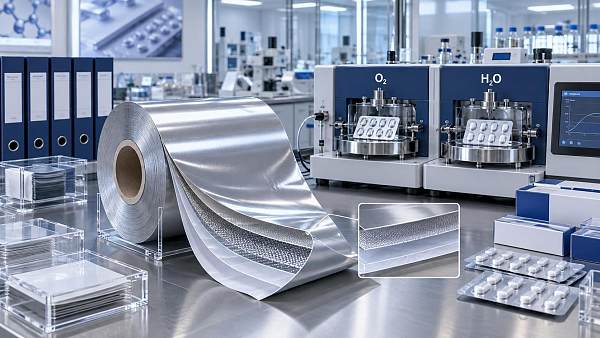
For technical evaluators, the value of vacuum metallization coating on BOPP lies not in its metallic appearance, but in measurable reductions in oxygen and water vapor transmission. A thin aluminum layer can substantially improve barrier performance, yet results depend on substrate surface quality, pretreatment, deposition uniformity, and coating integrity during converting. The practical question is not simply how low the initial transmission rate can go. It is whether that protection survives lamination, pouch formation, distribution, and the conditions surrounding the packed product.
Two films can look equally silver and behave quite differently in service. That is why a useful evaluation connects deposition conditions with oxygen transmission rate (OTR), water vapor transmission rate (WVTR), and the durability of the finished structure—not optical density alone.
The barrier gain comes from continuity, not bulk
Uncoated biaxially oriented polypropylene already provides useful moisture resistance, but its oxygen barrier is comparatively limited. Orientation improves mechanical properties and influences permeation, yet it does not turn polypropylene into an oxygen-blocking material. For oxygen-sensitive products, the base film often needs another barrier mechanism.
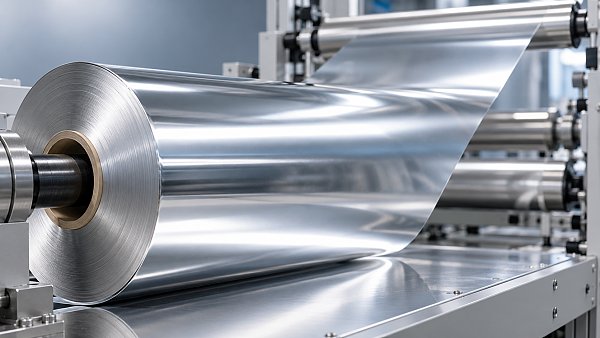
During vacuum metallization, aluminum is evaporated under reduced pressure and deposited onto the moving film. The deposited metal is typically measured in nanometers rather than the micrometers used for the BOPP substrate. A sufficiently continuous layer restricts oxygen and moisture transport far more effectively than the polymer alone.
Real coatings are not perfectly continuous sheets. Pinholes, incompletely covered regions, scratches, and cracks create transport pathways. Barrier performance therefore depends heavily on the number, size, and distribution of these defects, as well as the polymer beneath them. Adding aluminum can improve coverage, but increasing deposited mass does not necessarily resolve contamination or poor adhesion.
This explains why a thicker-looking coating may disappoint. If the dominant problem is a defect population that survives deposition, the extra metal may contribute less than a cleaner, smoother substrate would.
The BOPP surface sets the practical ceiling
“BOPP” is not a complete substrate specification. Metallization grades can differ in skin-layer chemistry, surface topography, additives, and treatment history. A film selected for easy slip or printing may not provide the same metal adhesion and barrier consistency as one engineered for metallization.
Antiblock particles, surface contamination, and migrated additives can disturb deposition or weaken the interface. Some surface texture is useful for winding and handling, so removing every source of roughness is not a sensible objective. The task is to balance machinability against the surface quality needed for a continuous, well-anchored metal layer.
Corona or plasma treatment can modify surface chemistry and support adhesion, depending on the film construction and process. However, a surface-energy reading is a screening measurement, not proof of metal bond strength. Treatment age, storage, additive migration, and contamination can change the surface presented to the metallizer.
When investigating weak barrier results, request the substrate grade, metallized side, treatment history, and storage conditions. Comparing two deposition trials on different BOPP grades without recording these details can lead to the wrong process correction.
Why optical density cannot certify barrier quality
Optical density describes light attenuation through the metallized film. It is valuable for monitoring deposition consistency and detecting variation across the web. It is not a direct measurement of oxygen or water vapor transmission.
Within a stable film-and-process combination, optical density may correlate with barrier performance. That relationship becomes less reliable when substrate chemistry, defect distribution, or subsequent handling changes. Small defects can matter disproportionately to gas transmission while barely changing the overall optical reading.
Use optical density as a process-control indicator alongside transmission testing. If optical density remains stable while OTR deteriorates, investigate surface condition, coating damage, adhesion, and sampling location before simply increasing aluminum deposition.
Deposition uniformity matters beyond the roll average
Web speed, evaporation stability, vacuum conditions, cooling, and tension interact during metallization. Excessive thermal or mechanical loading can compromise the substrate or coating. Unstable deposition can produce cross-web or machine-direction variation that a single laboratory specimen misses.
For qualification, sample across the usable web and at defined positions along the roll. A strong center sample does not demonstrate that edge lanes perform equally well. Retain sample locations so later results can be traced back to the process rather than averaged into an apparently acceptable batch.
Converting can change the result that matters
The metallizer supplies a film; the customer relies on a package. Between those points, rollers, winding tension, adhesive application, curing, slitting, and pouch forming can alter coating integrity.
Lamination can protect the aluminum against abrasion and, in some structures, improve measured barrier by covering defects. It can also introduce stress or expose a weak metal-to-polymer interface. Adhesive compatibility, coat uniformity, curing conditions, and tension therefore belong in the barrier assessment—not just in the bond-strength report.
A peel test needs careful interpretation. If metal transfers with the adhesive, the measured force may reflect failure at the metal–BOPP interface rather than the adhesive bond originally under investigation. Record the failure mode, not only the force.
Flexing is another common dividing line between promising laboratory data and dependable packaging. Folding or repeated crumpling can crack a thin metal layer. For a snack pouch, creases formed during filling and handling may expose weaknesses that remain invisible on a flat film specimen. Testing the converted laminate before and after controlled flexing is more informative than selecting solely on its best initial OTR.
Compare OTR and WVTR under conditions that mean something
A transmission value without test conditions is incomplete. OTR is commonly reported as a gas volume per unit area per day, while WVTR is commonly reported as mass per unit area per day. Neither number is directly comparable across different temperatures, humidity conditions, or measurement configurations.
ASTM D3985 covers oxygen transmission measurement using a coulometric sensor; ASTM F1249 covers water vapor transmission using a modulated infrared sensor. These are relevant references, but citing a method number does not establish that two laboratories used equivalent conditions. Confirm the applicable edition, conditioning procedure, instrument suitability, and reporting details.
- Temperature and humidity: Record the test temperature and humidity conditions on each side of the specimen where relevant. Ambient and tropical-condition results should not be treated as interchangeable.
- Gas concentration and pressure: Clarify the oxygen challenge and pressure conditions. Results from different driving forces require careful interpretation.
- Specimen state: Identify whether the sample is metallized film, cured laminate, flexed laminate, or material removed from a finished pouch.
- Measurement capability: Confirm the method’s quantification limit and leak-control procedure. “Below detection” does not mean zero transmission.
For flex durability, ASTM F392 provides a recognized practice for conditioning flexible barrier materials. Specify the conditioning severity and then measure transmission using the agreed barrier method. Flex conditioning alone is not an OTR or WVTR measurement, nor does one flex regimen reproduce every distribution environment.
Do not assume oxygen and moisture results will track each other proportionally. The substrate, coating defects, laminate layers, and test conditions influence the two permeants differently. A film can meet its WVTR requirement while still being unsuitable for an oxygen-sensitive product.
Set acceptance limits around product failure, not a supplier ranking
For a dry, crisp product, moisture ingress may control shelf life. For an oxidation-sensitive product, oxygen ingress may be more restrictive, although residual headspace oxygen and product chemistry also matter. Light protection can be valuable, but it does not replace an oxygen-barrier requirement.
A useful starting estimate multiplies the measured transmission rate by exposed package area and storage time, provided conditions are reasonably aligned. This is only a screening calculation. It does not account fully for changing concentration gradients, seal leakage, folds, temperature cycling, or product interactions.
Consequently, excellent flat-film barrier cannot compensate for unreliable seals. Finished-package leak testing and shelf-life validation should follow material qualification, particularly when the proposed film is thinner or the converting process has changed.
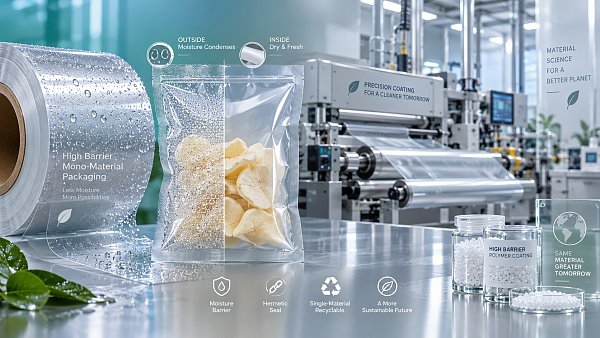
The same restraint applies to sustainability claims. A polypropylene-based laminate may support a mono-material design strategy, but metallization, adhesives, inks, and local collection and recycling requirements still need assessment. “BOPP-based” is not, by itself, evidence of recyclability.
A qualification decision that survives production
For PPCS, connecting polymer-film physics with packaging performance means keeping the evidence chain intact: substrate specification, deposition consistency, converted-film durability, and package validation. A barrier claim loses practical value when any of those links is missing.
A defensible qualification compares multiple roll locations, measures OTR and WVTR under agreed conditions, checks adhesion and failure mode, and repeats barrier testing after representative converting and flexing. Production acceptance should address variation as well as the average result.
The better vacuum metallization coating is not necessarily the darkest or the one with the lowest isolated laboratory value. It is the one that consistently meets the product’s oxygen and moisture limits after the film has become a package. Before approving a grade, ask for that evidence—not just a silver sample and a single transmission number.
Recommended News
 Oct 21, 2026How vacuum metallization coating affects BOPP barrier performanceDiscover how vacuum metallization coating improves BOPP oxygen and moisture barriers. Learn what drives coating durability and how to select films for reliable packaging performance.
 Oct 20, 2026How to choose barrier lidding films for oxygen-sensitive foodsChoose barrier packaging films for lidding with confidence. Compare oxygen barriers, seal compatibility, and shelf-life validation to protect sensitive foods and reduce packaging risks.
 Oct 19, 2026Choosing BOPP laminated films for moisture-sensitive food packagingCompare food packaging materials: laminated films made with BOPP. Discover how to assess moisture barriers, seal integrity, and compliance to protect food quality and extend shelf life.
 Oct 06, 2026How moisture barrier coating polymers affect package shelf lifeMoisture barrier coating polymers can extend package shelf life. Learn how to evaluate WVTR, adhesion, seal integrity, processing, and recyclability for reliable protection.
 Oct 05, 2026How beverage labels stay secure at high production speedsHigh speed labeling materials for beverages: learn how to secure labels against moisture, abrasion, and fast-line failures while protecting print quality and traceability.
 Oct 03, 2026When does micron-level coating technology improve BOPP barrier film performance?Micron-level coating technology can elevate BOPP barrier film performance for oxygen, aroma, and moisture protection. Explore when coated structures deliver smarter, lightweight packaging results.
 Sep 24, 2026How to compare extreme barrier films in Europe for oxygen protectionExtreme barrier films Europe: compare OTR, coating durability, converting performance, recyclability and PPWR readiness for reliable oxygen protection.
 Sep 20, 2026How barrier packaging for pet food helps prevent fat oxidationBarrier packaging for pet food helps prevent fat oxidation by blocking oxygen, moisture, and light—protecting freshness, flavor, nutrition, and shelf life.
 Sep 16, 2026Pharma Compliance Protection Films: Migration, Barrier, and Documentation ChecksPharma compliance protection films: master migration, barrier performance, and documentation checks to build safer, audit-ready pharmaceutical packaging.
 Sep 16, 2026Selecting Protection Films Compliant with Pharma Regulations and Cleanroom UseCompliant to pharma regulations protection films: learn how to select cleanroom-ready materials with proven traceability, chemical resistance, low particle risk, and reliable validation support.
 Sep 10, 2026How pharmaceutical film technology affects moisture protection in blister packsPharmaceutical film technology for blister packs: learn how barrier films, WVTR, thermoforming, and seal integrity protect moisture-sensitive medicines and support reliable compliance.
 Sep 05, 2026How to choose food-grade flexible packaging films for dry foodsFlexible Packaging Films food grade guide: choose the right barrier, seal strength, compliance, and durability to protect dry foods and extend shelf life.
 Sep 03, 2026How film label materials affect label durability in refrigerated storageFilm label materials play a critical role in refrigerated durability. Learn how films, adhesives, printing, and moisture resistance protect labels in cold storage.
 Aug 24, 2026How to evaluate barrier film suppliers in Europe for food packagingBarrier film Europe sourcing made practical: learn how to assess food packaging suppliers on barrier performance, compliance, machinability, and total cost before you buy.
![]() Aug 14, 2026EU PPWR enforcement: BOPP high barrier film exports need to pay attention to labeling complianceEU PPWR enforcement makes BOPP high barrier film exports to Europe focus on labeling compliance. Learn the key rules on recycling marks, recycled content, and recyclability claims before 2026.
 Aug 13, 2026EU PPWR Takes Effect for BOPP Barrier FilmsEU PPWR takes effect for BOPP barrier films on Aug 12, 2026. Learn the new labeling, recycled content, and life-cycle declaration rules shaping EU import compliance.
 Aug 13, 2026Barrier Packaging for Pet Food: How to Choose the Right Moisture and Oxygen BarrierBarrier packaging for pet food explained: learn how to choose the right moisture and oxygen barrier to protect freshness, shelf life, seals, and sustainability goals.
 Aug 12, 2026EU PPWR Now in Force: BOPP Barrier Films Face Labeling RulesEU PPWR now in force puts BOPP barrier films under stricter labeling rules. Learn how recyclability, composition, and recycled content disclosures affect EU market access.
 Aug 12, 2026How to Evaluate Recyclable Mono Material Packaging for Barrier Performance and ReprocessingRecyclable mono material packaging: learn how to assess barrier performance, seal reliability, and reprocessing suitability to choose packaging that supports recyclability without sacrificing product protection.
 Aug 11, 2026EU PPWR Rules Now Mandate Labels on BOPP Barrier FilmsEU PPWR rules now require labels on BOPP barrier films sold in Europe. Learn the 15% recycled content, material ID, and customs compliance steps exporters must act on now.
 Aug 10, 2026PPWR Rule Takes Effect for BOPP Barrier Film LabelsPPWR Rule takes effect for BOPP barrier film labels in the EU from August 10, 2026. Learn key ARL Code, recyclability, and compliance steps to avoid customs risk and penalties.
 Aug 09, 2026EU PPWR Rule Takes Effect for BOPP Barrier FilmsEU PPWR rule now applies to BOPP barrier films entering the EU. Learn the new labeling, material ratio, and recyclability requirements to avoid customs delays and rising compliance costs.
 Aug 08, 2026PPWR Rule Takes Effect for BOPP Barrier FilmsPPWR rule takes effect for BOPP barrier films in the EU from August 8, 2026. Learn how labeling, material ratio disclosure, customs compliance, and technical file updates may impact exports.
 Aug 07, 2026EU PPWR Rule Takes Effect for BOPP Barrier FilmsEU PPWR rule takes effect for BOPP barrier films, requiring recycling labels, material composition percentages, and recyclability claims. See what exporters must act on now.