Search News
Industry Portal
Hot Articles
- How order volume affects OEM packaging material pricesSee how order volume affects OEM packaging materials price, compare total costs and MOQ tiers, and find practical ways to save without overbuying.
- Washington Fines 38 Companies Over Recycled Plastic RequirementsWashington recycled plastic requirements led to $246,548 in fines for 38 companies. See which products are affected and what businesses should review.
- How to check printer compatibility with a variable data printing materials manufacturerLearn how to assess a variable data printing materials manufacturer, verify printer compatibility, and run production trials before approving materials.
Popular Tags
Can mono-material flexible packaging provide an oxygen barrier?
Time
Click Count
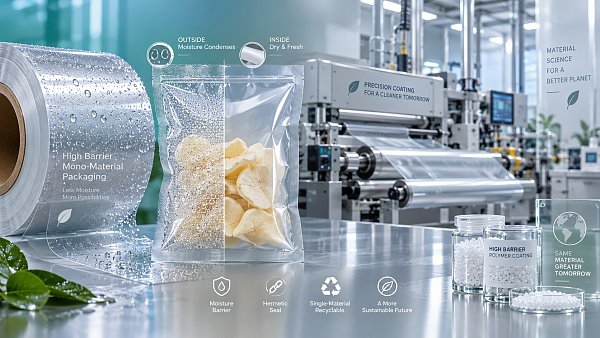
Can mono-material flexible packaging provide an oxygen barrier without compromising recyclability? The answer depends on the film structure, barrier technology, and intended application.
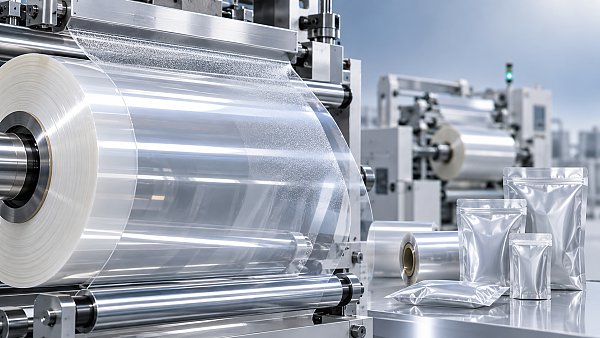
For technical evaluators, mono material flexible packaging materials offer promising options, including oriented polyethylene or polypropylene films with compatible barrier coatings or thin functional layers.
However, oxygen transmission rates can vary with humidity, temperature, and processing conditions, while recyclability depends on the complete structure and local recycling guidelines.
This article examines the main material choices, testing requirements, and performance trade-offs to help you assess their suitability for oxygen-sensitive products.
How much oxygen barrier can a mono-material package provide?
Yes, a mono-material flexible package can provide an oxygen barrier, but its performance ranges from modest protection to levels suitable for demanding shelf-life applications.
Uncoated polyethylene and polypropylene films provide useful moisture resistance, but their oxygen barriers are generally limited compared with specialized barrier layers and coatings.
Adding ethylene vinyl alcohol, an inorganic coating, or another barrier technology can substantially reduce oxygen transmission. The final result depends on formulation, thickness, humidity, and conversion.
A structure marketed as mono-material often contains a dominant polymer family rather than one chemically pure substance. Small amounts of other materials may serve essential functions.
That distinction matters: a polyethylene-rich laminate can perform well and qualify for a specific recycling stream, but neither outcome follows from the name alone.
Start with the product’s oxygen sensitivity and target shelf life. Then compare candidate structures using data for the finished package under representative conditions.
Which mono material flexible packaging materials offer oxygen protection?
Polyethylene-rich structures
Polyethylene-rich structures commonly combine an oriented polyethylene print web with a polyethylene sealant layer. The layers can be engineered for stiffness, sealing, and converting performance.
Because polyethylene alone is a relatively weak oxygen barrier, demanding applications typically require a functional layer or coating, such as a controlled amount of EVOH.
These structures may suit brands targeting polyethylene film recycling streams, subject to the requirements of the relevant market, collection system, and design guidance.
Technical evaluation should include heat resistance during sealing, dimensional stability, machinability, and the influence of inks and adhesives on the complete laminate.
Polypropylene-rich structures
Polypropylene-rich structures often use biaxially oriented polypropylene for printability and stiffness, combined with compatible polypropylene-based sealing layers or additional functional coatings.
Orientation improves film properties and can affect barrier performance, but standard uncoated BOPP should not automatically be treated as a high-oxygen-barrier material.
Barrier-coated or metallized polypropylene structures can address more demanding applications. Their suitability for recycling depends on coating characteristics and the available polypropylene recycling pathway.
Polypropylene offers useful moisture resistance, although package geometry and seals still matter. Confirm performance at the temperatures and humidity levels expected throughout distribution.
Barrier layers and coatings
EVOH is a widely used oxygen-barrier polymer in multilayer films. It can deliver strong dry-condition performance at relatively low thickness, depending on grade and structure.
Its oxygen barrier can deteriorate as humidity rises. Surrounding layers can slow moisture ingress, but they do not remove the need for humid-condition testing.
Silicon oxide and aluminum oxide coatings can provide transparent barriers when deposited onto suitable films. Their effectiveness depends on coating integrity and subsequent handling.
Metallization can improve oxygen and light protection, but performance depends on the deposited layer and its continuity. It can also affect sorting and recycling compatibility.
Organic barrier coatings offer another route. Their performance and recyclability depend on chemistry, coating weight, curing, and compatibility with the chosen substrate and recycling process.
There is no universal ranking across these technologies. Request comparable data for the actual laminate, including the coating or barrier layer, rather than relying on material names.
What oxygen transmission rate does your product actually need?
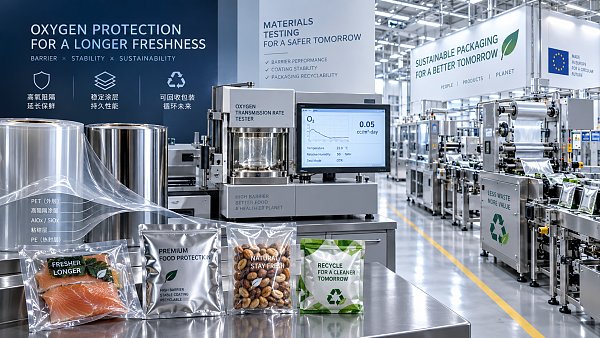
Oxygen transmission rate, or OTR, describes the amount of oxygen passing through a material under specified test conditions. Lower values indicate a stronger barrier.
Film OTR is commonly reported in cubic centimeters per square meter per day, with temperature, relative humidity, pressure conditions, and test method stated alongside it.
A single OTR value is incomplete. The same structure can perform differently at another temperature or humidity, especially when moisture-sensitive barrier materials are present.
Set a target from product requirements rather than choosing the lowest available number. Excess barrier can add cost or complicate recycling without extending useful shelf life.
Consider oxygen-sensitive ingredients, initial dissolved or headspace oxygen, residual oxygen after flushing, package size, storage temperature, light exposure, and the desired shelf life.
For example, a dry snack and an oxygen-sensitive sauce may require different barrier strategies even when their pouches have similar dimensions and appearances.
Use supplier data to screen candidates, then confirm the target through product-specific shelf-life studies. Sensory changes and chemical markers may reveal failure before visible defects appear.
When comparing reports, check whether results describe a single film, a complete laminate, or a finished package. These measurements answer different engineering questions.
Why film data alone cannot predict package performance
Oxygen can enter through more than the main film surface. Seals, folds, pinholes, fitments, and damaged regions can determine the performance of a finished pack.
As an initial estimate, multiply film OTR by exposed package area to approximate oxygen ingress through the film. Use consistent units and matching test conditions.
This estimate excludes leaks and other ingress paths. It also assumes a representative oxygen driving force and stable conditions, which may not reflect actual distribution.
For illustration, a film rated at 1 cc/m²/day across 0.1 m² of exposed area gives approximately 0.1 cc/day through the film under the stated conditions.
That figure is not the package’s total oxygen uptake. Headspace oxygen, product absorption, seals, and changes in external conditions must also be considered.
Finished-package testing is especially important for pouches with spouts, complex seals, deep folds, or abrasive contents that can damage a thin barrier layer.
Test packages after filling, sealing, transport simulation, and any thermal treatment. A strong laboratory film result can deteriorate during ordinary conversion and distribution.
Which test conditions should appear on a supplier specification?
Ask for the test standard and full conditions, including temperature, relative humidity, oxygen partial-pressure conditions, sample conditioning, and whether results represent typical or maximum values.
ASTM D3985 and ISO 15105 are among the methods used for oxygen transmission testing. Confirm the applicable method and conditions before comparing results.
For multilayer materials containing EVOH or moisture-sensitive coatings, request data at humidity levels representative of both filling and storage, including the product-facing side where relevant.
Also request water vapor transmission rate, seal strength, hot tack, puncture resistance, and coefficient of friction where these properties affect your process or application.
For finished packs, include leak testing and a package-level oxygen ingress or headspace study where appropriate. Choose methods sensitive enough for the required shelf life.
Specify acceptance limits, sampling frequency, and the treatment of outliers. A typical supplier value alone does not establish the variability of commercial production.
If comparing candidates from different suppliers, test them using the same laboratory method and conditioning. Otherwise, apparent differences may reflect test setup rather than material performance.
Does adding a barrier layer affect recyclability?
It can. Recyclability depends on the complete package and the recycling system, including collection, sorting, reprocessing, and the existence of a viable end market.
A polyethylene-rich film containing EVOH is not chemically pure polyethylene. Some recycling design guidelines may accept limited amounts, subject to their own thresholds and conditions.
Those limits are not universal. They can differ by polymer stream, package format, geography, assessment scheme, and the way the barrier material is incorporated.
Coatings, metallization, adhesives, inks, labels, closures, and residual product can also affect sorting or recycled material quality. Evaluate them as part of the finished structure.
Ask suppliers for a full material breakdown by weight and layer function. Include coating chemistry and any components added during printing, conversion, or filling.
Then compare the design against current guidance for the intended market and obtain relevant compatibility testing or certification where appropriate. Verify collection access separately.
A package may be technically compatible with a recycling process while lacking practical collection in a particular location. Claims should reflect both evidence and local conditions.
For European applications, assess applicable packaging rules and implementation requirements using current legal guidance. Avoid assuming that a mono-material description alone establishes regulatory compliance.
How do conversion and filling affect the barrier?
A candidate must survive printing, lamination, pouch making, filling, sealing, and transport. Each step can change the barrier measured on the original film.
Thin inorganic coatings may lose effectiveness if they crack during bending or forming. Metallized layers can also develop defects under mechanical stress or poor handling.
Laminate construction, adhesive selection, curing, and web tension influence the final result. Establish process windows with the film supplier, converter, and packaging equipment team.
Check seal performance across the expected range of temperature, pressure, and dwell time. Product contamination in the seal area can create leaks despite acceptable film OTR.
For hot-fill or retort applications, confirm that every layer, adhesive, and seal is qualified for the actual temperature and duration, then test the processed package.
Consider shelf presentation and logistics as well. Sharp product edges, repeated flexing, compression, and scuffing may expose weaknesses that are absent in flat-film tests.
How to compare candidate structures in a technical trial
Begin with a written specification covering product sensitivity, target shelf life, package dimensions, distribution conditions, filling equipment, and the intended recycling market.
Shortlist structures with documented barrier performance and a plausible recycling pathway. Include at least one reference structure that represents the current package or baseline.
Compare complete laminates under consistent oxygen and water vapor test conditions. Check mechanical properties and process compatibility before committing to a full production trial.
Run representative filling trials and inspect seal integrity, machine speed, reject rates, appearance, and dimensional stability. Record settings so results can be reproduced.
Evaluate filled packs through realistic storage and distribution conditions. Measure oxygen ingress alongside product quality indicators at intervals aligned with the intended shelf life.
Finally, compare total cost per acceptable pack, including material, conversion, scrap, line efficiency, testing, and any changes in product loss or shelf life.
Document outstanding risks and supplier commitments. A promising laboratory result becomes a practical specification only after the structure performs consistently at commercial scale.
When is a mono-material barrier structure a good fit?
It is a strong candidate when a polyethylene-rich or polypropylene-rich design meets the product’s barrier target, runs reliably, and has a credible recycling pathway.
Dry foods, snacks, and selected personal care products may be suitable, but each application still needs testing against its own oxygen and moisture sensitivity.
Highly oxygen-sensitive products, demanding thermal processes, or long distribution periods may require more advanced barriers and closer scrutiny of coating durability and recycling compatibility.
If no candidate meets the required shelf life and process conditions, retain the performance target and investigate alternatives rather than assuming mono-material construction guarantees an acceptable result.
The practical decision rests on three pieces of evidence: finished-package performance, commercial processing reliability, and verified compatibility with the intended market’s recycling system.
Recommended News
 Nov 15, 2026Can mono-material flexible packaging provide an oxygen barrier?Explore how mono material flexible packaging materials provide oxygen protection, compare barrier options, and assess shelf life and recycling compatibility.
 Nov 14, 2026How to select flexible packaging films for moisture-sensitive pharmaceuticalsChoose Flexible Packaging Films for pharmaceuticals with confidence. Compare moisture barriers, seals and stability testing to protect sensitive products.
 Nov 12, 2026How metallized BOPP films improve moisture barriers in packagingBOPP vacuum metallization films help protect moisture-sensitive products. Discover how to evaluate barriers, seals, and shelf-life performance.
 Nov 11, 2026How to choose BOPP barrier packaging films in Europe for oxygen-sensitive productsCompare barrier packaging films in Europe for oxygen-sensitive products. Explore BOPP structures, seal integrity, compliance and recycling considerations.
 Nov 05, 2026How to choose vacuum metallized films for barrier packaging in North AmericaCompare vacuum metallized materials North America suppliers offer. Learn how to assess PET and BOPP films for barrier performance, compliance, and total cost.
 Oct 21, 2026How vacuum metallization coating affects BOPP barrier performanceDiscover how vacuum metallization coating improves BOPP oxygen and moisture barriers. Learn what drives coating durability and how to select films for reliable packaging performance.
 Oct 20, 2026How to choose barrier lidding films for oxygen-sensitive foodsChoose barrier packaging films for lidding with confidence. Compare oxygen barriers, seal compatibility, and shelf-life validation to protect sensitive foods and reduce packaging risks.
 Oct 19, 2026Choosing BOPP laminated films for moisture-sensitive food packagingCompare food packaging materials: laminated films made with BOPP. Discover how to assess moisture barriers, seal integrity, and compliance to protect food quality and extend shelf life.
 Oct 06, 2026How moisture barrier coating polymers affect package shelf lifeMoisture barrier coating polymers can extend package shelf life. Learn how to evaluate WVTR, adhesion, seal integrity, processing, and recyclability for reliable protection.
 Oct 05, 2026How beverage labels stay secure at high production speedsHigh speed labeling materials for beverages: learn how to secure labels against moisture, abrasion, and fast-line failures while protecting print quality and traceability.
 Oct 03, 2026When does micron-level coating technology improve BOPP barrier film performance?Micron-level coating technology can elevate BOPP barrier film performance for oxygen, aroma, and moisture protection. Explore when coated structures deliver smarter, lightweight packaging results.
 Sep 24, 2026How to compare extreme barrier films in Europe for oxygen protectionExtreme barrier films Europe: compare OTR, coating durability, converting performance, recyclability and PPWR readiness for reliable oxygen protection.
 Sep 20, 2026How barrier packaging for pet food helps prevent fat oxidationBarrier packaging for pet food helps prevent fat oxidation by blocking oxygen, moisture, and light—protecting freshness, flavor, nutrition, and shelf life.
 Sep 16, 2026Pharma Compliance Protection Films: Migration, Barrier, and Documentation ChecksPharma compliance protection films: master migration, barrier performance, and documentation checks to build safer, audit-ready pharmaceutical packaging.
 Sep 16, 2026Selecting Protection Films Compliant with Pharma Regulations and Cleanroom UseCompliant to pharma regulations protection films: learn how to select cleanroom-ready materials with proven traceability, chemical resistance, low particle risk, and reliable validation support.
 Sep 10, 2026How pharmaceutical film technology affects moisture protection in blister packsPharmaceutical film technology for blister packs: learn how barrier films, WVTR, thermoforming, and seal integrity protect moisture-sensitive medicines and support reliable compliance.
 Sep 05, 2026How to choose food-grade flexible packaging films for dry foodsFlexible Packaging Films food grade guide: choose the right barrier, seal strength, compliance, and durability to protect dry foods and extend shelf life.
 Sep 03, 2026How film label materials affect label durability in refrigerated storageFilm label materials play a critical role in refrigerated durability. Learn how films, adhesives, printing, and moisture resistance protect labels in cold storage.
 Aug 24, 2026How to evaluate barrier film suppliers in Europe for food packagingBarrier film Europe sourcing made practical: learn how to assess food packaging suppliers on barrier performance, compliance, machinability, and total cost before you buy.
![]() Aug 14, 2026EU PPWR enforcement: BOPP high barrier film exports need to pay attention to labeling complianceEU PPWR enforcement makes BOPP high barrier film exports to Europe focus on labeling compliance. Learn the key rules on recycling marks, recycled content, and recyclability claims before 2026.
 Aug 13, 2026EU PPWR Takes Effect for BOPP Barrier FilmsEU PPWR takes effect for BOPP barrier films on Aug 12, 2026. Learn the new labeling, recycled content, and life-cycle declaration rules shaping EU import compliance.
 Aug 13, 2026Barrier Packaging for Pet Food: How to Choose the Right Moisture and Oxygen BarrierBarrier packaging for pet food explained: learn how to choose the right moisture and oxygen barrier to protect freshness, shelf life, seals, and sustainability goals.
 Aug 12, 2026EU PPWR Now in Force: BOPP Barrier Films Face Labeling RulesEU PPWR now in force puts BOPP barrier films under stricter labeling rules. Learn how recyclability, composition, and recycled content disclosures affect EU market access.
 Aug 12, 2026How to Evaluate Recyclable Mono Material Packaging for Barrier Performance and ReprocessingRecyclable mono material packaging: learn how to assess barrier performance, seal reliability, and reprocessing suitability to choose packaging that supports recyclability without sacrificing product protection.