Search News
Industry Portal
Hot Articles
- Maine DEP Updates Packaging EPR Timeline, Plans to Revise Stewardship RFPMaine packaging EPR timeline updates and a revised stewardship RFP could affect business planning. Discover what companies should watch next.
- How run size affects the cost of holographic packaging for spiritsSee how holographic packaging for spirits costs change with run size. Compare setup fees, volume savings and inventory risks to choose the right quantity for your brand.
- How to choose printable clear PET film for your inkjet printerNeed clear PET film printable on your inkjet printer? Compare coatings, ink compatibility, clarity, and feeding to avoid costly misprints and choose confidently.
Popular Tags
Pharma Compliance Protection Films: Migration, Barrier, and Documentation Checks
Time
Click Count
Pharma compliance protection films must be assessed as contact-material systems, not as generic protective layers. A film can look clean, seal consistently, and show an acceptable oxygen or moisture transmission result while still presenting an unacceptable migration pathway or an incomplete evidence trail. The compliance decision rests on the combined behavior of polymer layers, tie resins, inks, coatings, adhesives, additives, converting conditions, the packaged dosage form, and the intended storage period.
Three questions should be resolved together: what substances can transfer from the film system into the product or its immediate package; whether the structure maintains the required barrier through its real use cycle; and whether the technical file demonstrates control over the exact material supplied. Treating these as separate approvals creates gaps, especially when a printed web, lidding film, overwrap, pouch, or protective laminate contains several functional layers.
Migration starts with the complete contact scenario
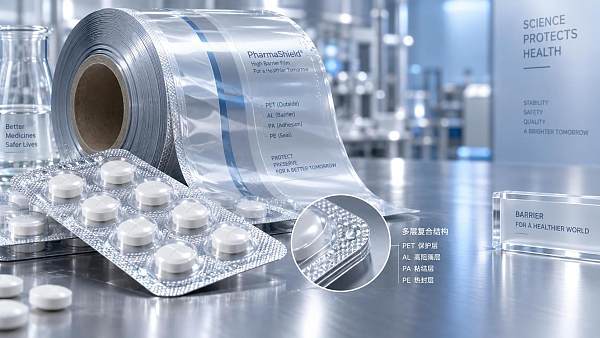
Migration is the movement of constituents from packaging into the pharmaceutical product, or into an intermediate package that can subsequently contact the product. The relevant concern is not limited to the base polymer. Processing aids, antioxidants, slip agents, residual monomers, oligomers, catalysts, pigments, plasticizers, adhesive components, coating ingredients, and substances introduced during printing or laminating can all require assessment where a plausible transfer route exists.
A material declaration that identifies polyethylene, polypropylene, polyester, or another familiar substrate is therefore not enough. Two films described by the same polymer family may behave differently because one contains a higher-slip surface, a sealant layer, a metallized surface, a primer, or a solvent-based adhesive. A multilayer laminate should be evaluated layer by layer, then as a finished construction. The finished construction matters because heat, pressure, curing, corona treatment, lamination, and winding can alter residual levels or bring mobile substances closer to the product-facing surface.
Migration evidence should match the product contact conditions rather than a simplified laboratory assumption. A dry tablet in a blister cavity, an aqueous oral liquid in a sachet, an alcohol-containing formulation, and a lipid-rich semi-solid do not present the same extraction behavior. Temperature exposure also changes the result. A film intended for a short room-temperature distribution cycle may be unsuitable evidence for a product held for an extended period, exposed to elevated temperatures during transport excursions, or sterilized after packing.
Where the protection film does not directly contact the drug, the distance and intervening materials still need to be understood. A printed reverse side separated by a functional barrier is different from print placed directly on the product-contact surface. Yet an assumed barrier should not be accepted merely because a structure includes a foil, metallized layer, or thicker polymer layer. Pinholes, edge exposure, seal-area interruptions, flex cracking, and incomplete coating coverage can weaken the separation that exists on a drawing.
Migration conclusions that are often overextended
A declaration of compliance may be useful supporting evidence, but it does not automatically validate every end use. It may apply only to specified food simulants, time-temperature conditions, or a particular film grade. Likewise, a low overall extractables result does not establish that an individual compound of toxicological concern is absent or controlled. Screening methods, targeted analyses, detection limits, sample preparation, and the identities of substances considered all affect what the report actually proves.
Residual solvents require the same discipline. A report on the laminated web taken immediately after conversion may not represent the material after normal cure and storage, while a report on a fully cured pilot sample may not represent production material if curing conditions drift. Adhesive ratio, coat weight, oven profile, web speed, and retained-solvent control are process variables with direct relevance to the final migration rationale.
Barrier performance must be tied to failure mode
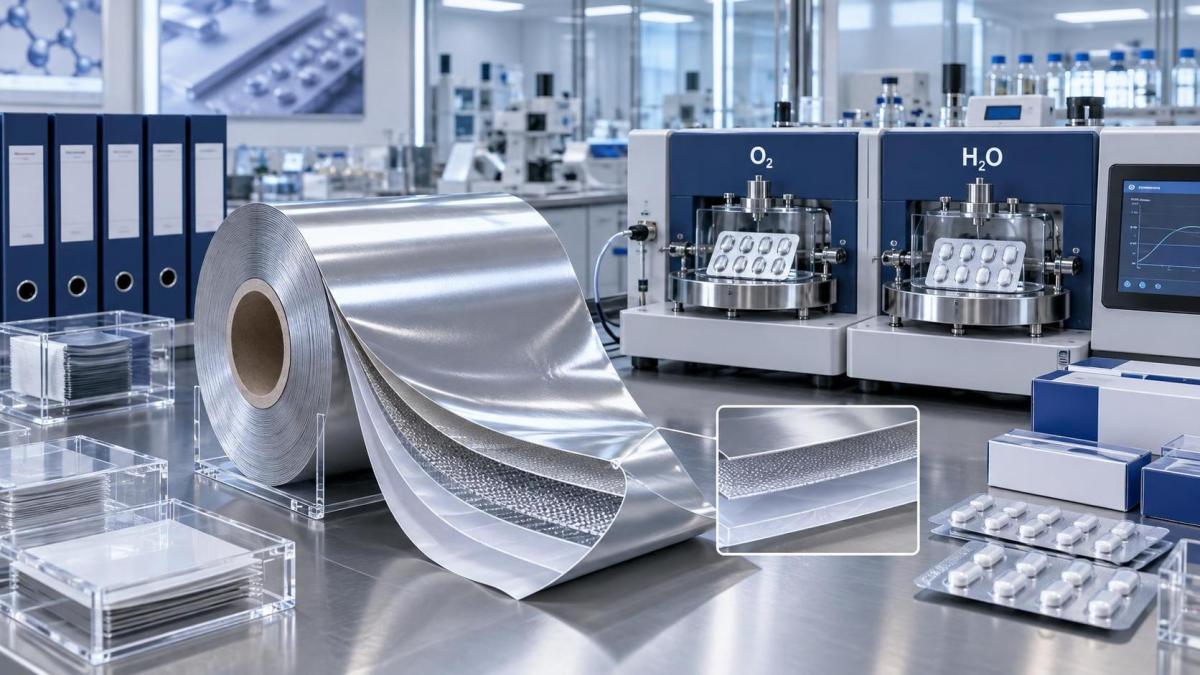
Oxygen transmission rate and water vapor transmission rate are useful measurements, but neither is a universal proxy for package protection. Oxygen-sensitive products can degrade through oxidation even when moisture control is adequate. Hygroscopic products may lose stability through water uptake despite a satisfactory oxygen barrier. Some formulations are vulnerable to both, and headspace conditions, desiccant use, closure integrity, and package geometry then influence the practical protection level as much as the nominal film result.
Barrier values should be read with the stated test temperature, relative humidity, test gas, and film orientation. Many barrier materials change performance markedly when humidity rises. A result generated under dry conditions can overstate protection in a humid distribution environment. Conversely, a high-barrier layer may perform well in the central web but fail to protect a pack when the seal, fold, tear notch, or puncture zone becomes the dominant permeation path.
Thickness is frequently misunderstood. Increasing gauge can reduce permeation through a homogeneous layer, but it does not repair a poorly protected seal interface or a defect-prone coating. With coextruded structures, total thickness alone says little about the thickness and continuity of the barrier layer. A nominally equivalent laminate can have a different barrier response when layer distribution changes, even if the total microns remain unchanged.
Mechanical abuse deserves explicit attention. Films are subjected to tension during unwinding, heat during sealing, compression in cartoning, abrasion during transport, and occasional sharp-edge contact. A high-barrier coating can be vulnerable to repeated flexing; a brittle foil layer can develop microcracks; a sealant can thin near formed corners. These are not cosmetic defects when they create a transport pathway for oxygen, moisture, or contaminants.
Document control is part of material control
Documentation should identify the supplied article precisely enough to link the physical roll or converted part to the evidence set. A generic supplier letter, disconnected from a controlled specification and revision, leaves uncertainty about whether the tested material matches the material received. The file should use a clear item identity, construction description, product-contact side, approved thickness range, coatings or treatments, printing status, and revision identifier.
For a multilayer film, the technical record should preserve the identity and function of each layer where that information affects migration, barrier, sealing, or compatibility. Proprietary formulas do not need to be disclosed in full to establish control, but the evidence needs enough specificity to distinguish a base resin substitution from a harmless administrative change. A change from one adhesive chemistry to another, a different slip additive package, altered ink system, revised metallization process, or new pigment source can invalidate prior assumptions even when the commercial film name stays the same.
A workable documentation set commonly connects the following records:
- A controlled specification defining the finished film or laminate, including dimensions, structure, appearance limits, sealing properties where relevant, barrier requirements, and the approved product-contact orientation.
- Material composition or regulatory statements scoped to the intended application and actual construction, with stated limitations rather than broad, unqualified claims.
- Migration, extractables, residual-solvent, or other chemical assessment reports that identify the tested sample, analytical approach, conditions, and conclusion boundaries.
- Barrier test reports showing conditioning and test conditions, specimen description, result units, and whether the result applies before or after conversion.
- Lot traceability linking received rolls, converted lots, test samples, certificates, and release records. Traceability that stops at a commercial invoice is weak when an investigation is needed.
- A change-notification agreement defining which raw-material, formula, process, site, specification, and test-method changes require prior notice and technical evaluation.
Certificates of analysis can be useful for lot release, but they should not substitute for qualification evidence. A certificate confirms only the parameters listed and only if the test method, sampling scheme, and acceptance limits are understood. If oxygen transmission is critical but the certificate reports only thickness and visual defects, the certificate does not establish barrier conformity. The same issue arises when a certificate reports a general volatile level without identifying whether it represents the relevant residual constituents.
Sampling and release decisions need a defined rationale
Incoming inspection often catches visible damage, roll-width errors, poor winding, or labeling discrepancies, but it rarely proves full chemical compliance. The release approach should distinguish attributes that can be verified on each lot from those supported by periodic qualification, validated process control, and documented change control. Repeating broad chemical testing on every shipment may add delay without improving control if the test does not target the relevant change risk. Conversely, relying indefinitely on an initial qualification report is weak when the supply chain has changed.
Sampling should account for roll position and material form. A specimen from the outer wraps may have different exposure history from material near the core. For printed or coated films, sampling only unprinted areas can miss the very components that require assessment. A finished pouch or lidding component may also behave differently from a flat web because forming and sealing introduce heat and stress.
When a deviation occurs, the first question is whether the nonconformity changes the established protection mechanism. A gauge result outside the approved range is not automatically equivalent to a barrier failure, but it may be significant if it reflects reduced barrier-layer distribution or altered sealant performance. A cosmetic coating streak can be irrelevant in a non-contact outer layer, or it can expose a functional barrier. The disposition record should state the technical path from observed defect to product impact instead of relying on a general statement that the material is acceptable.
Interfaces that commonly create hidden gaps
The film supplier, converter, printer, and packer may each hold only part of the information. The supplier understands resin and additive controls; the converter controls lamination and coating conditions; the printer controls inks and curing; the packing operation sees seal performance and formed-package behavior. Compliance evidence becomes unreliable when these interfaces are treated as independent transactions.
Printing and coding deserve particular scrutiny. Surface print on a non-contact side may still create concern where set-off occurs during winding, where ink components migrate through a thin structure, or where the printed surface is brought against a contact layer in a tightly packed configuration. Thermal transfer or overprint systems should be assessed for the actual placement and any expected abrasion, since damaged coding can affect traceability even if the protection film itself remains intact.
Storage is another interface with practical consequences. Film rolls exposed to excessive heat, humidity, dust, compression, or prolonged storage can show changed winding behavior, blocking, curl, or contamination risk. These effects can lead to sealing variation or particulate issues later in packing. Storage instructions should be reconciled with actual warehouse conditions, including any acclimatization period needed before use.
Building a defensible technical position
A defensible position is a connected argument: the specified film construction is known; its product-contact conditions are defined; chemical transfer has been assessed against those conditions; barrier data addresses the real degradation mechanism; conversion and package-making do not undermine the result; and controlled records show that the received material remains equivalent to the qualified material.
Gaps are easiest to resolve before a film is approved for routine use. Once a material has entered a packaging line, vague construction descriptions, unscoped declarations, and unreported changes become investigation problems. Clear evidence boundaries are more useful than broad claims because they show exactly when a new formulation, contact condition, barrier target, or converting process requires reassessment.
Recommended News
 Oct 21, 2026How vacuum metallization coating affects BOPP barrier performanceDiscover how vacuum metallization coating improves BOPP oxygen and moisture barriers. Learn what drives coating durability and how to select films for reliable packaging performance.
 Oct 20, 2026How to choose barrier lidding films for oxygen-sensitive foodsChoose barrier packaging films for lidding with confidence. Compare oxygen barriers, seal compatibility, and shelf-life validation to protect sensitive foods and reduce packaging risks.
 Oct 19, 2026Choosing BOPP laminated films for moisture-sensitive food packagingCompare food packaging materials: laminated films made with BOPP. Discover how to assess moisture barriers, seal integrity, and compliance to protect food quality and extend shelf life.
 Oct 06, 2026How moisture barrier coating polymers affect package shelf lifeMoisture barrier coating polymers can extend package shelf life. Learn how to evaluate WVTR, adhesion, seal integrity, processing, and recyclability for reliable protection.
 Oct 05, 2026How beverage labels stay secure at high production speedsHigh speed labeling materials for beverages: learn how to secure labels against moisture, abrasion, and fast-line failures while protecting print quality and traceability.
 Oct 03, 2026When does micron-level coating technology improve BOPP barrier film performance?Micron-level coating technology can elevate BOPP barrier film performance for oxygen, aroma, and moisture protection. Explore when coated structures deliver smarter, lightweight packaging results.
 Sep 24, 2026How to compare extreme barrier films in Europe for oxygen protectionExtreme barrier films Europe: compare OTR, coating durability, converting performance, recyclability and PPWR readiness for reliable oxygen protection.
 Sep 20, 2026How barrier packaging for pet food helps prevent fat oxidationBarrier packaging for pet food helps prevent fat oxidation by blocking oxygen, moisture, and light—protecting freshness, flavor, nutrition, and shelf life.
 Sep 16, 2026Pharma Compliance Protection Films: Migration, Barrier, and Documentation ChecksPharma compliance protection films: master migration, barrier performance, and documentation checks to build safer, audit-ready pharmaceutical packaging.
 Sep 16, 2026Selecting Protection Films Compliant with Pharma Regulations and Cleanroom UseCompliant to pharma regulations protection films: learn how to select cleanroom-ready materials with proven traceability, chemical resistance, low particle risk, and reliable validation support.
 Sep 10, 2026How pharmaceutical film technology affects moisture protection in blister packsPharmaceutical film technology for blister packs: learn how barrier films, WVTR, thermoforming, and seal integrity protect moisture-sensitive medicines and support reliable compliance.
 Sep 05, 2026How to choose food-grade flexible packaging films for dry foodsFlexible Packaging Films food grade guide: choose the right barrier, seal strength, compliance, and durability to protect dry foods and extend shelf life.
 Sep 03, 2026How film label materials affect label durability in refrigerated storageFilm label materials play a critical role in refrigerated durability. Learn how films, adhesives, printing, and moisture resistance protect labels in cold storage.
 Aug 24, 2026How to evaluate barrier film suppliers in Europe for food packagingBarrier film Europe sourcing made practical: learn how to assess food packaging suppliers on barrier performance, compliance, machinability, and total cost before you buy.
![]() Aug 14, 2026EU PPWR enforcement: BOPP high barrier film exports need to pay attention to labeling complianceEU PPWR enforcement makes BOPP high barrier film exports to Europe focus on labeling compliance. Learn the key rules on recycling marks, recycled content, and recyclability claims before 2026.
 Aug 13, 2026EU PPWR Takes Effect for BOPP Barrier FilmsEU PPWR takes effect for BOPP barrier films on Aug 12, 2026. Learn the new labeling, recycled content, and life-cycle declaration rules shaping EU import compliance.
 Aug 13, 2026Barrier Packaging for Pet Food: How to Choose the Right Moisture and Oxygen BarrierBarrier packaging for pet food explained: learn how to choose the right moisture and oxygen barrier to protect freshness, shelf life, seals, and sustainability goals.
 Aug 12, 2026EU PPWR Now in Force: BOPP Barrier Films Face Labeling RulesEU PPWR now in force puts BOPP barrier films under stricter labeling rules. Learn how recyclability, composition, and recycled content disclosures affect EU market access.
 Aug 12, 2026How to Evaluate Recyclable Mono Material Packaging for Barrier Performance and ReprocessingRecyclable mono material packaging: learn how to assess barrier performance, seal reliability, and reprocessing suitability to choose packaging that supports recyclability without sacrificing product protection.
 Aug 11, 2026EU PPWR Rules Now Mandate Labels on BOPP Barrier FilmsEU PPWR rules now require labels on BOPP barrier films sold in Europe. Learn the 15% recycled content, material ID, and customs compliance steps exporters must act on now.
 Aug 10, 2026PPWR Rule Takes Effect for BOPP Barrier Film LabelsPPWR Rule takes effect for BOPP barrier film labels in the EU from August 10, 2026. Learn key ARL Code, recyclability, and compliance steps to avoid customs risk and penalties.
 Aug 09, 2026EU PPWR Rule Takes Effect for BOPP Barrier FilmsEU PPWR rule now applies to BOPP barrier films entering the EU. Learn the new labeling, material ratio, and recyclability requirements to avoid customs delays and rising compliance costs.
 Aug 08, 2026PPWR Rule Takes Effect for BOPP Barrier FilmsPPWR rule takes effect for BOPP barrier films in the EU from August 8, 2026. Learn how labeling, material ratio disclosure, customs compliance, and technical file updates may impact exports.
 Aug 07, 2026EU PPWR Rule Takes Effect for BOPP Barrier FilmsEU PPWR rule takes effect for BOPP barrier films, requiring recycling labels, material composition percentages, and recyclability claims. See what exporters must act on now.