Search News
Industry Portal
Hot Articles
- How to verify FDA compliance for packaging inks used on food packagingPackaging inks FDA compliant? Learn how to verify food-contact safety through regulatory citations, migration testing, supplier declarations, and process controls.
- When do holographic foils add value to luxury goods packaging?Packaging materials for luxury goods gain impact with holographic foils that elevate shelf appeal, authenticity, and premium unboxing—learn when this finish delivers real value.
- Can nano encryption technology stop counterfeit labels from being copied?Nano encryption technology anti counterfeit labels combine physical security, tamper evidence, and serialization to make copying harder. Explore smarter protection.
Popular Tags
Oxygen Barrier Film Technology for Longer Shelf Life
Time
Click Count
For technical evaluators comparing packaging materials, oxygen barrier film technology is no longer just a shelf-life enhancer—it is a critical control point for product safety, logistics resilience, and brand value.
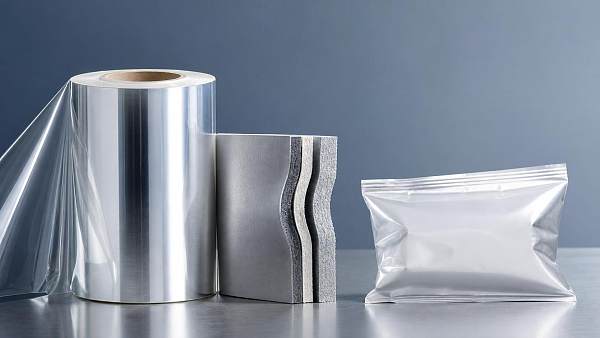
From biaxially oriented PET and BOPP structures to advanced coating chemistries and recyclable mono-material designs, the right barrier solution can slow oxidation, preserve aroma, prevent moisture-driven degradation, and reduce waste across global supply chains.
This article examines how oxygen barrier performance is engineered, measured, and applied in modern packaging systems.
Why Oxygen Barrier Film Technology Needs a Checklist Approach
Oxidation is rarely visible at the start.
It slowly changes flavor, color, strength, fragrance, nutrition, electronics reliability, and pharmaceutical stability before failure becomes obvious.
That is why oxygen barrier film technology must be evaluated through measurable checkpoints, not visual inspection alone.
A checklist prevents one-dimensional material selection.
Low oxygen transmission rate may look attractive, but poor seal integrity, flex cracking, or incompatible recycling streams can destroy total performance.
Modern packaging also faces conflicting requirements.
Films must protect sensitive contents, run efficiently on high-speed lines, reduce gauge, support shelf impact, and answer tighter sustainability rules.
A structured evaluation makes oxygen barrier film technology easier to compare across food, healthcare, electronics, cosmetics, and industrial consumables.
Core Checklist for Evaluating Oxygen Barrier Film Technology
Use the following checklist before approving a barrier film structure, coating route, or supplier qualification plan.
- Define the product’s oxygen sensitivity by tracking flavor loss, discoloration, microbial risk, active ingredient degradation, or corrosion across real storage conditions.
- Set the required oxygen transmission rate using shelf-life modeling, pack volume, headspace oxygen, product respiration, and expected distribution temperature.
- Compare substrate choices such as BOPP, PET, PE, PA, EVOH, and coated mono-material films against stiffness, clarity, puncture, and sealing needs.
- Verify barrier coatings under humidity, because some oxygen barrier film technology performs well when dry but weakens after moisture exposure.
- Test sealing windows on actual equipment, including jaw temperature, dwell time, pressure, contamination tolerance, and seal strength after cooling.
- Check flex-crack resistance by simulating pouch handling, pallet vibration, e-commerce compression, cold-chain bending, and repeated consumer opening.
- Measure aroma and solvent retention, especially for coffee, spices, cosmetics, tobacco alternatives, nutraceuticals, and fragrance-rich formulations.
- Confirm print and lamination compatibility, including ink adhesion, coating anchorage, optical density, slip control, and thermal transfer label readability.
- Assess recyclability claims through local infrastructure, mono-material percentage, adhesive chemistry, metallization level, and certification requirements.
- Calculate total landed cost by including film gauge, scrap rate, machine speed, shelf-life waste reduction, compliance exposure, and logistics damage.
This checklist turns oxygen barrier film technology into a decision system.
It links laboratory data with packaging-line reality and final shelf performance.
Performance Metrics That Should Not Be Skipped
Oxygen Transmission Rate
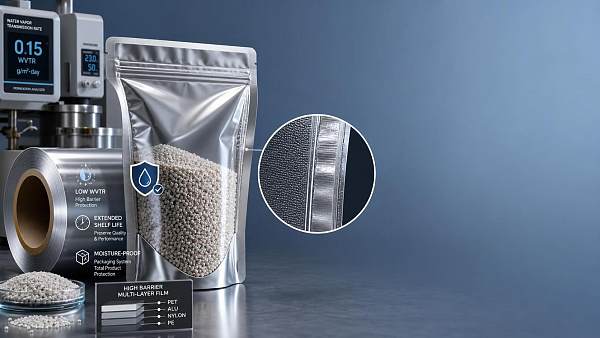
OTR is the headline metric for oxygen barrier film technology.
It shows how much oxygen passes through a defined film area under controlled temperature and humidity.
However, OTR must match real use conditions.
A dry test at room temperature may not predict performance in tropical logistics or refrigerated condensation.
Water Vapor Transmission Rate
WVTR matters because moisture can accelerate oxidation and weaken some barrier layers.
Snacks, powders, tablets, and electronic parts often need oxygen and moisture control together.
For this reason, oxygen barrier film technology should be studied with moisture barrier performance, not in isolation.
Seal Integrity and Package Leakage
A high-barrier web cannot compensate for weak seals.
Micro-leaks allow oxygen ingress faster than diffusion through the film surface.
Burst testing, dye penetration, vacuum decay, and peel strength checks should be part of qualification.
Material Routes Used in Oxygen Barrier Film Technology
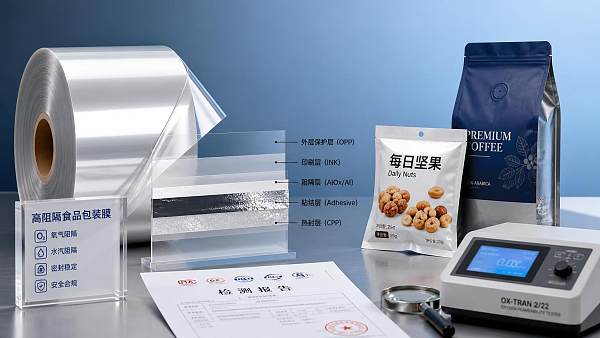
BOPP and PET Barrier Structures
Biaxially oriented films create strength through molecular alignment.
BOPP supports clarity, stiffness, machinability, and cost efficiency in many food and label constructions.
PET offers dimensional stability, heat resistance, print quality, and strong support for coating or metallization.
Both materials can become high-performance platforms when paired with the right oxygen barrier film technology.
EVOH, PA, and Coextruded Films
EVOH is widely used for strong oxygen resistance.
Its weakness is humidity sensitivity, so surrounding layers must protect it during storage and use.
PA improves puncture resistance and thermoforming performance.
Coextrusion can combine sealing, toughness, barrier, and abuse resistance in one film architecture.
Coated and Metallized Films
Coatings can deliver strong barriers with extremely thin functional layers.
Common approaches include acrylic coatings, PVDC alternatives, AlOx, SiOx, and vacuum metallized surfaces.
These options can enhance oxygen barrier film technology while preserving transparency, metallic shelf impact, or lightweight design.
Application Scenarios and Practical Selection Notes
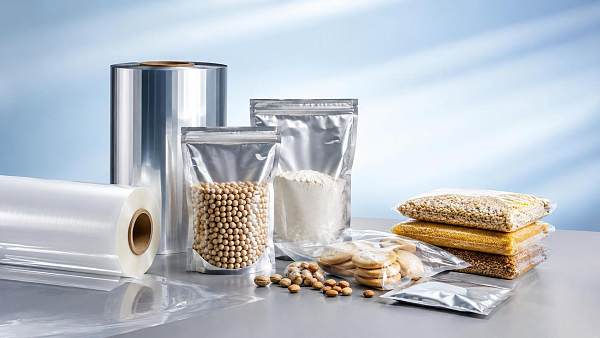
Dry Snacks and Crispy Foods
Chips, crackers, nuts, and baked snacks need oxygen control to slow rancidity.
They also need moisture resistance to protect texture.
Metallized BOPP and coated structures are common because they combine barrier performance, stiffness, and strong visual impact.
For these packs, oxygen barrier film technology should be reviewed with nitrogen flushing efficiency and seal contamination behavior.
Coffee, Tea, and Aroma-Sensitive Goods
Coffee packaging must retain aroma while managing oxygen and carbon dioxide.
Valve compatibility, laminate stiffness, and residual solvent control become important.
Transparent barrier films may support premium visibility, while metallized films improve light and oxygen protection.
The final choice depends on brand positioning and verified shelf-life testing.
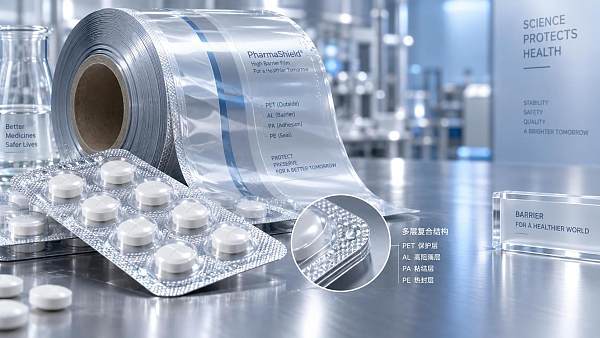
Pharmaceuticals and Nutraceuticals
Tablets, powders, capsules, and diagnostic consumables demand conservative barrier design.
Oxygen, moisture, light, and extractables must be controlled together.
Qualification should include stability studies, regulatory documentation, and change-control discipline.
In this field, oxygen barrier film technology must support evidence, not assumptions.
Electronics and Industrial Components
Electronic components can suffer corrosion, moisture damage, and electrostatic risks during storage.
Barrier films may need desiccant compatibility, puncture strength, and clean sealing performance.
When oxygen barrier film technology is used in industrial packs, mechanical abuse testing is as important as permeation data.
Common Overlooked Risks in Barrier Film Projects
- Ignoring humidity: Recheck oxygen barrier film technology at the humidity level expected during warehousing, ocean freight, retail display, and household storage.
- Assuming lab OTR equals package OTR: Validate the finished pouch, tray, sachet, or lidding system after forming, filling, sealing, and distribution simulation.
- Forgetting flex damage: Run compression, vibration, bending, and drop tests to detect barrier cracks that appear after transportation stress.
- Overlooking ink and adhesive effects: Confirm that lamination adhesives, inks, primers, and coatings do not reduce adhesion or create migration concerns.
- Making vague sustainability claims: Match recyclable barrier films with real collection, sorting, washing, and reprocessing capabilities in target markets.
These risks often explain why a promising laboratory film fails after commercialization.
They also show why oxygen barrier film technology needs cross-functional verification.
Execution Advice for Selecting and Validating Barrier Films
Start with the product failure mode.
Define what oxygen will damage, how quickly it happens, and which temperature or humidity level accelerates it.
Then translate that risk into measurable specifications.
- Build a target specification covering OTR, WVTR, seal strength, puncture resistance, coefficient of friction, optical properties, and regulatory limits.
- Request film samples from at least two material routes, such as coated PET, metallized BOPP, EVOH coextrusion, or recyclable PE-based structures.
- Run pilot packaging trials at normal and stressed machine settings to observe wrinkles, curl, static, seal contamination, and cutting behavior.
- Test finished packages after accelerated aging, cold-chain exposure, humidity cycling, pallet vibration, and retail display simulation.
- Compare total value, not only film price, by quantifying scrap, complaints, returns, food waste, plastic tax exposure, and shelf-life gain.
For data discipline, keep a single comparison matrix.
Include supplier certificates, test methods, film gauge, coating type, storage condition, and package format.
This record prevents confusion when oxygen barrier film technology options appear similar on technical datasheets.
Sustainability and Recyclability Considerations
Barrier packaging is moving toward thinner structures and cleaner recycling streams.
Mono-material PE or PP designs are gaining attention because they simplify sorting and reprocessing.
Yet recyclability must not remove essential product protection.
If weaker packaging causes spoilage, the environmental cost may increase.
The best oxygen barrier film technology balances downgauging, recyclability, pack reliability, and real shelf-life extension.
Compliance also matters.
Packaging rules increasingly examine material composition, recycled content, labeling accuracy, and extended producer responsibility fees.
Barrier film decisions should therefore include regulatory intelligence from the beginning.
Summary and Action Guide
Oxygen barrier film technology protects more than freshness.
It supports safety, appearance, logistics reliability, sustainability goals, and commercial shelf performance.
The right choice depends on product sensitivity, package format, converting route, storage environment, and end-market compliance.
Use a checklist before approving any structure.
Confirm OTR, WVTR, sealing, flex resistance, print compatibility, recyclability, and total cost under realistic conditions.
Next, shortlist two or three oxygen barrier film technology options and test finished packages, not only flat film samples.
A disciplined validation process reduces oxidation failures, avoids over-engineering, and creates packaging that survives both the shelf and the supply chain.
Recommended News
 Sep 10, 2026How pharmaceutical film technology affects moisture protection in blister packsPharmaceutical film technology for blister packs: learn how barrier films, WVTR, thermoforming, and seal integrity protect moisture-sensitive medicines and support reliable compliance.
 Sep 05, 2026How to choose food-grade flexible packaging films for dry foodsFlexible Packaging Films food grade guide: choose the right barrier, seal strength, compliance, and durability to protect dry foods and extend shelf life.
 Sep 03, 2026How film label materials affect label durability in refrigerated storageFilm label materials play a critical role in refrigerated durability. Learn how films, adhesives, printing, and moisture resistance protect labels in cold storage.
 Aug 24, 2026How to evaluate barrier film suppliers in Europe for food packagingBarrier film Europe sourcing made practical: learn how to assess food packaging suppliers on barrier performance, compliance, machinability, and total cost before you buy.
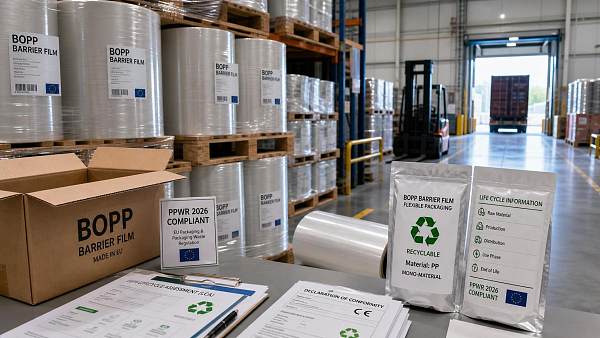
![]() Aug 14, 2026EU PPWR enforcement: BOPP high barrier film exports need to pay attention to labeling complianceEU PPWR enforcement makes BOPP high barrier film exports to Europe focus on labeling compliance. Learn the key rules on recycling marks, recycled content, and recyclability claims before 2026.
Aug 14, 2026EU PPWR enforcement: BOPP high barrier film exports need to pay attention to labeling complianceEU PPWR enforcement makes BOPP high barrier film exports to Europe focus on labeling compliance. Learn the key rules on recycling marks, recycled content, and recyclability claims before 2026. Aug 13, 2026EU PPWR Takes Effect for BOPP Barrier FilmsEU PPWR takes effect for BOPP barrier films on Aug 12, 2026. Learn the new labeling, recycled content, and life-cycle declaration rules shaping EU import compliance.
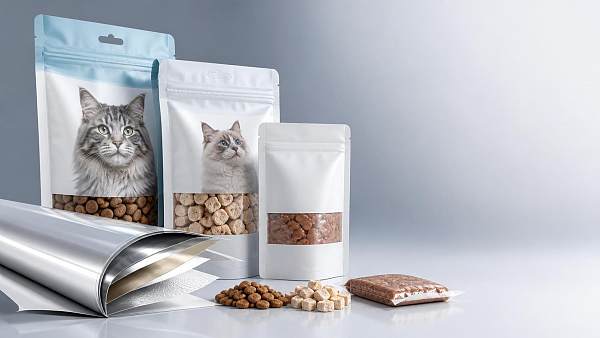
 Aug 13, 2026Barrier Packaging for Pet Food: How to Choose the Right Moisture and Oxygen BarrierBarrier packaging for pet food explained: learn how to choose the right moisture and oxygen barrier to protect freshness, shelf life, seals, and sustainability goals.
 Aug 12, 2026EU PPWR Now in Force: BOPP Barrier Films Face Labeling RulesEU PPWR now in force puts BOPP barrier films under stricter labeling rules. Learn how recyclability, composition, and recycled content disclosures affect EU market access.
 Aug 12, 2026How to Evaluate Recyclable Mono Material Packaging for Barrier Performance and ReprocessingRecyclable mono material packaging: learn how to assess barrier performance, seal reliability, and reprocessing suitability to choose packaging that supports recyclability without sacrificing product protection.
 Aug 11, 2026EU PPWR Rules Now Mandate Labels on BOPP Barrier FilmsEU PPWR rules now require labels on BOPP barrier films sold in Europe. Learn the 15% recycled content, material ID, and customs compliance steps exporters must act on now.
 Aug 10, 2026PPWR Rule Takes Effect for BOPP Barrier Film LabelsPPWR Rule takes effect for BOPP barrier film labels in the EU from August 10, 2026. Learn key ARL Code, recyclability, and compliance steps to avoid customs risk and penalties.
 Aug 09, 2026EU PPWR Rule Takes Effect for BOPP Barrier FilmsEU PPWR rule now applies to BOPP barrier films entering the EU. Learn the new labeling, material ratio, and recyclability requirements to avoid customs delays and rising compliance costs.
 Aug 08, 2026PPWR Rule Takes Effect for BOPP Barrier FilmsPPWR rule takes effect for BOPP barrier films in the EU from August 8, 2026. Learn how labeling, material ratio disclosure, customs compliance, and technical file updates may impact exports.
 Aug 07, 2026EU PPWR Rule Takes Effect for BOPP Barrier FilmsEU PPWR rule takes effect for BOPP barrier films, requiring recycling labels, material composition percentages, and recyclability claims. See what exporters must act on now.
 Aug 07, 2026How to Choose a Low WVTR Barrier Film for Moisture-Sensitive PackagingLow WVTR barrier film selection starts with product moisture sensitivity, seal performance, and converting reality. Learn how to compare structures, reduce risk, and choose packaging that protects shelf life.
 Aug 06, 2026EU PPWR Rule Takes Effect for BOPP Barrier Film LabelsEU PPWR rule now reshapes BOPP barrier film labels in the EU. Learn mandatory labeling, recyclability claims, customs risks, and how exporters can stay compliant.
 Aug 05, 2026EU PPWR Rule Takes Effect for BOPP Barrier FilmsEU PPWR rule now reshapes BOPP barrier films in the EU market. Learn mandatory labeling, recyclability, traceability, and customs compliance risks before exports are delayed.
 Aug 04, 2026EU PPWR Rules Now Apply to BOPP Barrier Film LabelsEU PPWR rules now apply to BOPP barrier film labels. Learn the new EU labeling, recyclability, and material disclosure requirements to avoid customs delays, fines, and compliance risks.
 Aug 03, 2026EU PPWR Rules Take Effect for BOPP Barrier Film LabelsEU PPWR rules now require BOPP barrier film labels to show recycling marks, material ratios, and recyclability claims. Learn how to avoid customs delays, fines, and supply chain disruption.
 Aug 02, 2026EU PPWR Rule Takes Effect for BOPP Barrier FilmsEU PPWR rule for BOPP barrier films takes effect from August 1, 2026. Learn key labeling, recyclability, customs, and supplier compliance steps to avoid fines and shipment delays.
 Aug 01, 2026EU PPWR Rule Takes Effect for BOPP Barrier FilmsEU PPWR rule for BOPP barrier films is now a critical compliance issue. Learn how material disclosure, recycling marks, and supplier documents affect EU customs, procurement, and delivery.
 Jul 31, 2026How to Choose Moisture Barrier Packaging Film by WVTR and Shelf-Life NeedsMoisture barrier packaging film selection should start with WVTR, shelf-life targets, and real package performance. Learn how to avoid overdesign, reduce risk, and choose the right barrier film.
 Jul 29, 2026EU PPWR Rule Takes Effect for BOPP Barrier Film ExportsEU PPWR rule takes effect for BOPP barrier film exports, reshaping labeling, recyclability marking, conformity files, and supplier certification. Learn the key compliance risks and trade impacts now.
 Jul 27, 2026EU PPWR Rule Takes Effect for BOPP Barrier Film ExportsEU PPWR Rule Takes Effect for BOPP Barrier Film Exports: learn how ISO 13431 recyclability labels and EN 13432 declarations now impact EU customs, buyer approval, and export compliance.