Search News
Industry Portal
Hot Articles
- Maine DEP Updates Packaging EPR Timeline, Plans to Revise Stewardship RFPMaine packaging EPR timeline updates and a revised stewardship RFP could affect business planning. Discover what companies should watch next.
- How run size affects the cost of holographic packaging for spiritsSee how holographic packaging for spirits costs change with run size. Compare setup fees, volume savings and inventory risks to choose the right quantity for your brand.
- How to choose printable clear PET film for your inkjet printerNeed clear PET film printable on your inkjet printer? Compare coatings, ink compatibility, clarity, and feeding to avoid costly misprints and choose confidently.
Popular Tags
What Should You Check Before Switching Packaging Suppliers?
Time
Click Count
A packaging supplier change rarely begins as a technical project. It often starts with a frustrating late shipment, a cost increase that no longer makes sense, a recurring print defect, or a sustainability claim that cannot be verified. Yet changing suppliers for films, labels, cushioning, thermal transfer ribbons, or decorative foils is not a simple purchasing decision. The material may touch food, protect a fragile device, carry a barcode through a wet supply chain, or create the first visual impression of a premium product.
What should you check before switching packaging suppliers? Beyond unit price, assess material performance, regulatory compliance, quality consistency, lead times, traceability, and sustainability credentials. For critical packaging consumables, a supplier change can affect product protection, shelf appeal, line efficiency, and operational continuity. The safest transition is not the one with the cheapest sample; it is the one that has been tested against the real conditions your packaging must survive.
Begin with the reason for switching—and define what must not change
Before comparing new quotations, write down why the current supplier is being replaced. The reason matters because it determines the checks that deserve the most attention. If the problem is frequent roll splices in a BOPP film, the relevant review is very different from a change driven by the need for recyclable cushioning or stronger anti-counterfeit protection.
Separate requirements into three groups:
- Non-negotiables: product safety, regulatory status, critical dimensions, adhesion, barrier performance, print readability, approved colors, or machine compatibility.
- Performance improvements: lower gauge, faster application speed, improved scuff resistance, better shelf appearance, or reduced packaging weight.
- Commercial targets: total delivered cost, payment terms, minimum order quantities, inventory flexibility, and lead-time stability.
This exercise protects teams from a common mistake: solving a purchasing problem while introducing an operations problem. A label that costs less per thousand may create more rejects on a high-speed applicator. A lighter stretch film may reduce material consumption but fail to hold loads securely if its puncture resistance and pre-stretch behavior are not validated. The question is not whether a new supplier can make “the same thing.” It is whether the new material can deliver the same functional outcome in your actual system.
Request specifications, not just samples
Samples are useful, but they can be misleading. A small hand-applied sample may look excellent while production rolls behave differently under tension, heat, humidity, or automated dispensing. Ask potential suppliers for a controlled specification package before moving to trial quantities.
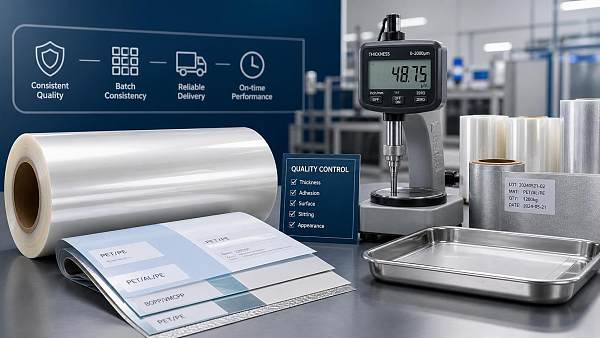
For flexible films, review thickness tolerance, tensile strength, elongation, haze, coefficient of friction, seal strength, oxygen or moisture barrier where relevant, and corona treatment level for printable grades. A BOPP or PET film may appear interchangeable on paper, but differences in orientation, surface treatment, slip additives, or metallization can change print adhesion and converting performance.
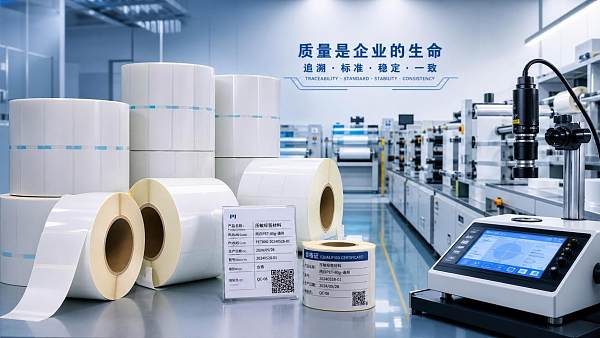
For pressure-sensitive labels, the adhesive system deserves close attention. Check initial tack, peel adhesion, shear or holding power, release liner construction, service temperature, application temperature, and resistance to moisture, oils, chemicals, or freezer conditions. A cold-chain label designed for room-temperature application is not automatically suitable for labeling chilled containers. Likewise, a tamper-evident label should be assessed for the exact evidence it leaves behind—such as a visible “VOID” pattern, substrate destruction, or irreversible film deformation.
Thermal transfer ribbons require a similarly practical review. Confirm whether the ribbon chemistry—wax, wax-resin, or resin—is suited to the label face stock and the intended environment. Barcode scans should remain reliable after abrasion, handling, condensation, sunlight exposure, and any cleaning process the package will encounter. A ribbon that produces dark, attractive print at the beginning of a test may still smear or fade when handling conditions become demanding.
Decorative foils and hot-stamping materials should be reviewed beyond color swatches. Adhesion to the substrate, release behavior, registration tolerance, abrasion resistance, and consistency of holographic or metallized effects all influence the finished pack. On a cosmetics carton or liquor box, a slight variation in metallic tone can be visible long before a technical defect is noticed.
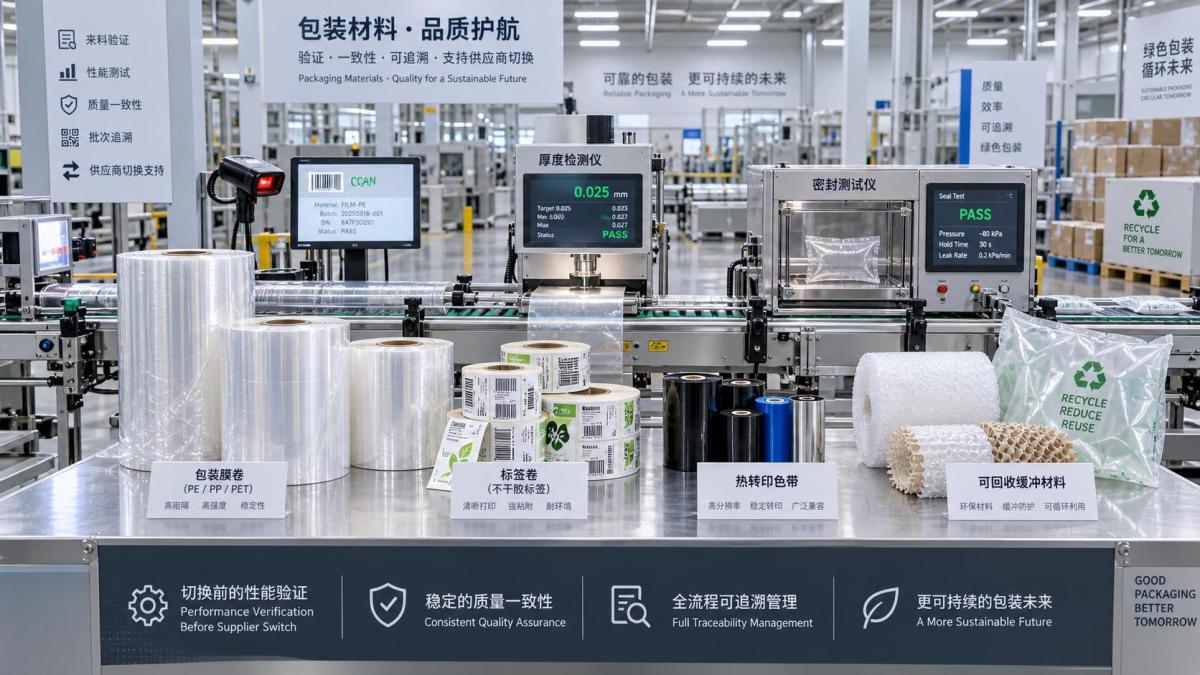
Test the material where it actually works
A supplier qualification plan should include laboratory review, pilot production, and finished-pack evaluation. Skipping the middle stage is where many avoidable surprises occur. Packaging is a system: the material, adhesive, ink, machine settings, warehouse conditions, transport route, and end use all interact.
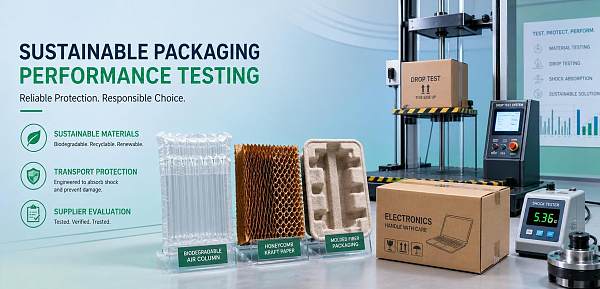
Build trials around credible failure conditions rather than ideal conditions. Run film on the same converting or packing equipment at normal speed. Apply labels to the real container surface, including curved, textured, recycled-content, cold, or damp surfaces. Print actual variable data and scan it with the devices used in your warehouse or distribution network. For cushioning, conduct packing and drop tests using the product’s real weight and geometry instead of an empty carton.
For biodegradable air pillows, paper honeycomb structures, or other alternatives to EPS foam, test both protection and process fit. A sustainable material that requires excessive labor to form, occupies too much warehouse volume, or loses compression strength in humid conditions may not be the right substitute without a packaging redesign. Sustainability and protection should be evaluated together, not treated as competing checkboxes.
Document trial conditions carefully: machine speed, temperature, pressure, dwell time, printhead settings, substrate batch, operator observations, reject rates, and post-test inspection results. This record creates a baseline for future troubleshooting and avoids arguments based on memory after a transition has begun.
Look past certificates to regulatory and traceability evidence
Compliance is not a generic statement. It depends on where the pack will be sold, what it contains, and how the material is used. Food-contact packaging, pharmaceutical labels, electronics packaging, children’s products, and cross-border shipments can each trigger different documentation needs.
Ask which regulations and customer standards the supplier’s material is intended to support, then request current declarations and supporting test information where appropriate. For packaging entering European markets, requirements connected to packaging waste, recyclability, recycled-content expectations, and national producer-responsibility rules may affect material selection. The evolving EU Packaging and Packaging Waste Regulation has made it especially important to avoid relying on vague claims such as “eco-friendly” or “fully recyclable” without defining the packaging structure and available collection pathway.
For anti-counterfeit labels, traceability should be assessed as a security process, not merely a graphic feature. Can security components be serialized? How are artwork files controlled? Who can authorize design changes? Are production batches traceable to raw materials and manufacturing dates? When labels protect pharmaceuticals, luxury goods, or regulated products, a supplier’s control of artwork, dies, holographic masters, and disposal of production waste can matter as much as the label’s visible effect.
Also verify change-control discipline. Suppliers should be able to explain how they notify customers before altering resin sources, adhesive formulations, liner grades, coating weights, manufacturing sites, or critical process settings. Unannounced substitutions are a serious risk when materials have been qualified for specific performance or compliance needs.
Assess consistency, not just capability
Many suppliers can produce an acceptable first batch. The harder question is whether they can repeat it month after month, across sites, seasons, and different raw-material lots. Consistency determines whether your production team trusts the material enough to run it without excessive inspection or frequent machine adjustments.
During supplier evaluation, ask about quality-control checkpoints, batch coding, retained samples, complaint handling, and root-cause analysis. It is reasonable to request data on the specifications most likely to affect your process, such as film gauge variation, label die-cut registration, adhesive coat weight, ribbon winding quality, or foil color consistency. The goal is not to overwhelm a supplier with paperwork; it is to see whether their controls match the risk of the application.
Pay particular attention to roll construction and packaging. Telescoping rolls, uneven winding tension, damaged edges, liner breaks, poorly protected cartons, or inconsistent core dimensions can stop an otherwise well-designed production line. For global shipments, confirm moisture protection, pallet configuration, stacking limits, container-loading practice, and the supplier’s procedure for handling transit damage.
Calculate the real cost of the switch
Unit price is only one line in the economics of packaging procurement. A more useful comparison considers material yield, waste, labor, freight, inventory exposure, machine downtime, quality holds, and claims risk. Thin-gauge stretch film, for example, may lower cost per wrapped pallet if it maintains load containment with less material. But that value must be demonstrated through wrapping trials, not assumed from gauge alone.
Ask suppliers to quote on comparable commercial terms and normalize the calculation. Are prices based on the same roll length, coating weight, usable width, core size, conversion yield, or delivered location? Does the proposed minimum order quantity force more inventory than your operation can comfortably hold? Are tooling, cylinders, printing plates, security features, or artwork revisions charged separately?
For imported materials, include currency exposure, customs procedures, port delays, and inland transport in the risk assessment. A low ex-works price can become expensive when a shipment delay leaves a labeling line idle. In some categories, a dual-source strategy—with approved specifications and a controlled split of volume—may be more resilient than shifting all business immediately to a single new supplier.
Review supply reliability like an operations partner would
Packaging consumables are often treated as ordinary commodities until a shortage halts production. Before switching, understand where the supplier manufactures, how much capacity is available, which raw materials are critical, and whether alternate production sites exist. Ask about standard lead times, rush-order procedures, forecast requirements, and typical shipment performance. A supplier should be able to distinguish between a promised lead time and the lead time they can reliably sustain during demand peaks.
Communication is part of supply reliability. Evaluate how quickly technical and commercial questions are answered during qualification. If artwork approval, specification clarification, or a complaint already takes weeks before the first order, the same friction will likely appear during an urgent production issue.
It is also worth discussing contingency planning directly. What happens if a coating line is down, a resin source is disrupted, or a port closure affects delivery? Suppliers do not need to promise that disruptions will never occur. What matters is whether they have a transparent escalation process, practical alternatives, and a willingness to share information early enough for you to act.
Make sustainability claims specific and usable
Sustainability is now a core supplier-selection issue, but it should be evaluated with the same discipline as barrier or adhesion. Ask what makes the material recyclable, compostable, biodegradable, renewable-content based, or lightweighted—and under what conditions those statements are valid.
Mono-material structures can improve recycling compatibility, yet a package still needs adequate sealing, protection, and graphics performance. Compostable cushioning may be suitable for a particular disposal system but not for every market or climate. Water-based adhesive or ink systems may reduce certain impacts, but they still require process compatibility and performance verification. Good suppliers explain the trade-offs plainly instead of relying on broad green language.
Request documentation that supports your own reporting and customer communication. That may include material composition, recycled-content declarations, disposal guidance, restricted-substance information, and evidence behind any environmental claim. Align these records with the language your brand intends to use on pack; a claim that cannot be substantiated can create both compliance and reputation problems.
Approve the transition in stages, with a fallback plan
A controlled switch is usually safer than a dramatic cutover. Start with technical samples, then pilot lots, then limited production volume before approving full-scale supply. Define acceptance criteria in advance: visual quality, line efficiency, reject rate, barcode grade, seal integrity, transport performance, and any application-specific measurement. Include representatives from procurement, quality, production, packaging engineering, logistics, regulatory, and brand teams when the material affects their work.
Keep a realistic buffer of incumbent material until the new supplier has completed the agreed qualification period. Maintain approved artwork, specifications, and revision records in one accessible location. If the product is highly regulated or the package is central to brand identity, formal change control may require customer notification or additional validation before commercial release.
The strongest supplier switch creates more than a lower purchase price. It gives your business clearer specifications, better traceability, a more resilient supply position, and packaging that protects both the product and the brand. Whether the material is a high-barrier polymer film, a security label, biodegradable cushioning, a durable thermal ribbon, or a visually striking stamping foil, the right decision comes from treating packaging as a performance-critical system—not a line item to replace in isolation.
Recommended News
 Oct 15, 2026How to verify a food-grade packaging film manufacturer’s complianceVerify your food grade packaging films manufacturer with a practical guide to compliance documents, migration tests, and batch traceability. Reduce sourcing risks before approval.
 Oct 11, 2026What uptime guarantees should a high speed labeling supplier provide?High speed labeling supplier uptime guarantees: compare availability, response times, critical spares, consumable compatibility, and production-based acceptance criteria.
 Oct 09, 2026What drives air column packaging bulk prices for high-volume orders?Air column packaging bulk price guide: compare film, design, volume, freight, and total protection costs to secure smarter high-volume packaging deals.
 Oct 02, 2026How to evaluate a packaging supplier’s quality control before orderingPackaging supplier quality evaluation: learn how to verify process control, traceability, testing, and corrective actions before placing your order.
 Sep 21, 2026How to make sustainable packaging material selection without overpayingSustainable packaging material selection: reduce total costs with performance-led specs, practical trials, and recovery-ready designs that protect products.
 Sep 19, 2026What Should You Check Before Switching Packaging Suppliers?What should I check before switching packaging suppliers? Explore key checks for quality, compliance, cost, supply reliability, and sustainable packaging decisions.
 Sep 19, 2026How Can You Compare Packaging Suppliers Across Countries?How can I compare packaging material suppliers across countries? Use a practical framework for quality, landed cost, compliance, supply resilience, and technical support.
 Sep 17, 2026Resource-Efficiency Metrics That Help Compare Renewable Packaging CompaniesRenewable packaging companies compared: use resource efficiency metrics for material, energy, water, waste, lifecycle emissions, and verified performance.
 Sep 09, 2026How to assess a water based adhesive materials factory’s quality controlWater based adhesive materials factory quality control: learn how to audit traceability, batch consistency, testing, and change control for safer sourcing.
 Sep 08, 2026How to qualify an electronic protective materials supplier for ESD controlLearn how to qualify an electronic protective materials supplier for reliable ESD control with test data, traceability, lot consistency, and packaging checks.
 Aug 18, 2026What to check before choosing a cryogenic labels supplierCryogenic labels supplier selection starts with performance, not price. Learn what to check for adhesion, print durability, compliance, and supply reliability before you buy.
 Aug 16, 2026How to measure packaging sustainability metrics that actually matterPackaging sustainability metrics that actually matter: learn how to compare carbon, recyclability, performance, and operational yield to make smarter packaging decisions.
 Aug 11, 2026How Low Migration Label Adhesive Technology Supports Food Packaging ComplianceLabel adhesive technology low migration explained: learn how to reduce migration risk, improve food packaging compliance, and choose label constructions that balance safety, performance, and approvals.
 Aug 10, 2026How to Choose Transfer Foils for Labels Based on Print Method and DurabilityTransfer foils for labels: learn how to choose the right option by print method, substrate, and durability needs to improve label performance, reduce rework, and achieve a premium finish.
 Aug 08, 2026How to Evaluate a Coating Materials Supplier for Consistent Quality and Lead TimesCoating materials supplier selection starts with the right questions. Learn how to compare quality consistency, process control, and lead-time reliability to reduce sourcing risk.
 Aug 03, 2026How High-Speed Labeling Technology Affects Accuracy and Throughput in PharmaceuticalsHigh-speed labeling technology pharmaceuticals depend on shapes accuracy, throughput, and compliance. Learn how materials, printing, and inspection drive reliable pharmaceutical packaging performance.
 Aug 02, 2026How to Choose Packaging for PCB Components Based on ESD and Moisture RiskPackaging for PCB components starts with risk, not bag type. Learn how to balance ESD, moisture, handling, and assembly needs to protect yield and choose smarter packaging.
 Jul 30, 2026How to Evaluate Throughput, Accuracy, and Downtime in High Speed Labeling SystemsHigh speed labeling systems should be judged by real throughput, labeling accuracy, and downtime recovery—not brochure speed. Learn how to compare machines for stable output and fewer stoppages.
 Jul 29, 2026How to Choose Food Grade Eco Friendly Packaging Materials for Moisture and Grease ResistanceEco friendly packaging materials food grade: learn how to choose options that balance moisture and grease resistance, food-contact compliance, and sustainability for safer, smarter packaging.
 Jul 27, 2026How to Evaluate a Thermal Labels Supplier for Cost, Quality, and Lead TimeThermal labels supplier evaluation guide: learn how to compare cost, print quality, adhesive performance, compliance, and lead time to reduce risk and choose a reliable partner.
 Jul 23, 2026How to Evaluate Industrial Label Systems for Durability and Total CostIndustrial label systems: learn how to compare durability, compliance, barcode performance, and total cost to reduce failures, control sourcing risk, and choose smarter long-term solutions.
 Jul 15, 2026Pressure Sensitive Label Materials Factory Audit Checklist for Stable QualityPressure sensitive label materials factory audit checklist for buyers: verify coating control, traceability, compliance, and lot consistency to reduce label failure risk.
 Jul 13, 2026How to Evaluate a Sustainable Cushioning Materials Supplier in 2026Sustainable cushioning materials supplier selection in 2026 starts with protection, proof, and scale. Learn how to compare claims, compliance, and total cost with confidence.
 Jul 12, 2026Metallic Cosmetic Packaging Materials: What Affects Finish, Durability, and Brand FitMetallic cosmetic packaging materials shape finish, durability, and brand appeal. Learn what affects gloss, scuff resistance, compliance, and cost before choosing the right premium pack.