Search News
Industry Portal
Hot Articles
- Maine DEP Updates Packaging EPR Timeline, Plans to Revise Stewardship RFPMaine packaging EPR timeline updates and a revised stewardship RFP could affect business planning. Discover what companies should watch next.
- How run size affects the cost of holographic packaging for spiritsSee how holographic packaging for spirits costs change with run size. Compare setup fees, volume savings and inventory risks to choose the right quantity for your brand.
- How to choose printable clear PET film for your inkjet printerNeed clear PET film printable on your inkjet printer? Compare coatings, ink compatibility, clarity, and feeding to avoid costly misprints and choose confidently.
Popular Tags
How to make sustainable packaging material selection without overpaying
Time
Click Count
For procurement teams, sustainable packaging material selection pays off only when the environmental claim survives contact with the product, packing line, transport route, recovery system, and cost sheet. A lower-impact material that causes seal failures, damaged shipments, unreadable labels, or higher packing consumption is not a cost-saving choice. The practical objective is to specify the least material and simplest construction that still delivers the required protection, compliance, presentation, and operational reliability.
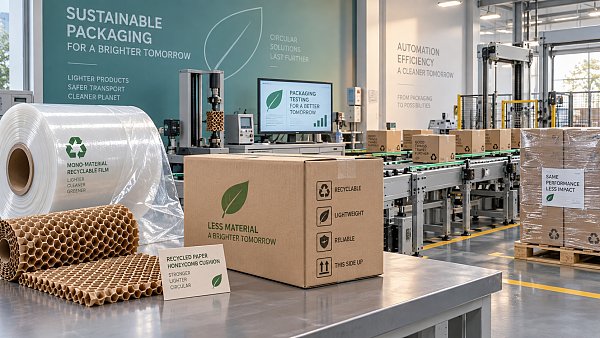
That approach often produces a different answer from a supplier catalogue. A recyclable mono-material film may be the right choice for one flexible pack, while a lightweight high-barrier structure remains necessary for a moisture-sensitive product. Paper cushioning can replace plastic void fill in a stable parcel format, but may add volume or fail to protect a dense, fragile item unless the pack design changes with it. Procurement should therefore compare packaging systems, not material labels in isolation.
Start with the failure the packaging must prevent
Before requesting sustainable alternatives, define the non-negotiable job of the existing pack. The relevant question is not whether a material is “green,” but what failure becomes expensive if the material is changed.
- For food, snacks, and hygroscopic goods, this may be moisture or oxygen ingress that shortens usable shelf life.
- For electronics, medical products, and precision components, it may be puncture resistance, static control, corrosion protection, or shock absorption.
- For e-commerce shipments, it may be damage during repeated handling, dimensional-weight exposure, or inadequate void fill.
- For cold-chain and regulated goods, adhesive performance, barcode legibility, tamper evidence, and traceability may matter as much as the outer pack.
- For retail packs, scuff resistance, print quality, transparency, and shelf appearance can affect whether a change is commercially acceptable.
Put these requirements into a short performance brief before comparing suppliers. Include product weight, pack geometry, filling method, distribution conditions, storage duration, label application conditions, and the actual disposal markets. This prevents a common procurement error: approving a material because it meets a broad sustainability statement while no one has defined the functional threshold it must meet.
The brief should distinguish between requirements and preferences. “Must survive pallet handling without load failure” is a requirement. “Must look similar to the previous glossy pack” may be a preference. That distinction creates room to reduce material, simplify layers, or alter pack design without compromising the outcome that matters.
Compare total landed cost, not the price per kilogram
Sustainable materials can carry a higher unit price, particularly where recycled content, certified feedstocks, specialty coatings, or lower-volume converting are involved. That does not automatically make them uneconomic. The purchase price is only one line in the cost of a packaging decision.
A thinner stretch film illustrates why unit pricing can mislead. If its tensile and puncture performance supports the same pallet stability at a lower gauge, the cost per metre and the number of wrapped pallets may improve even if the price per kilogram rises. But the result depends on the wrapping equipment, load profile, pre-stretch settings, and operator consistency. A lightweighting proposal should be evaluated against film consumption and load failures, not against resin price alone.
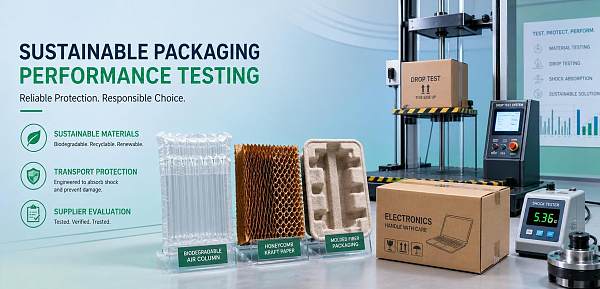
The same logic applies to cushioning. Biodegradable air pillows, paper honeycomb structures, molded fibre, and conventional void-fill systems should be compared by protection delivered per shipment. A material that needs more volume, more labour, or a larger carton can erase its apparent environmental and purchasing advantage. For fragile products, a packaging redesign may be required before the alternative can be fairly assessed.
Do not treat recyclable, recycled, and biodegradable as interchangeable
These claims address different issues, and each can be commercially valid in the right setting. Confusion occurs when a procurement specification uses them as if they mean the same thing.
A recyclable pack is designed to be collected, sorted, and processed through an available recycling pathway. In flexible packaging, mono-material structures can be easier to position for recycling than multi-material laminates, but the full structure still matters: barrier layers, metallization, inks, adhesives, labels, closures, and residues can affect the result. A “mono-material” claim should therefore describe the finished pack, not only its largest substrate.
Recycled content concerns what went into the material. It may support circularity goals, but it can introduce constraints around appearance, odour, mechanical consistency, regulatory suitability, or supply availability. The procurement question is which component can incorporate recycled content without creating unacceptable variation. Secondary packaging, protective components, and non-contact applications may offer a more practical starting point than a highly sensitive primary pack.
Biodegradable or compostable packaging concerns what happens under specified environmental conditions. It should not be selected simply because local collection and treatment systems are uncertain. A compostable item has value where the likely disposal route and contamination profile make it appropriate, such as certain food-service or organic-waste applications. In a conventional recycling stream, an incompatible compostable material may create confusion rather than a better outcome.
For this reason, the strongest claim is often the most specific one. “Designed for a defined recycling stream in the markets served” is more useful than a broad statement that the material is environmentally friendly.
Verify the construction behind the claim
Supplier declarations are an important starting point, but they do not replace technical and commercial due diligence. Procurement should request documentation that maps to the exact material grade, formulation, print treatment, adhesive, and region of sale. A generic certificate for a supplier’s product family may not cover the purchased construction.
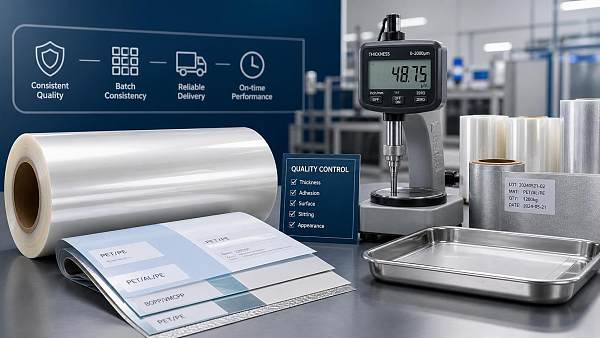
For films and laminates, ask what provides barrier performance and whether that layer changes recyclability or processing. For labels, examine the face stock, adhesive, liner, ink system, release chemistry, and how the label behaves on the final container. A durable thermal-transfer print may be essential for traceability, but the ribbon and label combination must match the substrate and service environment. A label that scans well at dispatch but smears after cold storage or abrasion creates waste and operational rework.
For cushioning, focus on protection performance under the shipping conditions that apply to the product. Product mass, centre of gravity, corner vulnerability, carton clearance, humidity exposure, and the risk of compression during storage all influence the suitable material. Replacing foam with paper or air cushions without reviewing the pack geometry is often an incomplete change.
Questions that expose weak specifications
- What is the complete material structure, including coatings, adhesives, inks, labels, and closures?
- Which end-of-life route is intended, and where is that route available for the markets served?
- What performance is guaranteed at the minimum specified gauge or basis weight?
- Has the proposed material been qualified on equipment comparable to the intended line and application conditions?
- What lot-to-lot tolerances apply to thickness, coefficient of friction, seal strength, adhesion, colour, and recycled-content percentage where relevant?
- What evidence supports the environmental claim for this exact SKU rather than a related product?
- What happens when supply is constrained: is there an approved equivalent, and does it preserve both performance and claim substantiation?
Use trials to test the economics that desk comparisons miss
A supplier sample can prove that a material is technically possible. It cannot establish that it is a sound purchasing decision. A controlled trial should measure the points where hidden costs emerge: material consumption per finished unit, line speed, seal or application rejects, scrap, pack appearance, scan quality, transit damage, and operator intervention.
Run trials using normal equipment settings first, then document any required changes in temperature, tension, dwell time, pre-stretch, or label application pressure. A material that performs only within a narrow operating window may be suitable for a tightly controlled line but risky across several plants or contract packers. The cost of retraining, slower setup, and inconsistent output belongs in the approval decision.
For export supply chains, test through the actual stress points where possible: temperature shifts, humidity, container compression, abrasion, cold storage, or long dwell times. This is particularly important for pressure-sensitive labels, high-barrier films, and lightweight stretch wrap, where a small formulation or gauge change can affect performance beyond the packing line.
Build a specification that leaves room for improvement
Many buyers inherit specifications written around a familiar material name, a fixed thickness, or a legacy construction. That can prevent suppliers from proposing a lower-material or more recyclable option. A stronger specification states the required result and the acceptable evidence, then sets limits on any attributes that truly cannot change.
For example, specify required barrier, seal integrity, package dimensions, drop protection, label readability, or pallet holding force rather than prescribing every layer of a legacy structure. Retain controls for safety, compliance, and brand-critical appearance. This gives technical teams and suppliers room to identify gauge reduction, material consolidation, or a different cushioning format without forcing a compromise on product protection.
At the same time, avoid vague language such as “fully sustainable” or “eco-friendly material.” Those phrases are difficult to purchase against, difficult to audit, and easy to interpret differently across regions. Procurement needs measurable acceptance criteria: the intended recovery pathway, allowable material composition, required documentation, performance limits, and the commercial baseline against which savings or added cost will be assessed.
The least expensive sustainable packaging choice is rarely the cheapest substrate on a quotation. It is the construction that protects the product reliably, fits the available recovery system, runs predictably, and uses no more material or complexity than the job demands. When those conditions are documented before supplier comparison, sustainability stops being a premium feature and becomes a disciplined packaging-cost decision.
Recommended News
 Oct 15, 2026How to verify a food-grade packaging film manufacturer’s complianceVerify your food grade packaging films manufacturer with a practical guide to compliance documents, migration tests, and batch traceability. Reduce sourcing risks before approval.
 Oct 11, 2026What uptime guarantees should a high speed labeling supplier provide?High speed labeling supplier uptime guarantees: compare availability, response times, critical spares, consumable compatibility, and production-based acceptance criteria.
 Oct 09, 2026What drives air column packaging bulk prices for high-volume orders?Air column packaging bulk price guide: compare film, design, volume, freight, and total protection costs to secure smarter high-volume packaging deals.
 Oct 02, 2026How to evaluate a packaging supplier’s quality control before orderingPackaging supplier quality evaluation: learn how to verify process control, traceability, testing, and corrective actions before placing your order.
 Sep 21, 2026How to make sustainable packaging material selection without overpayingSustainable packaging material selection: reduce total costs with performance-led specs, practical trials, and recovery-ready designs that protect products.
 Sep 19, 2026What Should You Check Before Switching Packaging Suppliers?What should I check before switching packaging suppliers? Explore key checks for quality, compliance, cost, supply reliability, and sustainable packaging decisions.
 Sep 19, 2026How Can You Compare Packaging Suppliers Across Countries?How can I compare packaging material suppliers across countries? Use a practical framework for quality, landed cost, compliance, supply resilience, and technical support.
 Sep 17, 2026Resource-Efficiency Metrics That Help Compare Renewable Packaging CompaniesRenewable packaging companies compared: use resource efficiency metrics for material, energy, water, waste, lifecycle emissions, and verified performance.
 Sep 09, 2026How to assess a water based adhesive materials factory’s quality controlWater based adhesive materials factory quality control: learn how to audit traceability, batch consistency, testing, and change control for safer sourcing.
 Sep 08, 2026How to qualify an electronic protective materials supplier for ESD controlLearn how to qualify an electronic protective materials supplier for reliable ESD control with test data, traceability, lot consistency, and packaging checks.
 Aug 18, 2026What to check before choosing a cryogenic labels supplierCryogenic labels supplier selection starts with performance, not price. Learn what to check for adhesion, print durability, compliance, and supply reliability before you buy.
 Aug 16, 2026How to measure packaging sustainability metrics that actually matterPackaging sustainability metrics that actually matter: learn how to compare carbon, recyclability, performance, and operational yield to make smarter packaging decisions.
 Aug 11, 2026How Low Migration Label Adhesive Technology Supports Food Packaging ComplianceLabel adhesive technology low migration explained: learn how to reduce migration risk, improve food packaging compliance, and choose label constructions that balance safety, performance, and approvals.
 Aug 10, 2026How to Choose Transfer Foils for Labels Based on Print Method and DurabilityTransfer foils for labels: learn how to choose the right option by print method, substrate, and durability needs to improve label performance, reduce rework, and achieve a premium finish.
 Aug 08, 2026How to Evaluate a Coating Materials Supplier for Consistent Quality and Lead TimesCoating materials supplier selection starts with the right questions. Learn how to compare quality consistency, process control, and lead-time reliability to reduce sourcing risk.
 Aug 03, 2026How High-Speed Labeling Technology Affects Accuracy and Throughput in PharmaceuticalsHigh-speed labeling technology pharmaceuticals depend on shapes accuracy, throughput, and compliance. Learn how materials, printing, and inspection drive reliable pharmaceutical packaging performance.
 Aug 02, 2026How to Choose Packaging for PCB Components Based on ESD and Moisture RiskPackaging for PCB components starts with risk, not bag type. Learn how to balance ESD, moisture, handling, and assembly needs to protect yield and choose smarter packaging.
 Jul 30, 2026How to Evaluate Throughput, Accuracy, and Downtime in High Speed Labeling SystemsHigh speed labeling systems should be judged by real throughput, labeling accuracy, and downtime recovery—not brochure speed. Learn how to compare machines for stable output and fewer stoppages.
 Jul 29, 2026How to Choose Food Grade Eco Friendly Packaging Materials for Moisture and Grease ResistanceEco friendly packaging materials food grade: learn how to choose options that balance moisture and grease resistance, food-contact compliance, and sustainability for safer, smarter packaging.
 Jul 27, 2026How to Evaluate a Thermal Labels Supplier for Cost, Quality, and Lead TimeThermal labels supplier evaluation guide: learn how to compare cost, print quality, adhesive performance, compliance, and lead time to reduce risk and choose a reliable partner.
 Jul 23, 2026How to Evaluate Industrial Label Systems for Durability and Total CostIndustrial label systems: learn how to compare durability, compliance, barcode performance, and total cost to reduce failures, control sourcing risk, and choose smarter long-term solutions.
 Jul 15, 2026Pressure Sensitive Label Materials Factory Audit Checklist for Stable QualityPressure sensitive label materials factory audit checklist for buyers: verify coating control, traceability, compliance, and lot consistency to reduce label failure risk.
 Jul 13, 2026How to Evaluate a Sustainable Cushioning Materials Supplier in 2026Sustainable cushioning materials supplier selection in 2026 starts with protection, proof, and scale. Learn how to compare claims, compliance, and total cost with confidence.
 Jul 12, 2026Metallic Cosmetic Packaging Materials: What Affects Finish, Durability, and Brand FitMetallic cosmetic packaging materials shape finish, durability, and brand appeal. Learn what affects gloss, scuff resistance, compliance, and cost before choosing the right premium pack.