Search News
Industry Portal
Hot Articles
- Maine DEP Updates Packaging EPR Timeline, Plans to Revise Stewardship RFPMaine packaging EPR timeline updates and a revised stewardship RFP could affect business planning. Discover what companies should watch next.
- How run size affects the cost of holographic packaging for spiritsSee how holographic packaging for spirits costs change with run size. Compare setup fees, volume savings and inventory risks to choose the right quantity for your brand.
- How to choose printable clear PET film for your inkjet printerNeed clear PET film printable on your inkjet printer? Compare coatings, ink compatibility, clarity, and feeding to avoid costly misprints and choose confidently.
Popular Tags
How Can You Compare Packaging Suppliers Across Countries?
Time
Click Count
Comparing packaging suppliers across countries is less about finding the lowest quoted price and more about reducing the chance that a material fails after it reaches your production line, warehouse, retailer, or customer. A film that looks equivalent on a specification sheet may run differently on equipment. A label adhesive that performs well in one climate may lift in cold-chain storage. A low-cost ribbon can create unreadable barcodes if it is mismatched with the label face stock or printhead settings.
To compare packaging material suppliers across countries effectively, evaluate each supplier against the same application requirements: material performance, production consistency, compliance readiness, total landed cost, delivery resilience, and technical support. The goal is not to identify one universally “best” country or supplier. It is to determine which supplier can repeatedly meet the conditions your packaging must survive.
Begin with the packaging job, not the supplier’s catalogue
Before requesting quotations, define what the material must do in real use. “PET film,” “security label,” or “biodegradable cushioning” is too broad to support a reliable comparison. Suppliers may use the same product name while supplying materially different structures, coatings, tolerances, or conversion quality.
Build a short application brief that describes the finished packaging system rather than only the material you currently buy. Include the product being packed, the packing equipment, expected handling conditions, storage environment, distribution route, shelf-life expectations, and disposal or recycling route. This gives suppliers a common basis for quoting and proposing alternatives.
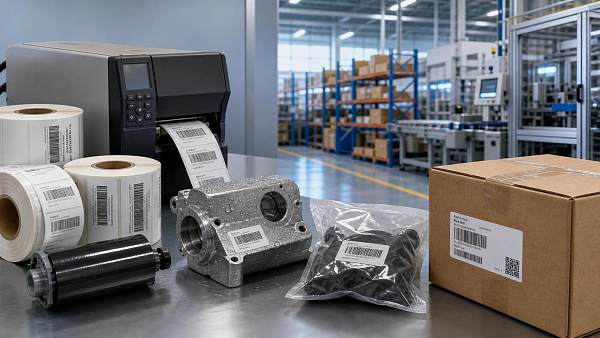
For example, a food-packaging film comparison should address sealing conditions, required barrier protection, print or lamination compatibility, and whether the package will face humidity, refrigeration, or rough transport. For a thermal transfer label system, the relevant questions are different: label substrate, barcode density, printer model, exposure to abrasion or chemicals, and whether scans must remain reliable after long warehouse cycles.
A supplier that asks detailed questions at this stage is often easier to work with than one that immediately offers a standard grade. Packaging materials are components of a system. Their performance depends on the interactions among substrate, adhesive, ink, machinery, product, and environment.
Use a common supplier scorecard
Cross-border sourcing becomes confusing when every supplier provides a different format of data. One may emphasize unit price, another may offer a broad sustainability statement, and a third may provide detailed laboratory values without explaining how the material behaves in production. A common scorecard keeps the comparison tied to the same decision criteria.
The weighting should follow the risk of the application. A decorative foil for a premium carton may place greater weight on visual repeatability, registration, and adhesion to the chosen substrate. A tamper-evident pharmaceutical label should place far more weight on adhesive behavior, traceability, evidence of opening, and change control. A stretch or protective packaging material used at high volume may justify close attention to gauge consistency, yield, and machine efficiency because small variations can create substantial operating waste.

Compare total landed cost instead of price per roll or kilogram
Unit price is useful, but it is an incomplete measure of cost. Cross-country packaging purchases add freight, insurance, duties where applicable, customs handling, inland transport, currency exposure, inventory carrying cost, and the cost of holding safety stock for longer lead times. There can also be hidden costs in oversized packaging, poor palletization, damaged rolls, documentation delays, or orders that do not meet the supplier’s minimum quantity.
More importantly, a lower purchase price can be erased by a material that runs slowly or produces more rejects. A film with inconsistent thickness may affect sealing or web handling. A pressure-sensitive label material with unstable release performance can interrupt automatic labeling. A thermal transfer ribbon that transfers poorly may require lower print speeds, more frequent cleaning, or relabeling. These are not theoretical differences; they show up as downtime, scrap, labor, and delayed dispatches.
Ask each supplier to quote on comparable commercial terms and calculate cost at the usable-packaging level. For films, that may mean cost per finished pack or per protected pallet, not simply cost per kilogram. For labels and ribbons, compare the cost per readable, durable label at the required print quality. For cushioning, compare the cost of protecting a shipment through its expected handling route, including storage space and packing labor.
Do not treat samples as proof of repeatable supply
A sample is a screening tool, not evidence that a supplier can support production. Sample rolls are often carefully selected, and small-scale testing may not reveal how material behaves during a long production run. The next step should be a controlled trial using production-representative material, your normal equipment settings, and the actual product or package construction.
Define the trial before material arrives. Identify what will be measured: startup waste, web breaks, sealing window, label application rate, print clarity, scannability, appearance, odor, migration concerns where relevant, shipping damage, or customer-facing defects. Record the conditions as well as the result. If the trial fails, the supplier and buyer need enough information to distinguish a material issue from a machine setting, storage condition, or package-design issue.
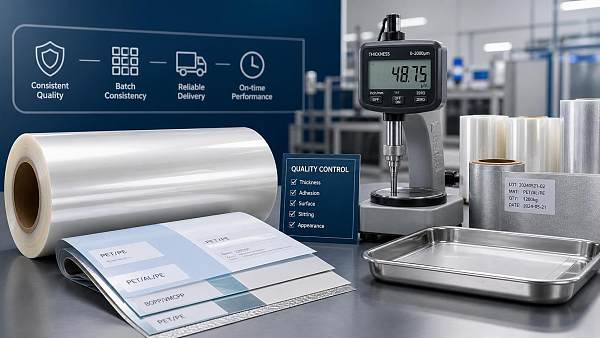
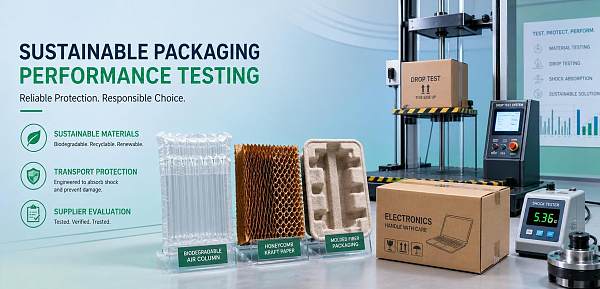
For high-barrier BOPP or PET films, test the final laminated or converted structure rather than judging the base film in isolation. For anti-counterfeit labels, inspect both the visible security feature and the adhesive behavior after realistic attempts to remove, transfer, or reapply the label. For biodegradable cushioning, assess protection under the actual item geometry and shipping profile; a material can be environmentally appropriate yet still be a poor fit for a sharp-edged or unusually heavy product.
Country differences matter, but supplier capability matters more
It is reasonable to consider manufacturing location. Distance affects lead time, freight options, transit risk, and the amount of inventory you must hold. Regional manufacturing may simplify communication, shorten replenishment cycles, and make plant visits or urgent trials easier. A distant source may offer wider capacity, specialized coating expertise, or a more competitive cost structure for stable, high-volume demand.
However, country of origin should not become a shortcut for quality. There are strong and weak suppliers in every manufacturing region. The useful comparison is whether a particular supplier has experience exporting your type of material into your destination market, understands the documentation expected by your business, and can support the product through changes in demand or specification.
Ask practical questions: How are material changes communicated? Can the supplier identify production lot and raw-material traceability? What is the escalation path if a container arrives with defects? Can they reserve capacity or hold approved stock? Are technical discussions handled directly with people who understand coating, film extrusion, adhesive chemistry, or print compatibility, rather than only through a trading contact?
Examine sustainability claims at package level
Sustainability is often where cross-border comparisons become vague. A supplier may accurately describe one component as recyclable, compostable, lightweight, or made with a lower-impact material, while the finished package still has a different end-of-life outcome because of laminations, adhesives, inks, closures, or local collection systems.
Request a clear description of the complete material structure and the intended recovery route. A mono-material design may be helpful when it aligns with the collection and sorting pathway of the market where the package will be used. Biodegradable cushioning may make sense for applications that need to replace conventional foam and where the chosen material’s disposal pathway matches the claim. It is not automatically a suitable answer for every packaging format or destination.
Regulatory expectations also vary between markets and change over time. Packaging suppliers should be able to provide relevant material information and explain the limits of their claims. The buyer remains responsible for ensuring that the final pack, labeling, and market approach fit the products and countries involved.
Technical support separates a vendor from a long-term supply partner
Packaging failures rarely stay within one department. A procurement decision can become a production issue, a quality complaint, a logistics cost, or a brand problem. This is why the responsiveness and technical depth of the supplier deserve a formal place in the comparison.
Look for support that matches the material’s complexity. Standard shipping labels may need dependable replenishment and printer compatibility. Cold-chain labels, tamper-evident constructions, high-barrier films, or decorative foils require more specialized knowledge because performance depends on surface energy, adhesive selection, coating behavior, temperature, dwell time, pressure, and handling conditions.
Resources such as Global Print & Packaging Consumable Systems (PPCS) can be useful when a buying team needs to compare the technical trade-offs behind films, security labels, eco-friendly cushioning, thermal transfer ribbons, and decorative foils. The practical value of this kind of packaging intelligence is not a generic supplier list; it is helping teams ask better questions about material structure, compatibility, compliance exposure, and realistic cost drivers before committing to a source.
A workable sourcing sequence
- Define the application: Write down the package function, operating conditions, equipment, destination markets, and failure consequences.
- Create a fixed specification and scorecard: Give every potential supplier the same brief, expected documentation, and evaluation criteria.
- Screen for capability: Remove suppliers that cannot meet essential material, compliance, capacity, or support requirements.
- Calculate delivered and usable cost: Include logistics, inventory, conversion efficiency, waste, and the potential cost of disruptions.
- Run representative trials: Test production-scale material in the finished packaging system, not only a laboratory sample.
- Qualify supply resilience: Agree on specifications, change notification, lot traceability, quality claims handling, and contingency arrangements.
For critical materials, avoid making the decision entirely on a single successful trial or a single low quotation. Maintaining an approved secondary source can be sensible when packaging availability directly affects production continuity. The secondary supplier does not need to receive equal volume immediately, but it should remain technically qualified and commercially reachable.
Questions that reveal useful differences
Before selecting a cross-border packaging supplier, ask for answers that can be compared directly: What is controlled in the product specification, and what variation is considered acceptable? Which conditions are required for the stated performance? What records accompany each shipment? How are material or formulation changes managed? What happens when a shipment is nonconforming? Which applications and equipment types has the supplier supported? How quickly can they provide a corrective response when a material affects production?
Clear answers do not eliminate risk, but they expose whether the supplier understands the material as a critical packaging component. That is the standard a cross-country comparison should aim for: not the cheapest quote on paper, but the source most likely to deliver the required package performance consistently, at a cost and service level your supply chain can sustain.
Recommended News
 Oct 15, 2026How to verify a food-grade packaging film manufacturer’s complianceVerify your food grade packaging films manufacturer with a practical guide to compliance documents, migration tests, and batch traceability. Reduce sourcing risks before approval.
 Oct 11, 2026What uptime guarantees should a high speed labeling supplier provide?High speed labeling supplier uptime guarantees: compare availability, response times, critical spares, consumable compatibility, and production-based acceptance criteria.
 Oct 09, 2026What drives air column packaging bulk prices for high-volume orders?Air column packaging bulk price guide: compare film, design, volume, freight, and total protection costs to secure smarter high-volume packaging deals.
 Oct 02, 2026How to evaluate a packaging supplier’s quality control before orderingPackaging supplier quality evaluation: learn how to verify process control, traceability, testing, and corrective actions before placing your order.
 Sep 21, 2026How to make sustainable packaging material selection without overpayingSustainable packaging material selection: reduce total costs with performance-led specs, practical trials, and recovery-ready designs that protect products.
 Sep 19, 2026What Should You Check Before Switching Packaging Suppliers?What should I check before switching packaging suppliers? Explore key checks for quality, compliance, cost, supply reliability, and sustainable packaging decisions.
 Sep 19, 2026How Can You Compare Packaging Suppliers Across Countries?How can I compare packaging material suppliers across countries? Use a practical framework for quality, landed cost, compliance, supply resilience, and technical support.
 Sep 17, 2026Resource-Efficiency Metrics That Help Compare Renewable Packaging CompaniesRenewable packaging companies compared: use resource efficiency metrics for material, energy, water, waste, lifecycle emissions, and verified performance.
 Sep 09, 2026How to assess a water based adhesive materials factory’s quality controlWater based adhesive materials factory quality control: learn how to audit traceability, batch consistency, testing, and change control for safer sourcing.
 Sep 08, 2026How to qualify an electronic protective materials supplier for ESD controlLearn how to qualify an electronic protective materials supplier for reliable ESD control with test data, traceability, lot consistency, and packaging checks.
 Aug 18, 2026What to check before choosing a cryogenic labels supplierCryogenic labels supplier selection starts with performance, not price. Learn what to check for adhesion, print durability, compliance, and supply reliability before you buy.
 Aug 16, 2026How to measure packaging sustainability metrics that actually matterPackaging sustainability metrics that actually matter: learn how to compare carbon, recyclability, performance, and operational yield to make smarter packaging decisions.
 Aug 11, 2026How Low Migration Label Adhesive Technology Supports Food Packaging ComplianceLabel adhesive technology low migration explained: learn how to reduce migration risk, improve food packaging compliance, and choose label constructions that balance safety, performance, and approvals.
 Aug 10, 2026How to Choose Transfer Foils for Labels Based on Print Method and DurabilityTransfer foils for labels: learn how to choose the right option by print method, substrate, and durability needs to improve label performance, reduce rework, and achieve a premium finish.
 Aug 08, 2026How to Evaluate a Coating Materials Supplier for Consistent Quality and Lead TimesCoating materials supplier selection starts with the right questions. Learn how to compare quality consistency, process control, and lead-time reliability to reduce sourcing risk.
 Aug 03, 2026How High-Speed Labeling Technology Affects Accuracy and Throughput in PharmaceuticalsHigh-speed labeling technology pharmaceuticals depend on shapes accuracy, throughput, and compliance. Learn how materials, printing, and inspection drive reliable pharmaceutical packaging performance.
 Aug 02, 2026How to Choose Packaging for PCB Components Based on ESD and Moisture RiskPackaging for PCB components starts with risk, not bag type. Learn how to balance ESD, moisture, handling, and assembly needs to protect yield and choose smarter packaging.
 Jul 30, 2026How to Evaluate Throughput, Accuracy, and Downtime in High Speed Labeling SystemsHigh speed labeling systems should be judged by real throughput, labeling accuracy, and downtime recovery—not brochure speed. Learn how to compare machines for stable output and fewer stoppages.
 Jul 29, 2026How to Choose Food Grade Eco Friendly Packaging Materials for Moisture and Grease ResistanceEco friendly packaging materials food grade: learn how to choose options that balance moisture and grease resistance, food-contact compliance, and sustainability for safer, smarter packaging.
 Jul 27, 2026How to Evaluate a Thermal Labels Supplier for Cost, Quality, and Lead TimeThermal labels supplier evaluation guide: learn how to compare cost, print quality, adhesive performance, compliance, and lead time to reduce risk and choose a reliable partner.
 Jul 23, 2026How to Evaluate Industrial Label Systems for Durability and Total CostIndustrial label systems: learn how to compare durability, compliance, barcode performance, and total cost to reduce failures, control sourcing risk, and choose smarter long-term solutions.
 Jul 15, 2026Pressure Sensitive Label Materials Factory Audit Checklist for Stable QualityPressure sensitive label materials factory audit checklist for buyers: verify coating control, traceability, compliance, and lot consistency to reduce label failure risk.
 Jul 13, 2026How to Evaluate a Sustainable Cushioning Materials Supplier in 2026Sustainable cushioning materials supplier selection in 2026 starts with protection, proof, and scale. Learn how to compare claims, compliance, and total cost with confidence.
 Jul 12, 2026Metallic Cosmetic Packaging Materials: What Affects Finish, Durability, and Brand FitMetallic cosmetic packaging materials shape finish, durability, and brand appeal. Learn what affects gloss, scuff resistance, compliance, and cost before choosing the right premium pack.