Search News
Industry Portal
Hot Articles
- How to verify FDA compliance for packaging inks used on food packagingPackaging inks FDA compliant? Learn how to verify food-contact safety through regulatory citations, migration testing, supplier declarations, and process controls.
- When do holographic foils add value to luxury goods packaging?Packaging materials for luxury goods gain impact with holographic foils that elevate shelf appeal, authenticity, and premium unboxing—learn when this finish delivers real value.
- Can nano encryption technology stop counterfeit labels from being copied?Nano encryption technology anti counterfeit labels combine physical security, tamper evidence, and serialization to make copying harder. Explore smarter protection.
Popular Tags
Food Grade Barrier Films: Key Compliance Risks and Tests
Time
Click Count
For quality and safety teams, food grade barrier films are only as strong as their proof of compliance. In today’s market, documentation alone is no longer enough.
Regulators, retailers, and customs authorities now expect test-backed evidence covering migration, composition, traceability, and intended use. A small gap can create costly disruption.
That is why food grade barrier films have moved from a packaging material issue to a broader risk-control priority across the supply chain.
This article reviews the main compliance risks, the tests that matter most, and the signals showing where verification standards are tightening.
Why food grade barrier films are under closer scrutiny now
The compliance bar is rising because food packaging is facing simultaneous pressure from safety rules, sustainability targets, and cross-border trade complexity.
Food grade barrier films must protect against oxygen, moisture, aroma loss, grease, and contamination. Yet every added layer, coating, adhesive, or ink can introduce regulatory questions.
Authorities increasingly focus on the real performance of functional barriers, not just the declared structure. This changes how testing programs should be built.
At the same time, recycled content, downgauging, and mono-material redesign are reshaping film structures. Compliance assumptions from older laminates may no longer apply.
Recent signals that testing expectations are shifting
- More emphasis on supplier declarations supported by raw data.
- Closer review of non-intentionally added substances, or NIAS.
- Greater scrutiny of adhesives, primers, and printing interfaces.
- Higher demand for end-use simulation, not generic lab assumptions.
- Tighter import checks for missing migration or GMP records.
The main drivers behind stricter food grade barrier films compliance
Several forces are pushing packaging systems toward deeper verification. The trend is not temporary, and it affects both commodity and premium food applications.
Where compliance risks usually hide in food grade barrier films
The highest risks are often not visible in the finished roll. They sit in interfaces, substitutions, and poorly controlled change events.
1. Migration risk from multi-layer structures
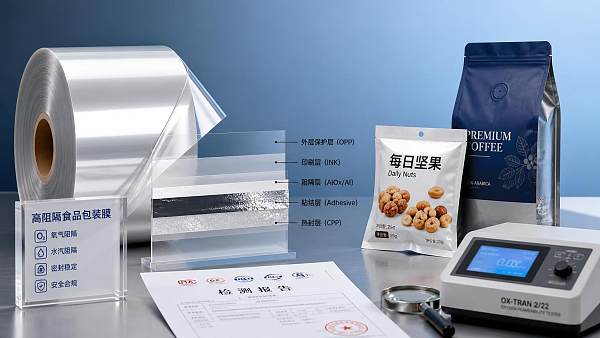
Food grade barrier films often combine base films, tie layers, inks, metallization, coatings, and sealants. Each interface can influence transfer behavior.
Overall migration and specific migration may change with temperature, fatty foods, sterilization, or long shelf life. Legacy data may not reflect actual use.
2. Overstated functional barrier claims
A barrier layer may block oxygen well but still fail to prevent low-molecular contaminants from passing through over time.
This is a frequent issue when food grade barrier films rely on coatings or internal layers to justify reduced testing on non-food-contact components.
3. Incomplete GMP and traceability records
A technically safe material can still become a compliance problem if batch linkage, change control, or supplier qualification records are weak.
4. NIAS and change-management blind spots
Processing aids, reaction by-products, impurities, and degradation compounds are harder to predict than listed substances. These hidden variables deserve more attention.
5. End-use mismatch
Food grade barrier films tested for dry snacks may later be used for oily, acidic, frozen, or hot-fill products. Compliance can break when use conditions shift.
The essential tests that now define credible compliance
The strongest programs combine chemical safety testing, barrier performance validation, and process-control evidence. One category without the others leaves exposure.
Core chemical compliance tests
- Overall migration testing under relevant food simulants and time-temperature conditions.
- Specific migration testing for regulated monomers, additives, metals, and other target substances.
- Screening for NIAS using risk-based analytical methods.
- Residual solvent or volatile compound testing where applicable.
- Organoleptic assessment for odor or taste transfer when product sensitivity is high.
Barrier and functional validation tests
- OTR testing to assess oxygen barrier consistency.
- WVTR testing for moisture protection under expected humidity conditions.
- Seal integrity and burst testing after processing exposure.
- Pinhole, flex-crack, or abrasion resistance for distribution durability.
- Functional barrier challenge studies when non-contact layers require verification.
System and documentation checks
- Declaration of compliance review.
- GMP audit records and hygiene controls.
- Full formulation disclosure protocol, where possible.
- Change notification and version control procedures.
- Lot traceability from resin input to converted roll output.
How these shifts affect packaging decisions across the business
The tightening around food grade barrier films changes more than lab schedules. It affects material selection, supplier approval, launch timing, and cross-border resilience.
Film structures that once looked cost-efficient may become expensive if they require repeated migration testing or create uncertainty in multiple markets.
Documentation quality is now part of packaging performance. A roll with strong barrier values but weak traceability may still fail a customer or customs review.
- New product launches may slow if intended-use conditions are not defined early.
- Supplier changes can trigger full or partial retesting.
- Sustainability redesigns may need fresh barrier and migration evidence.
- Export programs need market-specific compliance mapping.
What deserves the closest attention in the next review cycle
The most effective response is to focus on a short list of high-leverage controls. These reduce both safety risk and commercial disruption.
- Match each food grade barrier films specification to exact food type, shelf life, and process conditions.
- Recheck migration assumptions after downgauging, reformulation, or layer redesign.
- Validate functional barrier claims with test logic, not marketing language.
- Strengthen supplier technical files before commercial approval.
- Build a trigger list for retesting after any raw material or process change.
- Keep compliance records audit-ready and batch-linked.
A practical way to judge whether current controls are enough
The next step for safer and more resilient food grade barrier films
A strong compliance program starts with one disciplined review of structure, intended use, test coverage, and supplier evidence. That review should be practical and current.
For organizations tracking film, coating, label, and packaging intelligence, PPCS supports sharper judgment on material risk, regulatory direction, and verification priorities.
Use this moment to reassess food grade barrier films before the next audit, export shipment, or packaging redesign makes hidden gaps visible.
Recommended News
 Sep 10, 2026How pharmaceutical film technology affects moisture protection in blister packsPharmaceutical film technology for blister packs: learn how barrier films, WVTR, thermoforming, and seal integrity protect moisture-sensitive medicines and support reliable compliance.
 Sep 05, 2026How to choose food-grade flexible packaging films for dry foodsFlexible Packaging Films food grade guide: choose the right barrier, seal strength, compliance, and durability to protect dry foods and extend shelf life.
 Sep 03, 2026How film label materials affect label durability in refrigerated storageFilm label materials play a critical role in refrigerated durability. Learn how films, adhesives, printing, and moisture resistance protect labels in cold storage.
 Aug 24, 2026How to evaluate barrier film suppliers in Europe for food packagingBarrier film Europe sourcing made practical: learn how to assess food packaging suppliers on barrier performance, compliance, machinability, and total cost before you buy.
![]() Aug 14, 2026EU PPWR enforcement: BOPP high barrier film exports need to pay attention to labeling complianceEU PPWR enforcement makes BOPP high barrier film exports to Europe focus on labeling compliance. Learn the key rules on recycling marks, recycled content, and recyclability claims before 2026.
Aug 14, 2026EU PPWR enforcement: BOPP high barrier film exports need to pay attention to labeling complianceEU PPWR enforcement makes BOPP high barrier film exports to Europe focus on labeling compliance. Learn the key rules on recycling marks, recycled content, and recyclability claims before 2026. Aug 13, 2026EU PPWR Takes Effect for BOPP Barrier FilmsEU PPWR takes effect for BOPP barrier films on Aug 12, 2026. Learn the new labeling, recycled content, and life-cycle declaration rules shaping EU import compliance.
 Aug 13, 2026Barrier Packaging for Pet Food: How to Choose the Right Moisture and Oxygen BarrierBarrier packaging for pet food explained: learn how to choose the right moisture and oxygen barrier to protect freshness, shelf life, seals, and sustainability goals.
 Aug 12, 2026EU PPWR Now in Force: BOPP Barrier Films Face Labeling RulesEU PPWR now in force puts BOPP barrier films under stricter labeling rules. Learn how recyclability, composition, and recycled content disclosures affect EU market access.
 Aug 12, 2026How to Evaluate Recyclable Mono Material Packaging for Barrier Performance and ReprocessingRecyclable mono material packaging: learn how to assess barrier performance, seal reliability, and reprocessing suitability to choose packaging that supports recyclability without sacrificing product protection.
 Aug 11, 2026EU PPWR Rules Now Mandate Labels on BOPP Barrier FilmsEU PPWR rules now require labels on BOPP barrier films sold in Europe. Learn the 15% recycled content, material ID, and customs compliance steps exporters must act on now.
 Aug 10, 2026PPWR Rule Takes Effect for BOPP Barrier Film LabelsPPWR Rule takes effect for BOPP barrier film labels in the EU from August 10, 2026. Learn key ARL Code, recyclability, and compliance steps to avoid customs risk and penalties.
 Aug 09, 2026EU PPWR Rule Takes Effect for BOPP Barrier FilmsEU PPWR rule now applies to BOPP barrier films entering the EU. Learn the new labeling, material ratio, and recyclability requirements to avoid customs delays and rising compliance costs.
 Aug 08, 2026PPWR Rule Takes Effect for BOPP Barrier FilmsPPWR rule takes effect for BOPP barrier films in the EU from August 8, 2026. Learn how labeling, material ratio disclosure, customs compliance, and technical file updates may impact exports.
 Aug 07, 2026EU PPWR Rule Takes Effect for BOPP Barrier FilmsEU PPWR rule takes effect for BOPP barrier films, requiring recycling labels, material composition percentages, and recyclability claims. See what exporters must act on now.
 Aug 07, 2026How to Choose a Low WVTR Barrier Film for Moisture-Sensitive PackagingLow WVTR barrier film selection starts with product moisture sensitivity, seal performance, and converting reality. Learn how to compare structures, reduce risk, and choose packaging that protects shelf life.
 Aug 06, 2026EU PPWR Rule Takes Effect for BOPP Barrier Film LabelsEU PPWR rule now reshapes BOPP barrier film labels in the EU. Learn mandatory labeling, recyclability claims, customs risks, and how exporters can stay compliant.
 Aug 05, 2026EU PPWR Rule Takes Effect for BOPP Barrier FilmsEU PPWR rule now reshapes BOPP barrier films in the EU market. Learn mandatory labeling, recyclability, traceability, and customs compliance risks before exports are delayed.
 Aug 04, 2026EU PPWR Rules Now Apply to BOPP Barrier Film LabelsEU PPWR rules now apply to BOPP barrier film labels. Learn the new EU labeling, recyclability, and material disclosure requirements to avoid customs delays, fines, and compliance risks.
 Aug 03, 2026EU PPWR Rules Take Effect for BOPP Barrier Film LabelsEU PPWR rules now require BOPP barrier film labels to show recycling marks, material ratios, and recyclability claims. Learn how to avoid customs delays, fines, and supply chain disruption.
 Aug 02, 2026EU PPWR Rule Takes Effect for BOPP Barrier FilmsEU PPWR rule for BOPP barrier films takes effect from August 1, 2026. Learn key labeling, recyclability, customs, and supplier compliance steps to avoid fines and shipment delays.
 Aug 01, 2026EU PPWR Rule Takes Effect for BOPP Barrier FilmsEU PPWR rule for BOPP barrier films is now a critical compliance issue. Learn how material disclosure, recycling marks, and supplier documents affect EU customs, procurement, and delivery.
 Jul 31, 2026How to Choose Moisture Barrier Packaging Film by WVTR and Shelf-Life NeedsMoisture barrier packaging film selection should start with WVTR, shelf-life targets, and real package performance. Learn how to avoid overdesign, reduce risk, and choose the right barrier film.
 Jul 29, 2026EU PPWR Rule Takes Effect for BOPP Barrier Film ExportsEU PPWR rule takes effect for BOPP barrier film exports, reshaping labeling, recyclability marking, conformity files, and supplier certification. Learn the key compliance risks and trade impacts now.
 Jul 27, 2026EU PPWR Rule Takes Effect for BOPP Barrier Film ExportsEU PPWR Rule Takes Effect for BOPP Barrier Film Exports: learn how ISO 13431 recyclability labels and EN 13432 declarations now impact EU customs, buyer approval, and export compliance.