Search News
Industry Portal
Hot Articles
- How order volume affects OEM packaging material pricesSee how order volume affects OEM packaging materials price, compare total costs and MOQ tiers, and find practical ways to save without overbuying.
- Washington Fines 38 Companies Over Recycled Plastic RequirementsWashington recycled plastic requirements led to $246,548 in fines for 38 companies. See which products are affected and what businesses should review.
- How to check printer compatibility with a variable data printing materials manufacturerLearn how to assess a variable data printing materials manufacturer, verify printer compatibility, and run production trials before approving materials.
Popular Tags
How does the EU PPWR affect flexible packaging compliance?
Time
Click Count
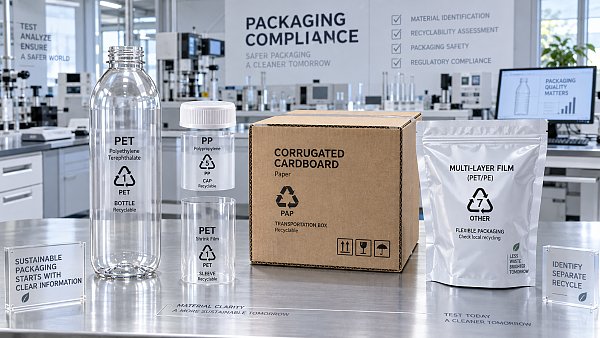
The EU Packaging and Packaging Waste Regulation (PPWR) is reshaping flexible packaging compliance, with implications for material selection, recyclability, documentation, and supply chain oversight. For quality control and safety managers, the challenge is to protect product integrity while preparing for requirements that apply on different timelines. A film may be technically recyclable in isolation yet perform poorly when its adhesive, printing, barrier coating, and label are considered as part of the finished pack. The practical task is to assess that complete structure—and keep enough evidence to support the assessment.
The regulation is in force, but the obligations do not all start together
Regulation (EU) 2025/40 entered into force on 11 February 2025 and generally applies from 12 August 2026. It replaces the EU Packaging and Packaging Waste Directive, although some provisions and transitional arrangements follow different dates. It applies broadly to packaging and packaging waste, including flexible packaging used for food, cosmetics, industrial goods, and transport.
For a compliance team, the distinction between entry into force and application is not administrative trivia. A pouch being redesigned today may remain on the market when later recyclability or recycled-content requirements begin to apply. Conversely, a future target should not be treated as though every technical rule behind it is already settled.
The PPWR sets the framework, but several detailed methods and criteria depend on subsequent EU acts. Teams should track the regulation alongside those acts rather than relying on a supplier presentation or an old summary. National rules, including producer responsibility arrangements and waste-management requirements, also remain relevant where applicable.
Recyclability is assessed across the pack, not just the base film
The PPWR requires packaging placed on the market to be recyclable, subject to the regulation’s definitions, timetable, and applicable exceptions. From 2030, the framework links recyclability to design-for-recycling criteria and performance grades; the separate requirement for packaging to be recycled at scale follows from 2035. The detailed assessment depends on EU rules developed under the regulation.
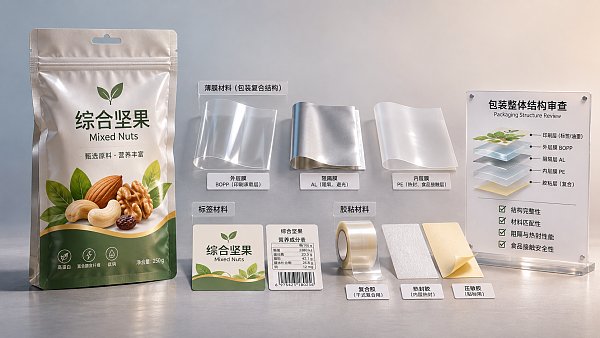
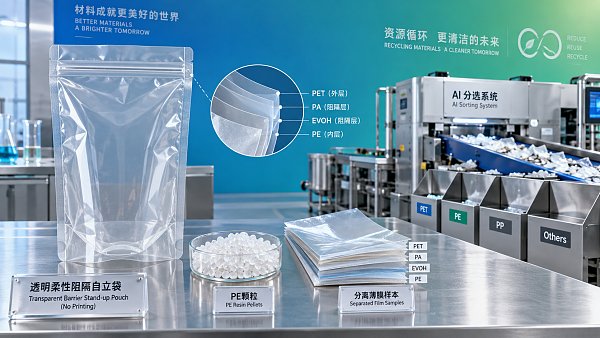
That changes the question asked during material approval. “Is this polyethylene film recyclable?” is a reasonable starting point, but it is not a complete approval question. A finished pack may include a sealant layer, barrier layer, inks, lacquer, adhesive, label, zipper, and tear feature. Each can affect identification, sorting, processing, or the quality of the resulting recyclate.
Consider a snack pouch converted from a mixed-material laminate to a predominantly polyolefin structure. The change may improve its prospects under a relevant recycling pathway, but the team still needs to check oxygen and moisture protection, seal integrity, puncture resistance, and machine performance. The barrier coating and printing system also deserve review. A mono-material claim is not, by itself, proof that the finished pouch meets the future PPWR criteria.
The same caution applies to BOPP and PET films. Their orientation and coating choices can deliver useful mechanical and barrier properties, but the polymer name alone does not establish compatibility with the intended recycling stream. Ask suppliers to identify the full construction and the assessment method used, including the assumptions about components and sorting.
Labels and adhesives can change the compliance picture
A small component can become a large source of uncertainty when no one owns its specification. A tamper-evident label, for example, may need to leave visible evidence after removal. That security function can conflict with a desire for easy separation during recycling. Changing the adhesive merely to make the label easier to remove could also compromise its intended security performance.
Review label facestock, coverage, adhesive chemistry, inks, and any metallic or holographic features against the intended packaging stream. Where the label must remain attached, evaluate the complete labelled pack rather than assuming the label will be removed by the user. For cold-chain labels, include adhesion and barcode readability after the actual temperature and handling conditions specified for the product.
Thermal transfer ribbons and decorative foils deserve the same change-control discipline. A new resin ribbon or metallic finish may appear to be a minor artwork decision, but it changes what is present on the packaging. Ask whether the supplier’s recyclability evidence covers the relevant ink, coating, and application method. If it does not, record the gap rather than extending the claim by assumption.
Recycled content needs a separate evidence trail
From 2030, the PPWR introduces minimum recycled-content targets for the plastic part of packaging, with further targets from 2040. The applicable percentage depends on the packaging category, and the regulation contains exclusions and exceptions. Calculation and verification rules are also subject to implementing measures. A team should therefore determine the pack’s category before putting a target into a purchasing specification.
Do not confuse a supplier’s statement that material is “recycled” with evidence that it qualifies toward the applicable PPWR target. Ask about the feedstock, traceability, allocation method where relevant, and the documentation available for the supplied grade. Keep the evidence linked to the actual material and revision used in production.
Food-contact packaging adds another constraint. Recycled content cannot be introduced at the expense of applicable food-contact requirements, including Regulation (EC) No 1935/2004 and, where relevant, Regulation (EU) 2022/1616 on recycled plastic materials intended to contact food. A recycled-content declaration is not a substitute for the appropriate food-contact compliance documentation, migration assessment, or suitability for the intended use.
For high-barrier applications, the best route may involve a careful division of functions between layers. That is a technical decision, not a blanket exemption: document why the construction is needed, which requirements apply, and which assumptions must be revisited as detailed rules are adopted.
Lightweighting has a safety limit
The PPWR also addresses packaging minimisation. Manufacturers need to assess whether packaging weight and volume are reduced to the minimum necessary while preserving required functions. For flexible packs, those functions may include product protection, safety, hygiene, transport performance, and usability.
A thinner stretch film or pouch can reduce material use, but thickness alone is a poor approval metric. A downgauged film may behave differently around pallet corners, under humidity changes, or during a long distribution cycle. A lighter pouch may need a wider seal or a revised handling process to maintain package integrity. If those changes increase damage or require additional packaging elsewhere, the nominal material saving deserves another look.
Retain the reasoning behind the selected design: test conditions, acceptance criteria, observed failure modes, and the functions that prevented further reduction. A specification that simply says “optimised” gives an auditor little to examine.
Compostable does not automatically mean compliant or recyclable
Compostability is a specific end-of-life route, not a general substitute for recyclability. The PPWR requires certain defined packaging formats to be compostable under specified conditions and allows particular national measures in some circumstances. Those provisions should not be read as a universal requirement—or permission—for all flexible packaging to be compostable.
For cushioning or film made with materials such as PLA or PBAT, verify the complete product, the applicable standard or test basis, and the environment covered by any claim. Industrial compostability should not be described as guaranteed degradation in soil, the sea, or an ordinary bin. Also check whether the destination market has a collection and treatment route that accepts the item. A technically defensible material claim can still mislead if the disposal instruction does not match local practice.
Build a file that survives a supplier change
The PPWR provides for conformity assessment, technical documentation, and an EU declaration of conformity for packaging, with obligations distributed among economic operators according to their roles. Identify who is acting as manufacturer, importer, distributor, or other relevant operator for each packaging flow. A converter’s data sheet may support the file, but it does not automatically discharge every downstream obligation.
A workable technical file starts with a controlled bill of materials for the finished packaging. It should make it possible to trace the structure and components to current supplier evidence, performance testing, relevant risk assessments, and the applicable conformity route. For a flexible laminate, that means knowing more than the name of the outer film: record the layers, coatings, adhesives, printing, and separately applied components.
Suppliers may understandably protect confidential formulations. In that case, agree on what evidence they can provide without disclosing trade secrets: material family, functional role, relevant restrictions, assessment results, and a commitment to notify changes. A confidentiality agreement or a documented assessment by a qualified third party may help where greater detail is necessary.
Make change notification specific. A substitute adhesive, new ink, altered film grade, or different recycled feedstock can invalidate assumptions even when the external appearance is unchanged. Quality should have a defined trigger for reassessing recyclability, product safety, and pack performance before the change reaches production.
What to do while detailed rules are still developing
Start with the packs that are hardest to change: those with long shelf-life requirements, complex barrier structures, security labels, or multiple suppliers. Map their current construction and intended markets, then separate confirmed legal requirements from assumptions awaiting detailed EU criteria. Assign an owner and review date to each open point.
For redesign projects, run recyclability and product-protection reviews together. A promising laboratory film still needs sealing, distribution, and shelf-life validation for the actual application. Equally, a pack that passes today’s line trials should not be approved on the assumption that its recycling pathway is settled for the next decade.
Use the official text of Regulation (EU) 2025/40 as the starting point, then monitor subsequent Commission acts and guidance relevant to the packaging category. Where a supplier offers a recyclability certificate or claim, check its scope, version, test method, and whether it covers the finished construction. The immediate priority is not to label every pack compliant today; it is to know which decisions are supported, which depend on future criteria, and which could put product safety at risk if rushed.
Recommended News
 Nov 17, 2026Washington Fines 38 Companies Over Recycled Plastic RequirementsWashington recycled plastic requirements led to $246,548 in fines for 38 companies. See which products are affected and what businesses should review.
 Nov 16, 2026University of Georgia Study Links Lighter Packaging to Lower RecyclingUniversity of Georgia research links lightweight packaging to lower recycling rates. Discover what the findings mean for sustainable packaging design.
 Nov 13, 2026Germany Seeks PPWR Changes to Ease Compliance for Small RetailersGermany seeks PPWR changes to ease compliance for small retailers. Explore the proposed exemptions, simpler registration and implications for EU trade.
 Nov 13, 2026How does the EU PPWR affect flexible packaging compliance?Flexible packaging compliance is changing under the EU PPWR. Explore key timelines, recyclability rules, documentation and practical steps to prepare.
 Nov 12, 2026EU Delays Adoption of PPWR Packaging Labelling Rules Until 2027EU PPWR packaging labelling rules are now expected in 2027. Explore what the delay means for suppliers, compliance planning and production decisions.
 Nov 11, 2026CEN Approves Four Specifications for Recyclable Biodegradable PackagingRecyclable biodegradable packaging faces new CEN specifications. Discover what the four approvals could mean for packaging design and EU PPWR assessments.
 Nov 09, 2026German Union Leader Thorsten Frei Questions Planned Plastics TaxGerman plastics tax plans face scrutiny as Union leader Thorsten Frei raises questions. Explore what the debate could mean for packaging businesses.
 Nov 07, 2026EU Packaging Waste Rules Raise Compliance Concerns for Small BusinessesEU packaging waste rules are raising compliance concerns for small businesses. Explore PPWR, PFAS, packaging costs and practical preparation steps.
 Nov 06, 2026EU PPWR Implementation: Small Businesses Face Compliance HurdlesEU PPWR implementation poses compliance hurdles for small businesses. Explore PFAS restrictions, EPR registration and practical steps for cross-border sellers.
 Nov 03, 2026Nigeria Sets Recycled PET Target and Chemical Restrictions for Plastic PackagingNigeria’s plastic packaging rules set a 25% recycled PET target and chemical restrictions. Explore what exporters need to know about scope and compliance.
 Nov 01, 2026How Europe's New Green Rules Affect Packaging Compliance for Printers and PublishersEU packaging compliance is changing for printers and publishers. Explore how the PPWR may affect procurement, transport packaging and environmental claims.
 Oct 31, 2026How are extended producer responsibility packaging fees calculated?Extended producer responsibility packaging fees depend on material weight, rates and local rules. Learn how to calculate costs and build a reliable budget.
 Oct 29, 2026Maine DEP Updates Packaging EPR Timeline, Plans to Revise Stewardship RFPMaine packaging EPR timeline updates and a revised stewardship RFP could affect business planning. Discover what companies should watch next.
 Oct 27, 2026HERMA Gains Cold-Wash Certification for PP and PE Labels, Supporting PPWR AlignmentHERMA earns cold-wash certification for PP and PE labels, proving complete removal at 40°C. Discover how this supports cleaner recycling and PPWR alignment.
 Oct 26, 2026Plastic is Fantastic Association Plans Middle East Debut at GPCA ForumPlastic is Fantastic Association plans its Middle East debut at the GPCA Forum in Dubai in November 2026. Discover its goals for regional partnerships and evidence-based plastic packaging dialogue.
 Oct 25, 2026Freiburg to Limit Packaging Tax to Disposable Cups from 2027Freiburg’s packaging tax will target disposable drink and ice cream cups at €0.50 each from January 1, 2027. Explore what this means for purchasing costs and reusable alternatives.
 Oct 23, 2026UK Confirms Plastic Packaging Tax Rules Introducing Chemical Recycling Mass BalanceUK Plastic Packaging Tax changes introduce chemical recycling mass balance from 1 April 2027. Explore what packaging businesses should review to prepare for compliance.
 Oct 22, 2026Avery Dennison AD CleanFlake Earns First RecyClass Approval for PET Tray RecyclingAvery Dennison AD CleanFlake earns the first RecyClass approval for PET tray recycling. Discover how its label separation technology helps preserve recycled PET quality.
 Oct 12, 2026How to verify whether flexible barrier packaging is recyclableIs flexible barrier packaging recyclable? Learn how to verify materials, barriers, inks, collection routes, and evidence for credible recycling claims.
 Oct 11, 2026How PPWR rules may change customs checks for packaged goodsPPWR customs checks may reshape EU imports. Learn how to prepare packaging evidence, manage border risks, and keep packaged goods moving.
 Oct 10, 2026What a PPWR packaging label should show for compliant EU shipmentsPPWR packaging label guidance for compliant EU shipments: show accurate material details, sorting instructions, recyclability evidence, and component-level disposal information.
 Oct 01, 2026How to verify whether PLA PBAT compostable film meets compostability standardsPLA PBAT compostable film verification guide: check EN 13432, ASTM D6400, certificates, thickness, inks, layers, and industrial composting scope.
 Sep 18, 2026How to verify BPI certification for compostable packaging materialsCompostable packaging materials BPI verification made practical: learn how to confirm certified products, documentation, labels, coatings, and supplier traceability.
 Sep 16, 2026How to verify compostability claims for eco friendly packaging filmsEco friendly packaging films require more than a logo. Learn to verify compostability certificates, finished-film scope, components, and disposal claims.